
Fractional nonlocal strain-gradient isogeometric analysis of porous functionally graded piezoelectric microplates resting on elastic substrates
Keywords:
Fractional nonlocal strain–gradient, Porous piezoelectric microplates, Isogeometric analysis, Elastic substrate interactionAbstract
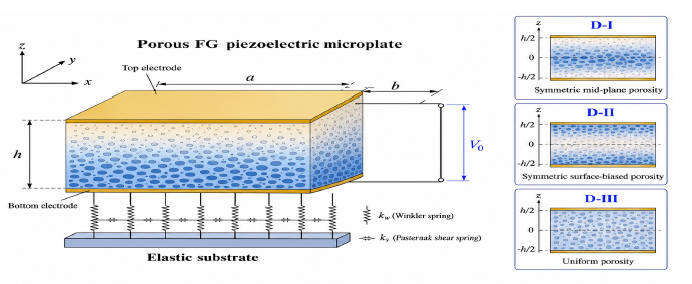
Existing strain-gradient models for piezoelectric microplates often capture local microstructural size effects but do not simultaneously represent long-range spatial interactions, porosity-induced material degradation, electromechanical coupling, and elastic-substrate effects within a unified computational framework. This paper develops a fractional nonlocal strain-gradient isogeometric formulation for the free vibration analysis of porous functionally graded piezoelectric microplates resting on elastic substrates. The plate kinematics are described using higher-order shear deformation theory, while the fractional Laplacian operator is introduced to model spatial nonlocality and the strain-gradient term accounts for intrinsic length-scale stiffening. The governing equations are derived from Hamilton's variational principle by incorporating thickness-dependent elastic, piezoelectric, dielectric, and density properties. The Winkler-Pasternak foundation model is used to represent substrate interaction, and isogeometric analysis is adopted to satisfy the higher-order continuity requirements of the enriched formulation. The proposed model is validated against published benchmark results in the classical and strain-gradient limits, with percentage-error comparisons included. Parametric results show that porosity reduces the natural frequencies, whereas strain-gradient effects and elastic foundation stiffness increase them. The fractional order, nonlocal interaction length, applied electric voltage, and porosity pattern significantly influence the effective stiffness and vibration response. The proposed formulation provides a physically consistent framework for designing smart porous piezoelectric microplates used in microelectromechanical systems, sensors, actuators, and micro-energy harvesting systems.
Published
How to Cite
Issue
Section
Copyright (c) 2026 Sule Adekunle Jimoh, Olorunsola Oriola Niyi, Adebola Samuel Adeoye, Daramola Oluwatosin Bunmi, Ezekiel Olaoluwa Omole

This work is licensed under a Creative Commons Attribution 4.0 International License.
How to Cite
Similar Articles
- Aondugu Alexander Tyovenda, Theresa Jummai Usman, Emmanuel Vezua Tikyaa, Air quality impact of open tyre burning: analysis of particulate matter and gases , African Scientific Reports: Volume 5, Issue 1, April 2026
- E. Agboeze, N. P. Ani, E. O. Omeje, Extraction and Characterization of Pharmaceutical Grade Microcrystalline Cellulose From Bambara Nut (Voandzeia Subterranean (L) Thousars) Husk , African Scientific Reports: Volume 1, Issue 2, August 2022
- K. Issa, R. A. Bello, M. H. Sulaiman, Approximate solution of time-fractional non-linear parabolic equations arising in Mathematical Physics , African Scientific Reports: Volume 3, Issue 2, August 2024
- Ifeanyi Edozie Otuokere, Onyinye Uloma Akoh, Felix Chigozie Nwadire, Chinedum Ifeanyi Nwankwo, Joy Nwachukwu Egbucha, Chiemela Wisdom, Ogbonna Augustine Okwudiri, GC-MS Profiling and In Silico Studies to Identify Potential SARS-CoV-2 Nonstructural Protein Inhibitors from Psidium guajava , African Scientific Reports: Volume 1, Issue 3, December 2022
- Ahmad M. Shuaibu, Kizito O. Musa, Ijioma M. Okiyi, Groundwater recharge modelling using SWAT analysis for groundwater reserve quantification of Ka watershed catchment area part of Sokoto-Rima Basin, North West Nigeria , African Scientific Reports: Volume 4, Issue 1, April 2025
- Dorcas Modupe Okewole, Sunday Samuel Odebode, Olumide Sunday Adesina, Adedayo Funmi Adedotun, Evaluation of some Bayesian parametric survival models with application to hypertensive patients , African Scientific Reports: Volume 5, Issue 2, August 2026
- M. A. Aliu, A. M. Junaid, A. Ibraheem, A. Ishaq, A. Lawal, K. E. Ayeni, A. R. Lawal, L. B. Abdulrauf, Dispersive liquid-liquid microextraction/HPLC techniques for determination of oxytetracycline and doxycycline residues in beef samples: method developments and statistical analysis , African Scientific Reports: Volume 2, Issue 1, April 2023
- Surajo Muhammed Gwio, Ousmane Soumah, Comparative analysis of pure CO2 and CO2 enhanced polymer flooding: a numerical modelling approach , African Scientific Reports: Volume 4, Issue 1, April 2025
- E. S. Okonofua, N. Kayode-Ojo, Urban Flooding Vulnerability Analysis Using Weighted Linear Method With Geospatial Information System , African Scientific Reports: Volume 2, Issue 3, December 2023
- I. M. Echi, E. V. Tikyaa, E. J. Eweh, A. A. Tyovenda, T. Igbawua, Investigation of the spatial distribution of deterministic chaos in some meteorological variables across Nigeria , African Scientific Reports: Volume 4, Issue 2, August 2025
You may also start an advanced similarity search for this article.