Air quality impact of open tyre burning: analysis of particulate matter and gases
Keywords:
Particulate matter, Gaseous pollutants, Heavy metalsAbstract
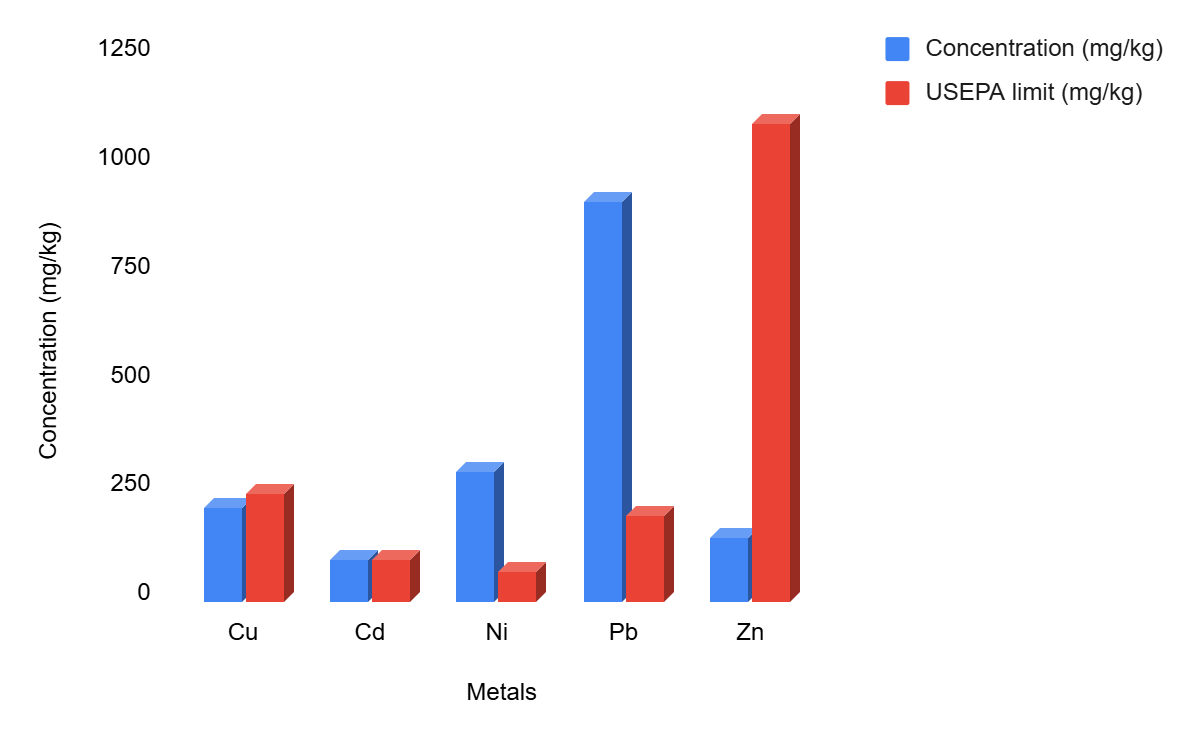
Open tyre burning remains a significant environmental concern due to the release of harmful pollutants such as particulate matter (PM), toxic gases, and heavy metals including Cu, Cd, Pb, and Ni. This study assessed the impact of tyre burning on air quality in Makurdi metropolis using a 4-in-1 multi-gas detector, high-volume respirable dust sampler (APM 460NL Model), and Atomic Absorption Spectrometer (AAS). Results show that the concentrations of Cu (228.40 mg/kg), Cd (104.80 mg/kg), Pb (919.20 mg/kg), and Ni (304.60 mg/kg) exceeded recommended safety limits, while Zn (165.70 mg/kg) remained within acceptable levels. Similarly, the mean concentrations of CO (17 µg/m³), SO₂ (93 µg/m³), and NO₂ (110 µg/m³) exceeded the World Health Organization (WHO) guideline limits of 4, 40, and 25 µg/m³, respectively. Particulate matter analysis showed a mean PM₂.₅ concentration of 10 µg/m³, which was slightly below the WHO limit of 15 µg/m³, while PM₁₀ recorded a mean concentration of 52 µg/m³, substantially exceeding the recommended limit of 45 µg/m³.The Air Quality Index (AQI) indicated that CO levels fell within the “good” category, NO₂ showed occasional spikes, SO₂ frequently exceeded safe levels, and PM₂.₅ posed the highest risk due to moderate to unhealthy concentrations. These findings highlight the severe public health implications of open tyre burning and underscore the need for regulatory action, public awareness, and adoption of safer waste-management alternatives.
References
[1] T. Prakash, P. Duckshin & I. Young-Chul, “Recent insight into particulate matter (PM2.5)-mediated toxicity in humans: An overview”, International Journal of Environmental Research and Public Health 19 (2022) 7511. https://doi.org/10.3390/ijerph19127511.
[2] T. P. Jack, O. C. Lachlan & E. S. Stephanie, “The physiological effect of air pollution: Particulate matter, physiology and disease”, Environmental Health and Exposure 10 (2022) 882569. https://doi.org/10.3389/fpubh.2022.882569.
[3] C. C. Okafor, J. C. Ibekwe, C. A. Nzekwe, C. C. Ajaero & C. M. Ikeotuonye, “Estimating emissions from open-burning of uncollected municipal solid waste in Nigeria”, AIMS Environmental Science 9 (2022) 140. https://doi.org/10.3934/environsci.2022011.
[4] M. Rasche, M. Walther, R. Schifferner, N. Kroegel, S. Rupprecht, P. Schalttman, P. C. Schulze, P. Franzke, O. W. Witte & M. Schwab, “Rapid increases in nitrogen oxides are associated with acute myocardial infarction: A case-crossover study”, European Journal of Preventive Cardiology 29 (2018) 323. https://doi.org/10.1177/2047487317736829.
[5] National Population Commission (NPC), “Federal Republic of Nigeria Official Gazette”, Vol. 96, 2009. [Online]. https://nesrea.gov.ng/wp-content/uploads/2025/05/Watershed/Mountainous/Hilly/and/Catchment/Areas-Regulations-2009.pdf.
[6] United States Environmental Protection Agency (USEPA), Supplemental Guidance for Developing Soil Screening Levels for Superfund Sites, Office of Solid Waste and Emergency Response, Washington D.C., USA, 2002. http://www.epa.gov/Superfund/health/commedia/soil/index.htm.
[7] Environmental Protection Agency (EPA), Compilation of Air Pollutant Emission Factors, Volume 1: Stationary Point and Area Source: Large Stationary Diesel and Dual Fuel Industrial Engines, Fifth edition, Office of Air Quality Planning and Standards, Research Triangle Park, NC, USA, 1995. https://nepis.epa.gov/Exe/ZyPURL.cgi?Dockey=200149JJ.TXT.
[8] D. Taieb & B. A. Ben, “Methodology for developing an air quality index (AQI) for Tunisia”, International Journal of Renewable Energy Technology 4 (2013) 86. https://doi.org/10.1504/IJRET.2013.051067.
[9] H. Z. Anf & S. Emad, “An environmental impact assessment of open burning of scrap tires”, Journal of Applied Sciences 14 (2014) 2695. https://doi.org/10.1007/s13762-017-1498-5.
[10] Environmental Protection Agency (EPA), Air Quality Index: A Guide to Air Quality and Your Health, EPA, Washington D.C., USA, 2000. http://www.njaqinow.net/APP/AQI/AQI.en-US.pdf.
[11] K. M. Shakya, L. D. Ziemba & R. J. Griffin, “Characteristics and source apportionment of ambient PM2.5 in Houston during spring 2006”, Atmospheric Environment 42 (2008) 4347. https://doi.org/10.1016/j.atmosenv.2008.04.013.
[12] J. Downard, A. Singh, R. Bullard, T. Jayarathne, C. M. Rathnayake, D. L. Simmons, B. Wels, S. N. Spak, T. Peters & E. A. Stone, “Uncontrolled combustion of shredded tires in a landfill — Part 1: Characterization of gaseous and particulate emissions”, Atmospheric Environment 104 (2015) 195. https://doi.org/10.1016/j.atmosenv.2014.12.059.
[13] M. Anf & A. Sood, “Chemical characterization of ash and emissions from open-air combustion of waste automobile tyres”, Journal of Applied Sciences 14 (2014) 2695. https://doi.org/10.3923/jas.2014.2695.2703.
[14] F. O. Okonkwo, A. A. Njan, C. E. C. Ejike, U. U. Nwodo & I. N. E. Onwurah, “Health implications of occupational exposure of butchers to emissions from burning tyres: Butchers in Abuja”, Annals of Global Health 84 (2018) 387. https://doi.org/10.29024/aogh.2321.
[15] L. A. Jimoda, I. D. Sulaymon & G. A. Adebayo, “Emission characteristics of laboratory-scale open burning of scrap tyres”, Environmental Technology & Innovation 13 (2019) 290. https://doi.org/10.1016/j.eti.2018.11.014.
[16] J. Ikwebe & D. C. Bando, “Impact of waste vehicle tyres incineration and heavy metals contamination of soil in some locations in Lafia, Nasarawa State”, African Journal of Environmental Science and Technology 18 (2024) 1. https://doi.org/10.5897/ajest2023.3233.
[17] M. M. Narra, D. Gbiete, K. Agboka, S. Narra & M. Nelles, “Tracing the EoL tyre management chain in Togo with focus on implementing a tyre recycling plant”, Sustainability 16 (2024) 9193. https://doi.org/10.3390/su16219193.
[18] World Health Organization (WHO), Global Air Quality Guidelines: Particulate Matter, WHO, Geneva, Switzerland, 2021. https://www.who.int/publications/i/item/9789240034228.
Published
How to Cite
Issue
Section
Copyright (c) 2026 Aondugu Alexander Tyovenda, Theresa Jummai Usman, Emmanuel Vezua Tikyaa

This work is licensed under a Creative Commons Attribution 4.0 International License.