Effect of indigenous extraction solvents on the phytochemical, GC-MS profile and antioxidant activities of Ocimum gratissimum extracts
Keywords:
Phytochemicals, Extraction solven, GC-MS profiling, Ocimum gratissimumAbstract
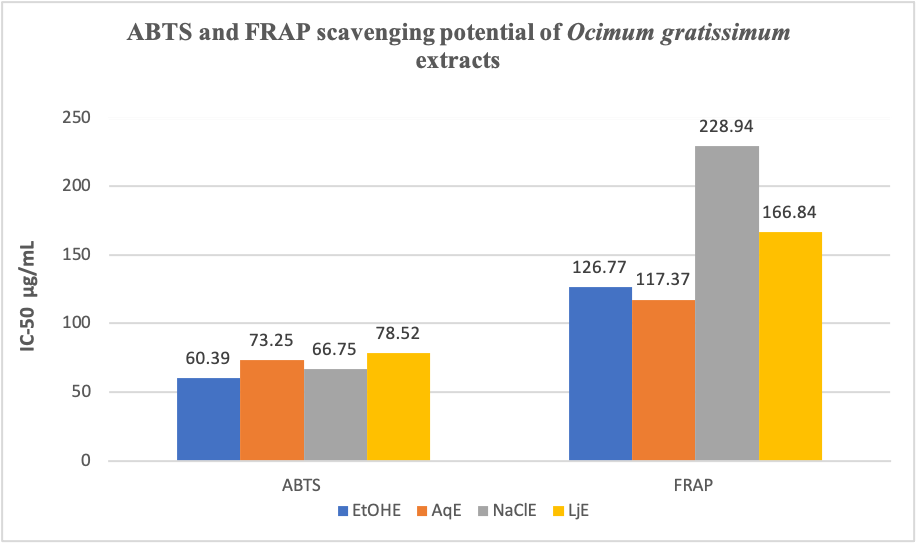
This study compared the effects of Ethanol and indigenous extractants (Aqueous, 2% NaCl solution, and 40% v/v Lime juice) on the bioactive properties of Ocimum gratissimum extract. Phytochemical, GC-MS, and antioxidant analysis of the Ethanol (EtOHE), Aqueous (AqE), NaCl solution (NaClE), and Lime juice (LjE) extracts were carried out. All the extracts contained saponins, tannins, flavonoids, phenols, steroids, and alkaloids, with Ethanol and Aqueous extracts showing higher concentrations of these compounds compared with NaCl and Lime juice extracts (p < 0.05). GC-MS characterization identified twenty-one bioactive compounds in the Ethanol extract, while only fifteen compounds were found in the Aqueous, NaCl, and Lime juice extracts, respectively. The Ethanol extract had higher Total Antioxidant Capacity (TAC) (26.08 ± 0.76 μg/ml) compared with Aqueous (7.79 ± 0.61 μg/ml), NaCl (7.82 ± 0.81 μg/ml), and Lime juice (3.49 ± 0.48 μg/ml) extracts (p < 0.05). The Aqueous extract had the strongest Ferric reducing antioxidant power, with a lower IC50 value of 117.37 μg/ml, compared with NaCl (228.94 μg/ml) and Lime juice (166.84 μg/ml) extracts, while Ethanol extracts had the lowest IC50 value (60.39 μg/ml) for ABTS radicals compared with NaCl (66.75 μg/ml) and Lime juice (78.52 μg/ml) extracts. In conclusion, all the extracts exhibited potential medicinal and antioxidant properties; however, the bioactive and antioxidant properties of the extracts demonstrate a dependence on the extraction methods and solvents. It is therefore important to always ascertain which extraction solvent and method is appropriate for the preparation of safe medicinal herbs.
References
[1] S. N. Ijioma, O. Emmanuel, C. I. Nosiri & E. A. Ugbogu, “Evaluation of toxicity profile and pharmacological potentials of Aju Mbaise polyherbal extract in rats”, Scientific African 11 (2021) 681. https://doi.org/10.1016/j.sciaf.2020.e00681.
[2] M. A. Bisi-Johnson, C. L. Obi, L. Kambizi & M. Nkomo, “A survey of indigenous herbal diarrhoeal remedies of O.R. Tambo district, Eastern Cape Province, South Africa”, African Journal of Biotechnology 9 (2010) 1475. https://doi.org/10.5897/AJB09.1475.
[3] K. K. Anachuna, E. G. Moke, J. C. Oyem, A. I. Omogbiya, T. M. E. Daubry & E. I. Ebuwa, “Ethanolic extract of Ocimum gratissimum (scent leaf) leaves improves haematological parameters in restrain-stressed rats”, Journal of Applied Sciences and Environmental Management 25 (2021) 1605. https://dx.doi.org/10.4314/jasem.v25i9.10.
[4] M. N. Zayapor & M. Syahida, “Herbal infusion – processing techniques, bioactivity, quality, and safety”, Food Research 6 (2023) 134. https://doi.org/10.26656/fr.2017.6(S2).019.
[5] C. Rocha, A. P. Moura & L. M. Cunha, “Consumers’ associations with herbal infusions and home preparation practices”, Food Quality Preference 86 (2020) 104006. https://doi.org/10.1016/j.foodqual.2020.104006.
[6] C. Onyebuchi & D. Kavaz, “Effect of extraction temperature and solvent type on the bioactive potential of Ocimum gratissimum L. extracts”, Scientific Reports 10 (2020) 21760. https://doi.org/10.1038/s41598-020-78847-5.
[7] O. O. Olusola-Makinde & D. A. Lawrence, “Biological activities of Ocimum gratissimum (Linn) ethanol extracts on bacteria associated with surface waters Akure”, Microbes and Infectious Diseases 4 (2023) 655. https://doi.org/10.21608/MID.2022.117972.1239.
[8] R. I. Ogundoju, M. K. Oladunmoye & O. J. Babatunde, “GC-MS profiling and antibacterial efficacy of Ocimum gratissimium (Linn.) against bacteria associated with gastroenteritis”, Microbes and Infectious Diseases 6 (2025) 873. https://doi.org/10.21608/MID.2023.216316.1538.
[9] T. T. Makinwa, H. Adiele, O. O. Oyebiyi, T. D. Alabi & K. O. Sodehinde, “Effects of NaCl and lime water on the hypoglycemic and antioxidant activities of Occimum gratissimum in alloxan-induced diabetic rats”, Journal of Pharmacy and Biological Sciences 3 (2013) 01. https://doi.org/10.9790/3008-0830105.
[10] O. F. Ujah, Y. Y. Mohammad & C. M. Dewua, “Quantification, antioxidant and free radical scavenging potentials of polyphenols from crude extracts of Phyllanthus amarus leaves”, Chemical Search Journal 12 (2021) 209989. https://www.ajol.info/index.php/csj/article/view/209989.
[11] G. A. Ayoola, H. A. B. Coker, S. A. Adesegun, A. A. Adepogu-Bello, K. Obaweya, E. C. Ezennia & T. O. Atangbayila, “Phytochemical screening and antioxidant activities of some selected medicinal plants used foe malaria theraphy in South-western Nigeria”, Tropical Journal of Pharmaceutical Research 7 (2008) 1019. https://doi.org/10.4314/tjpr.v7i3.14686.
[12] H. O. Edeoga, D. E. Okwu & B. O. Mbaebie, “Phytochemical constituents of some Nigerian medicinal plants”, African Journal of Biotechnology 4 (2005) 3127. https://doi.org/10.5897/AJB2005.000-3127.
[13] C. C. Chang, M. H. Yang, H. M. Wen & J. C. Chen, “Estimation of total flavonoid content in propolis by two complementary colorimetric methods”, Journal of Food and Drug Analysis 3 (2002) 3. https://doi.org/10.38212/2224-6614.2748.
[14] S. E. Chukwuma & M. E. Chigozie, “Qualitative and quantitative determination of phytochemical contents of indigenous Nigerian softwoods”, New Journal of Science 2016 (2016) 9. https://doi.org/10.1155/2016/5601327.
[15] O. A. Ameen, A. A. Hamid, Q. Yusuf, O. G. Njoku, T. O. Oseni & W. Jamiu, “Quantitative and qualitative assessment of phytochemicals in methanolic extracts of hurricane weed (Phyllanthus amarus Schumach. & Thonn) plant”, Journal of Applied Sciences and Environmental Management 25 (2021) 159. https://dx.doi.org/10.4314/jasem.v25i2.4.
[16] C. O. Edeogu & C. E. Ekuma, “Antinutrients level in staple food crops in Ebonyi-Nigeria”, Research Journal of Environmental Sciences 1 (2007) 302. https://doi.org/10.3923/rjes.2007.302.309.
[17] S. A. Mallick, K. Azaz, M. Gupta, V. Sharma & B. K. Sinha, “Characterization of grain nutritional quality in wheat”, Indian Journal of Plant Physiology 18 (2013) 183. https://doi.org/10.1007/s40502-013-0025-z.
[18] O. L. Oke, “Chemical studies on some Nigerian vegetable”, Tropical Science 8 (1966) 2693987. https://www.scirp.org/reference/referencespapers?referenceid=2693987.
[19] A. M. Magashi & U. Abdulmalik, “GC-MS and HPLC analysis of crude extracts of stem bark of Adansonia digitata”, Bayero Journal of Pure and Applied Sciences 10 (2017) 1. https://www.cabidigitallibrary.org/doi/full/10.5555/20183235503.
[20] S. K. Sadhu, E. Okuyama, H. Fujimoto & M. Ishibashi, “Separation of Leucas aspera, a medicinal plant of Bangladesh, guided by prostaglandin inhibitory and antioxidant activities”, Chemical Pharmaceutical Bulletin 51 (2003) 595. https://doi.org/10.1248/cpb.51.595.
[21] R. Re, N. Pellegrini, A. Proteggente, A. Pannala, M. Yang & C. Rice-Evans, “Antioxidant activity applying an improved ABTS radical decolorization assay”, Free Radical Biology and Medicine 26 (1999) 315. https://doi.org/10.1016/S0891-5849(98)00315-3.
[22] I. F. Benzie & J. J. Strain, “The ferric reducing ability of plasma (FRAP) as a measure of antioxidant power: the FRAP assay”, Analytical Biochemistry 239 (1996) 70. https://doi.org/10.1006/abio.1996.0292.
[23] P. M. Etaware, J. America, O. W. Egara & V. S. Ekun, “Herbal medicine: scientific validation and future prospects”, International Journal of Pharmacy and Chemistry 11 (2025) 67. https://doi.org/10.11648/j.ijpc.20251103.12.
[24] F. A. Al-Bayati & H. F. Al-Mola, “Antibacterial and antifungal activities of different parts of Tribulus terrestris L. growing in Iraq”, Journal of Zhejiang University Science 9 (2008) 154. https://link.springer.com/article/10.1631/jzus.B0720251.
[25] H. S. Ouandaogo, S. M. Diallo, E. Odari & J. Kinyua, “Phytochemical screening and GC-MS analysis of methanolic and aqueous extracts of Ocimum kilimandscharicum leaves published as part of ACSO special issue Phytochemistry”, ACS Omega 8 (2023) 5554. https://doi.org/10.1021/acsomega.3c05554.
[26] G. Corea, E. Fattorusso, V. Lanzotti, R. Capasso & A. A. Izzo, “Antispasmodic saponins from bulbs of red onion, Allium cepa L. var. Tropea”, Journal of Agricultural and Food Chemistry 53 (2005) 935. https://pubs.acs.org/doi/abs/10.1021/jf048404o.
[27] G. Albahri, A. Badran, A. Hijazi, A. Daou, E. Baydoun, M. Nasser & O. Merah, “The therapeutic wound healing bioactivities of various medicinal plants”, Life (Basel) 13 (2023) 1. https://doi.org/10.3390/life13020317.
[28] A. Pizzi, “Tannins medical/pharmacological and related applications: a critical review”, Sustainable Chemistry and Pharmacy 22 (2021) 100481. https://doi.org/10.1016/j.scp.2021.100481.
[29] D. Wang, X.-H. Wang, X. Yu, F. Cao, X. Cai, P. Chen, M. Li, Y. Feng, H. Li & X. Wang, “Pharmacokinetics of anthraquinones from medicinal plants”, Frontiers in Pharmacology 12 (2021) 638993. https://doi.org/10.3389/fphar.2021.638993.
[30] J. E. Ikokide, F. I. Jaja, T. O. Ajibade, A. A. Oyagbemi & M. O. Oyeyemi, “Phytochemical analysis of polyphenol-rich extract of Ocimum gratissimum leaves by GC-MS, TFC, TPC, TTC, and in vitro antioxidant properties”, Discover Molecules 2 (2025) 24. https://doi.org/10.1007/s44345-025-00030-y.
[31] M. Lopez-Moreno, M. Garces-Pimon & M. Miguel, “Antinutrients: lectins, goitrogens, phytates and oxalates, friends or foe?”, Journal of Functional Foods 89 (2022) 104938. https://doi.org/10.1016/j.jff.2022.104938.
[32] V. M. Do, L. A. T. D. & T. K. Huynh, “Antioxidant activity of compounds of fractions from Cayratia trifolia species”, Tropical Journal of Natural Product Research 9 (2025) 46. https://doi.org/10.26538/tjnpr/v9i6.46.
[33] J. M. Sakilan, J. R. L. Pizon, C. G. Demayo & P. Opanasopit, “In vitro anticancer activities and GC-MS analysis of the leaf ethanol extracts from the genus Piper (Piperaceae) in Lapuyan Zamboanga del Sur, Philippines”, Tropical Journal of Natural Product Research 9 (2025) 54. https://doi.org/10.26538/tjnpr/v9i6.54.
[34] Q. W. Zhang, L. G. Lin & W. C. Ye, “Techniques for extraction and isolation of natural products: a comprehensive review”, Chinese Medicine 13 (2018) 177. https://doi.org/10.1186/s13020-018-0177-x.
[35] F. Tinello & A. Lante, “Valorisation of ginger and turmeric peels as source of natural antioxidants”, Plant Foods and Human Nutrition 74 (2019) 443. https://dx.doi.org/10.1007/s11130-019-00748-4.
[36] S. Moradi, A. Fazlali & H. Hamedi, “Microwave-assisted hydro-distillation of essential oil from rosemary: Comparison with traditional distillation”, Avicenna Journal of Medical Biotechnology 10 (2018) 1. https://api.semanticscholar.org/CorpusID:8831565.
[37] F. Suryanti, L. Qadariyah & M. Mahfud, “Effect of addition of NaCl salt on extraction of essential oil from lemongrass leaves by microwave hydro-distillation method”, Journal of Chemistry 23 (2023) 974. https://doi.org/10.22146/ijc.78919.
[38] M. Hassan, S. Z. Bala, M. Bashir, P. M. Waziri, R. M. Adam, M. A. Umar & P. Kini, “LC-MS and GC-MS profiling of different fractions of Ficus platyphylla stem bark ethanolic extract”, Hindawi Journal of Analytical Methods in Chemistry 2022 (2022) 6349332. https://doi.org/10.1155/2022/6349332.
[39] A. Pauldasan, I. T. Arockiyaehil & V. G. Anand, “Phytochemical screening and GC-MS studies of Cyperus compressus Rottb”, Journal of Medicinal Plants Studies 8 (2020) 90. https://www.plantsjournal.com/archives/?year=2020&vol=8&issue=6&part=B&ArticleId=1231.
[40] Y. Yahia, M. A. Benabderrahim, N. Tlili, M. Bagues & K. Nagaz, “Bioactive compounds, antioxidant and antimicrobial activities of extracts from different plant parts of two Ziziphus Mill. species”, PLoS One 15 (2020) 0232599. https://doi.org/10.1371/journal.pone.0232599.
[41] H. I. Hameed, J. A. Huda & J. M. Ghaidaa, “Evaluation of antifungal and antibacterial activity and analysis of bioactive phytochemical compounds of Cinnamomum zeylanicum (cinnamon bark) using gas chromatography-mass spectrometry”, Oriental Journal of Chemistry 32 (2016) 1769. http://dx.doi.org/10.13005/ojc/320406.
[42] S. Venn-Watson & N. J. Schork, “Pentadecanoic acid (C 15:0): an essential fatty acid that shares clinically relevant cell-based activities with leading longevity-enhancing compounds”, Nutrients 15 (2023) 4607. https://doi.org/10.3390/nu15214607.
[43] T. E. Oseni, M. E. Adejoh, O. S. Omowaye, F. Attah, J. Peter, M. A. Tennyson, T. T. Oladipe, C. K. Olubiyo, T. T. Oludare, J. C. Odiba, H. O. Ocean & T. T. Olopade, “GC-MS analysis, qualitative and quantitative phytochemical composition of Boerhavia diffusa (Linn.) leaf extract characterizing its medicinal use”, FUDMA Journal of Sciences 8 (2024) 2889. https://doi.org/10.33003/fjs-2024-0806-2889.
[44] A. Dutta, T. Panchali, A. Khatun, S. R. Jarapala, K. Das, K. Ghosh, S. Chakrabarti & S. Pradhan, “Anti-cancer potentiality of linoelaidic acid isolated from marine Tapra fish oil (Ophisthopterus tardoore) via ROS generation and caspase activation on MCF-7 cell line”, Scientific Reports 13 (2023) 14125. https://doi.org/10.1038/s41598-023-34885-3.
[45] J. O. Oni, F. A. Akomaye, A. A. Markson & A. C. Egwu, “GC-MS analysis of bioactive compounds in some wild-edible mushrooms from Calabar, Southern Nigeria”, European Journal of Biology and Biotechnology 1 (2020) 1. https://doi.org/10.24018/ejbio.2020.1.6.129.
[46] A. Mika, P. Strepnowski, M. Chmielewski, S. Malgorzewicz, L. Kaska, M. Proczko, K. Ratnicki-Sklucki, M. Sledzinki & T. Aledzinski, “Increased serum level of cyclopropanedecanoic acid 2-hexyl in patients with hypertriglyceridemia-related disorder”, Lipids 51 (2016) 867. https://doi.org/10.1007/s11745-016-4141-1.
[47] P. Prieto, M. Pineda & M. Aguilar, “Spectrophotometric quantitation of antioxidant capacity through the formation of a phosphomolybdenum complex: Specific application to the determination of vitamin E”, Analytical Biochemistry 269 (1999) 337. https://doi.org/10.1006/abio.1999.4019.
[48] M. O. Sofidiya & O. Familoni, “Antioxidant activities of different solvent extracts of leaves and root of Flabellaria paniculata Cav. (Malpighiaceae)”, Journal of Medicinal Plants Research 6 (2012) 4682. https://ir.unilag.edu.ng/items/3bb664aa-695d-4b4b-aa1c-78463d90429b.
[49] M. Minarti, N. Ariani, M. Megawati, A. Hidayat, M. Hendra, G. Primahana & A. Darmawan, “Potential antioxidant activity methods DPPH, ABTS, FRAP, total phenol and total flavonoid levels of Macaranga hypoleuca (Reichb. f. & Zoll.) leaves extract and fractions”, ISAC-ICCME 2023 E3S Web of Conferences 503 (2024) 07005. https://doi.org/10.1051/e3sconf/202450307005.
Published
How to Cite
Issue
Section
Copyright (c) 2026 Tunmise T. Oladipe, Ebenezer O. Oladipe, Abayomi A. Taiwo, Ademuyiwa J. Adegbegi, Ajayi Ajetomobi, David A. Ibiyemi, Ekundayo T. Areh

This work is licensed under a Creative Commons Attribution 4.0 International License.