
Natural radionuclides in flood-affected rice agroecosystems: distribution patterns, transfer dynamics, and radiological implications

Authors

  • J. K. Simon
    National Open University of Nigeria, Plot 91, Cadastral Zone, Nnamdi Azikiwe Express Way, Jabi, Abuja, P.M.B 581, Nigeria
  • E. P. Inyang
    National Open University of Nigeria, Plot 91, Cadastral Zone, Nnamdi Azikiwe Express Way, Jabi, Abuja, P.M.B 581, Nigeria
  • H. G. Kama
    National Open University of Nigeria, Plot 91, Cadastral Zone, Nnamdi Azikiwe Express Way, Jabi, Abuja, P.M.B 581, Nigeria
  • S. Bello
    Umaru Musa Yar’adua University, Dutsin-ma Road, Katsina, Katsina State, P.M.B. 2218, Nigeria
  • A. G. Yisa
    National Open University of Nigeria, Plot 91, Cadastral Zone, Nnamdi Azikiwe Express Way, Jabi, Abuja, P.M.B 581, Nigeria
  • J. A. Yusuf
    Centre for Energy Research and Training, Ahmadu Bello University, Sokoto Road, Samaru, Zaria, Kaduna State, P.M.B. 1045, Nigeria

Keywords:

Flooding, Natural radionuclides, Rice agroecosystems, Soil-rice transfer factor, Radiological risk

Abstract

This study assessed the redistribution of natural radionuclides and associated radiological risks in flood-affected rice agroecosystems of Hadejia, Jigawa State, Nigeria. Radiation surveys and sample collection were conducted shortly after floodwater recession. A total of 50 soil and rice samples were analyzed using gamma spectrometry. The mean activity concentrations of 226Ra, 232Th, and 40K were 11.58 ± 0.41, 16.32 ± 1.28, and 470.24 ± 25.13 Bq/kg in soil, and 2.01 ± 0.15, 2.24 ± 0.17, and 130.22 ± 2.19 Bq/kg in rice, respectively. The corresponding radiological indices due to soil exposure were below world averages and recommended safety limits. Soil-to-rice transfer factors followed the order 40K (0.30) > 226Ra (0.18) > 232Th (0.17), consistent with the existing literature. The annual effective dose from rice consumption (0.06 ± 0.01 mSv/y) was below the public dose constraint of 0.3 mSv/y. Regression analysis showed strong dependence of 226Ra uptake on soil concentration (R2 = 0.815), weak correlation for 232Th (R2 = 0.304), and no significant relationship for 40K (R2 = 0.006). Spatial and normalized analyses revealed localized hotspots linked to flood-induced sediment deposition. The radiological risk was low, although continued monitoring is recommended.
Dimensions

[1] A. U. Muhammad, A. Mohammed, A. M. Mamman, B. Y. Zakari, & F. Babaji, ``Analysis of climate change information and flood adaptation strategies among rice farmers in Hadejia agricultural zone, Jigawa state, Nigeria'', Nigerian Journal of Agriculture and Agricultural Technology 4 (2024) 84. https://doi.org/10.59331/njaat.v4i4B.901.

[2] J. Simon, E. A. Ibanga, E. P. Inyang, H. G. Kama, K. O. Momoh, S. Bello, A. G. Yisa & D. S. Balami, ``Impact of climate change on heavy metal dispersion in rice farms: a case study of Hadejia, Jigawa State'', UMYU Scientifica 4 (2025) 438. https://doi.org/10.56919/usci.2541.043.

[3] T. Rupngam & A. J. Messiga, ``Unraveling the interactions between flooding dynamics and agricultural productivity in a changing climate'', Sustainability 16 (2024) 6141. https://doi.org/10.3390/su16146141.

[4] M. T. Islam, ``Radiation interactions with biological systems'', International Journal of Radiation Biology 93 (2017) 487. https://doi.org/10.1080/09553002.2017.1286050.

[5] F. O. Ugbede, ``Natural radioactivity and committed ingestion effective dose in freshly cultivated rice in some parts of Ebonyi State, Nigeria'', Chemistry Africa 5 (2022) 703. https://doi.org/10.1007/s42250-022-00329-0.

[6] E. Ankapong, O. Gyamfi, V. Agyei, M. Dodd, O. Akoto & G. Darko, ``Soil-to-plant transfer factors of uranium and thorium in mining and non-mining districts of Ghana'', Journal of Environmental Radioactivity 280 (2024) 107566. https://doi.org/10.1016/j.jenvrad.2024.107566.

[7] V. T. Nguyen, B. A. Le, N. P. T. Huynh & C. H. Le, ``Natural radionuclides in rice soils in the Mekong Delta region, Vietnam: health risk, transfer to rice, and long-term accumulation in topsoil'', Water, Air, & Soil Pollution 232 (2021) 354. https://doi.org/10.1007/s11270-021-05275-0.

[8] H. Haider, ``Climate change in Nigeria: impacts and responses'', 2019. Available online: https://hdl.handle.net/20.500.12413/14761.

[9] J. Mellawati, N. Madyaningarum, E. A. Fajrianshah, E. B. Jumpeno, T. R. D. Larasati, N. Mulyana, E. Nurtjahya & K. Khotimah, ``Radiation hazards from natural radionuclides contained in rice from former tin mining land'', Global Journal of Environmental Science and Management 10 (2024) 251. https://www.gjesm.net/article_714681_1e47fc209142afd00ba80a192eefca4f.pdf.

[10] A. Nahar, K. Asaduzzaman, M. M. Islam, M. M. Rahman & M. Begum, ``Assessment of natural radioactivity in rice and their associated population dose estimation'', Radiation Effects and Defects in Solids 173 (2018) 1105. https://doi.org/10.1080/10420150.2018.1542696.

[11] M. N. Yahaya, M. Sadiq & N. Abubakar, ``Assessment of radionuclide bioaccumulation in rice and sweet potatoes cultivated across selected agricultural communities in Kebbi State, Nigeria'', Int. J. Model. Appl. Sci. Res. 10 (2025) 57. https://doi.org/10.70382/caijmasr.v10i9.026.

[12] F. O. Ugbede & O. D. Osahon, ``Soil-to-plant transfer factors of 238U and 232Th in rice from Ezillo paddy fields, Ebonyi State, Nigeria'', Journal of Environmental Radioactivity 233 (2021) 106606. https://doi.org/10.1016/j.jenvrad.2021.106606.

[13] F. O. Ugbede, O. D. Osahon & A. F. Akpolile, ``Natural radioactivity levels of 238U, 232Th and 40K and radiological risk assessment in paddy soil of Ezillo rice fields in Ebonyi State, Nigeria'', Environmental Forensics 23 (2022) 32. https://doi.org/10.1080/15275922.2021.1892881.

[14] S. Bello, N. N. Garba, B. G. Muhammad & J. Simon, ``Application of RESRAD and ERICA tools to estimate dose and cancer risk for artisanal gold mining in Nigeria'', Journal of Environmental Radioactivity 251--252 (2022) 106932. https://doi.org/10.1016/j.jenvrad.2022.106932.

[15] O. A. Ibigbami, G. I. Akinola & S. S. Asaolu, ``Evaluation of natural radionuclides and radiation hazards of water and floodplain soils of Alato River using gamma ray spectrometry'', International Journal of Agricultural and Environmental Research 11 (2025) 648. https://doi.org/10.51193/ijaer.2025.11220.

[16] A. Abubakar, ``Flooding in Nigeria: a review'', African Journal of Sustainable Development 10 (2020) 99. Available online: https://www.ajol.info/index.php/ajsd/cart/view/220201/207784.

[17] J. Simon, E. A. Ibanga, E. P. Inyang, H. G. Kama, K. O. Momoh, S. Bello & A. G. Yisa , ``Assessment of heavy metal pollution from flooded rice farms in Hadejia LGA of Jigawa State, Nigeria: an impact of climate change'', Environmental Monitoring and Assessment 197 (2025) 764. https://doi.org/10.1007/s10661-025-14241-w.

[18] B. A. Gana, A. I. Harir, A. G. Bogoro & R. O. Oladosu, ``Stream ordering as a tool for effective river basin development: examples from Komadugu--Yobe River Basin'', J. Resour. Dev. Manag. 44 (2018) 67. https://iiste.org/Journals/index.php/JRDM/article/view/42665.

[19] S. J. Oniye, J. Simon, A. G. Yisa, J. A. Yusuf & A. O. Agbon, ``Radiological risk assessment and the implications for biodiversity in Jabi Lake, Abuja, Nigeria'', Environmental Monitoring and Assessment 198 (2026) 158. https://doi.org/10.1007/s10661-026-14978-y.

[20] M. C. Ohakwere-Eze, M. Nafiu, S. K. Singh, J. A. Rabiu & I. A. Obingonye, ``Investigation into the geological radiation levels and evaluation of hazard parameters in soil and rock specimens taken from mining sites across North-Eastern Nigeria'', Discover Environment 2 (2024) 140. https://doi.org/10.1007/s44274-024-00175-6.

[21] A. Uzorka, A. O. Olaniyan, O. O. Akiyode & D. K. Kalabuki, ``Evaluation of radioactivity levels and hazard indices of Th-232, Ra-226 and K-40 in sediment and water samples of Lake Victoria, Jinja, Uganda'', Discover Environment 2 (2024) 120. https://doi.org/10.1007/s44274-024-00155-w.

[22] Y. Yamusa, A. Ismaila, S. A. Johnah & M. Bello, ``Efficiency calibration of sodium iodide scintillation detector for application in neutron activation analysis (NAA)'', Nightingale Int. J. of Pure Appl. Sci. 8 (2025) 3027. https://doi.org/10.70382/nijpas.v8i9.006.

[23] L. Done & M. R. Ioan, ``Minimum detectable activity in gamma spectrometry and its use in low level activity measurements'', Applied Radiation and Isotopes 114 (2016) 28. https://doi.org/10.1016/j.apradiso.2016.05.004.

[24] J. M. Kirkpatrick, R. Venkataraman & B. M. Young, ``Minimum detectable activity, systematic uncertainties, and the ISO 11929 standard'', Journal of Radioanalytical and Nuclear Chemistry 296 (2013) 1005. https://doi.org/10.1007/s10967-012-2083-5.

[25] V. C. Ezemba, C. M. Amakom, C. P. Ononugbo, G. O. Avwiri & R. E. Ugwoke, ``Assessment of environmental radiation levels in Anambra South Senatorial District, Anambra State, Nigeria'', Environmental Health Insights 19 (2025) 12. Available online: https://journals.sagepub.com/doi/full/10.1177/11786302251350781.

[26] T. J. Aluko, P. O. Olagbaju & F. E. Ikuemonisan, ``Evaluation of naturally occurring radionuclides concentration and associated radiological health risks in agricultural soils from Iwerele, Oyo State, Nigeria'', Jewel J. Sci. Res. 10 (2025) 181. https://journals.fukashere.edu.ng/index.php/jjsr/article/view/929/705.

[27] IAEA, Radiation Protection and Safety of Radiation Sources: International Basic Safety Standards, General Safety Requirements Part 3, International Atomic Energy Agency, Vienna, Austria, 2014. Available online: https://www.iaea.org/publications/8930/radiation-protection-and-safety-of-radiation-sources-international-basic-safety-standards.

[28] O. Godly, E. A. Okpe & I. U. Wilfred, ``Rice production, consumption and economic development in Nigeria'', Annals of Spiru Haret University. Economic Series 21 (2021) 181. Available online: https://www.ceeol.com/search/article-detail?id=1034860.

[29] O. Arije, A. Ayodele & O. Olubi, ``Estimation of effective dose and excess lifetime cancer risks due to ingestion of natural radionuclides in rice samples from selected farms in Southwestern Nigeria'', Journal of Nuclear Sciences 8 (2022) 1. Available online: https://dergipark.org.tr/en/download/article-file/2430844.

[30] M. Charles, ``UNSCEAR Report 2000: sources and effects of ionizing radiation'', Journal of Radiological Protection 21 (2001) 83. Available online: https://iopscience.iop.org/article/10.1088/0952-4746/21/1/609/meta.

[31] ICRP, ``The 2007 recommendations of the International Commission on Radiological Protection: ICRP publication 103'', Annals of the ICRP 37 (2007) 1. Available online: https://www.icrp.org/publication.asp?id=ICRP%20Publication%20103.

[32] P. Sharma, P. K. Meher & K. P. Mishra, ``Terrestrial gamma radiation dose measurement and health hazard along river Alaknanda and Ganges in India'', Journal of Radiation Research and Applied Sciences 7 (2014) 595. https://doi.org/10.1016/j.jrras.2014.09.011.

[33] O. E. Agbalagba & L. U. Anekwe, ``Radiometric mapping of terrestrial gamma radiation and evaluation of radiological health risk on the residents in Nigeria state commercial and capital cities'', Environmental Forensics 22 (2021) 75. https://doi.org/10.1080/15275922.2020.1836079.

[34] C. M. Odoh, N. N. Garba, R. Nasiru & M. Isma'il, ``Assessment of terrestrial gamma radiation dose rates and its associated hazards in Taraba State, Nigeria'', Scientific Reports 15 (2025) 1. https://doi.org/10.1038/s41598-025-22939-7.

[35] W. Feng, Y. Zhang, Y. Li, P. Wang, C. Zhu, L. Shi, X. Hou & X. Qie, ``Spatial distribution, risk assessment and influence factors of terrestrial gamma radiation dose in China'', Journal of Environmental Radioactivity 222 (2020) 106325. https://doi.org/10.1016/j.jenvrad.2020.106325.

[36] S. K. Alausa, B. Adeyeloja & K. Odunaike, ``Radiological impact assessment of farm soils and ofada rice (Oryza sativa japonica) from three areas in Nigeria'', Baghdad Science Journal 17 (2020) 1080. https://doi.org/10.21123/BSJ.2020.17.3(SUPPL.).1080.

[37] N. Chetty & A. O. Ilori, ``Activity concentration and transfer of 226Ra, 232Th, and 40K from soil-to-crops in Irele Local Government Area of Ondo State, Southwestern Nigeria'', Scientific African 23 (2024) e02098. https://doi.org/10.1016/j.sciaf.2024.e02098.

[38] S. K. Alausa, ``Radiometric assessment of farm soils and food crops grown in Kuru-Jos, Nigeria'', Iranian Journal of Medical Physics 17 (2020) 289. Available online: https://doi.org/10.22038/ijmp.2019.42643.1633.

[39] Y. M. Hassan, H. M. Zaid, B. H. Guan, M. U. Khandaker, D. A. Bradley, A. Sulieman & S. A. Latif, ``Radioactivity in staple foodstuffs and concomitant dose to the population of Jigawa State, Nigeria'', Radiation Physics and Chemistry 178 (2021) 108945. https://doi.org/10.1016/j.radphyschem.2020.108945.

[40] K. Asaduzzaman, M. U. Khandaker, Y. M. Amin & R. Mahat, ``Uptake and distribution of natural radioactivity in rice from soil in north and west part of peninsular Malaysia for the estimation of ingestion dose to man'', Annals of Nuclear Energy 76 (2015) 85. https://doi.org/10.1016/j.anucene.2014.09.036.

[41] B. A. Miyama & H. S. Alkali, ``Natural radionuclides in rice samples cultivated in selected farmlands of Birnin Kebbi, Kebbi State, Nigeria: an evaluation of bioaccumulation'', International Journal of Innovative Environmental Studies Research 14 (2026) 59. https://doi.org/10.5281/zenodo.18405261.

[42] S. Hossain, S. Pervin, L. Lubna, S. Karmaker, S. Yeasmin & M. U. Khandaker, ``Transfer factors of naturally occurring radionuclides from soil-to-rice cultivated in Bangladesh and associated health implications'', Heliyon 10 (2024) e38004. https://doi.org/10.1016/j.heliyon.2024.e38004.

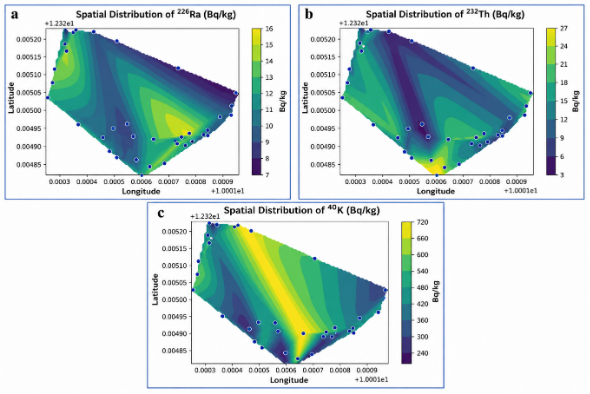
fig 4

Published

2026-07-22

How to Cite

Natural radionuclides in flood-affected rice agroecosystems: distribution patterns, transfer dynamics, and radiological implications. (2026). African Scientific Reports, 5(2), 539. https://doi.org/10.46481/asr.2026.5.2.539

Issue

Section

PHYSICS SECTION

How to Cite

Natural radionuclides in flood-affected rice agroecosystems: distribution patterns, transfer dynamics, and radiological implications. (2026). African Scientific Reports, 5(2), 539. https://doi.org/10.46481/asr.2026.5.2.539

Similar Articles

11-20 of 52

You may also start an advanced similarity search for this article.