Assessment of potentially harmful elements in mine spoils of Jos and environs, central Nigeria
Keywords:
Index of geo-accumulation, Pollution, Contamination, Mining, EnvironmentAbstract
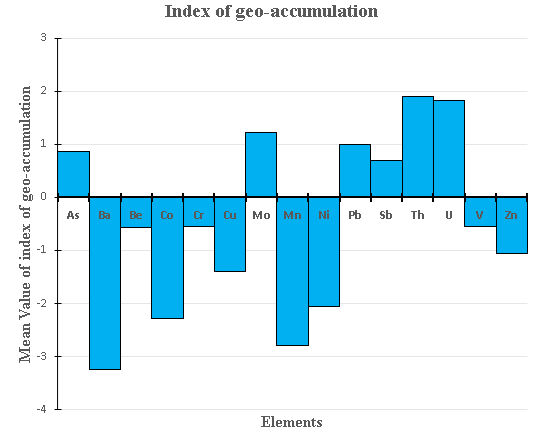
One of the main human activities that has greatly deteriorated the environment and people's health is mining. This study aimed to determine the level of potential harmful element contamination in mine spoils collected from Jos, Central Nigeria. Forty-five samples were collected, air-dried, pulverized, and sieved to collect fine particles and analyzed for As, Ba, Co, Cr, Cu, Mo, Mn, Ni, Pb, Sb, Th, U, V, and Zn using Inductively Coupled Plasma Mass Spectroscopy (ICP-MS). The average concentrations of the potentially harmful elements in the spoils were; As: 5.70 ppm; Ba: 97.31 ppm; Be: 3.02 ppm; Co: 7.48 ppm; Cr: 124.64 ppm; Cu: 19.16 ppm; Mo: 6.19 ppm; Mn: 165 ppm; Ni: 28.84 ppm; Pb: 38.72 ppm; Sb: 0.51 ppm; Th: 36.17 ppm; U: 10.94 ppm; V: 119.84; Zn: 19.15 ppm. Pollution indices such as contamination factor (CF), pollution load index (PLI) and index of geo-accumulation (Igeo) were used to determine the level of contamination in the samples. The CF values show that the soils are considerably contaminated with As, Ba, Be, Co, Cr, Cu, Mo, Mn, Ni, Pb, Sb, V, and Zn while it is highly contaminated with Th and U. Conversely, the PLI of 0.439 shows that the site is unpolluted. Based on the index of geo-accumulation, the mine spoils are moderately- uncontaminated with As, Ba, Be, Co, Cr, Cu, Mo, Mn, Ni, Pb, Sb, Th, U, V, and Zn. Most of these elements are sourced from natural or geogenic sources, and some are remobilized from mining activities.
References
REFERENCES
[1] N. R. Haddaway, S. J. Cooke, P. Lesser, B. Macura, A. E. Nilsson, J. J. Taylor & K. Raito, “Evidence of the impacts of metal mining and the effectiveness of mining mitigation measures on social–ecological systems in Arctic and boreal regions: a systematic protocol”, Environmental Evidence 8 (2019) 9. https://doi.org/10.1186/s13750-019-0152-8.
[2] A. O. Omotehinse and B. D. Ako, “The environmental implications of solid mineral mining in Nigeria with special focus on tin in Jos and Coal in Enugu”, Journal of Sustainable Mining 18 (2019) 18. https://doi.org/10.1016/j.jsm.2018.12.001.
[3] G. Hilson, T. R. Zolnikov, B. R. Ortiz & C. Kumah, “Formalizing artisanal gold mining under the Minamata Convention: previewing the challenges in Sub-Saharan Africa”, Environmental Science and Policy 18 (2018) 123. https://doi.org/10.1016/j.envsci.2018.03.026.
[4] P. C. Agyeman, S. K. Ahado, J. Kingsley, N. M. Kabonye, J. K. M. Biney, L. Boruvka & M. Vasat Kocarek, “Source apportionment, contamination levels & spatial prediction of potentially toxic elements in selected soils of the Czech Republic”, Environmental Geochemistry and Health 43 (2021) 601. https://doi.org/10.1007/s10653-020-00743-8.
[5] I. O. Olarinnoye, M. K. Atipo & O. B. Awojoyobge, “Assessment of heavy metals in mine soil and tailings from Jos, Nigeria”, IOP Conference Series: Earth and Environmental Science 849 (2021) 012010. https://doi.org/10.1088/1755-1315/849/1/012010.
[6] A. O. Owolabi, Z. O. Opafunso & L. Lajide, “Geochemical evaluation of waste and soil samples around cassiterite mine sites in Plateau State, Nigeria”, International Journal of Science and Technology 6 (2017) 808. https://bit.ly/47ytahE.
[7] U. Lar, E. Shettima & H. Dibal, “Heavy metals in the urban soils and vegetables in Jos metropolis, Nigeria: implication on children health”, American Journal of Environmental Protection 3 (2014) 70. https://doi.org/10.11648/j.ajep.s.2014030602.20.
[8] J. L. Hamelink, P. F. Landrum, B. L. Harold & B. H. William (Eds.), Bioavailability: Physical, Chemical & Biological Interactions, CRC Press Inc., Boca Raton, FL, 1994. https://www.kinokuniya.co.jp/f/dsg-02-9781566700863.
[9] J. A. S. Verkleji, “The effects of heavy metals stress on higher plants and their use as biomonitors in plant as bioindicators”, in Indicators of Heavy Metals in the Terrestrial Environment, B. Markert (Ed.), VCH, New York, 1993, pp. 415–424. https://books.google.co.jp/books/about/Plants_as_Biomonitors.html?id=S5nwAAAAMAAJ.
[10] S. Wang and X. Shi, “Molecular mechanisms of metal toxicity and carcinogenesis”, Molecular and Cellular Biochemistry 222 (2001) 3. https://doi.org/10.1023/A:1017918013293.
[11] K. A. C. De Schamphelaere, M. Canll, V. Van Lierde, I. Forrez, F. Vanhaecke & C. R. Janssen, “Reproductive toxicity of dietary zinc to Daphnia magna”, Aquatic Toxicology 70 (2004) 233. https://doi.org/10.1016/j.aquatox.2004.09.008.
[12] H. D. Zhou, J. Zhao, J. Lu, Y. C. Wang, H. Yuan & X. H. Wan, “Distribution, sources and ecological risk assessment of polycyclic aromatic hydrocarbons in sediments from Baiyangdian Wetland”, Asian Journal of Ecotoxicology 3 (2008) 291. https://caod.oriprobe.com/articles/23546256/Distribution__Sources_and_Ecological_Risk_Assessme.htm.
[13] Z. Atafar, A. Mesdaghinia, J. Nouri, M. Homaee, M. Yunesin, M. Ahmadimoghaddam & A. H. Mahvi, “Effects of fertilizer application on soil heavy metal concentration”, Environmental Monitoring and Assessment 160 (2010) 83. https://doi.org/10.1007/s10661-008-0659-x.
[14] V. P. Dudu, M. Mathuthu & M. Manjoro, “Assessment of heavy metals and radionuclides in dust fallout in the West Rand mining area of South Africa”, Clean Air Journal 28 (2018) 2. https://doi.org/10.17159/2410-972x/2018/v28n2a17.
[15] K.J. Bansah, A. B. Yalley & N. Dumakor-Dupey, “The hazardous nature of small-scale underground mining in Ghana”, Journal of Sustainable Mining 15 (2016) 8. https://doi.org/10.1016/j.jsm.2016.04.004.
[16] A. Alengebawy, S. T. Abdelkhalek, S. R. Qureshi & M.-Q. Wang, “Heavy metals and pesticides toxicity in agricultural soil and plants: ecological risks and human health implications”, Toxics 9 (2021) 42. https://doi.org/10.3390/toxics9030042.
[17] K. Raj and A. P. Das, “Lead pollution: impact on environment and human health and approach for a sustainable solution”, Environmental Chemistry and Ecotoxicology 5 (2023) 79. https://doi.org/10.1016/j.enceco.2023.02.001.
[18] M. Gabarr´on, R. Zornoza, J. A. Acosta, ´ A. Faz & S. Mart´ ınez-Mart´ ınez, “Mining environments”, in Advances in the Physics of Metal Processing, Elsevier, 2019, pp. 157–205. https://doi.org/10.1016/bs.apmp.2019.07.003.
[19] R. A. Hodge, M. Ericsson, O. L¨of, A. L¨of & P. Semkowich, “The global mining industry: corporate profile, complexity & change”, Mineral Economics 35 (2022) 587. https://doi.org/10.1007/s13563-022-00343-1.
[20] F. P. Carvalho, “Mining industry and sustainable development: time for change”, Food Energy Security 6 (2017) 61. https://doi.org/10.1002/fes3.109.
[21] L. Chen, M. Zhau, J. Wang, Z. Zhang, C. Duan, X. Wang, S. Zhao, X. Bai, Z. Li, Z. Li & L. Fang, “A global meta-analysis of heavy metal(loid)s pollution in soils near copper mines: evaluation of pollution levels and probabilistic health risks”, Science of The Total Environment 835 (2022) 155441. https://doi.org/10.1016/j.scitotenv.2022.155441.
[22] A. Khafouri, E. H. Talbi & A. Abdelouas, “Assessment of heavy metal contamination of the environment in the mining site of Ouixane (North East Morocco)”, Water, Air & Soil Pollution 232 (2021) 398. https://doi.org/10.1007/s11270-021-05318-6.
[23] M. Nekoeinia, R. Mohajer & M. H. Salehi, “Multivariate statistical approach to identify metal contamination sources in agricultural soils around Pb–Zn mining area, Isfahan province, Iran”, Environmental Earth Sciences 75 (2016) 760. https://doi.org/10.1007/s12665-016-5597-2.
[24] X. T. Vuong, L. D. Vu, A. T. T. Duong, H. T. Duong, H. T. H. Hoang, M. N. T. Luu, T. N. Nguyen, V. D. Nguyen, T. H. Van & T. B. Minh, “Speciation and environmental risk assessment of heavy metals in soils from lead/zinc site in Vietnam”, International Journal of Environmental Science and Technology, 20 (2023) 5295. https://doi.org/10.1007/s13762-022-04339-w.
[25] E. C. Umeobi, C. V. Azuka, K. I. Ofem, K. John, K. Nemeˇcek, C. M. Jidere & P. I. Ezeaku, “Evaluation of potentially toxic elements in soils developed on limestone and lead-zinc mine sites in parts of southeastern Nigeria”, Heliyon 10 (2024) e27503. https://doi.org/10.1016/j.heliyon.2024.e27503.
[26] P. N. Obasi and B. E. B. Akudinobi, “Pollution status of arable soils and stream sediments in mining areas of Abakaliki, Lower Benue Trough”, International Journal of Environmental Science and Technology 16 (2019) 7869. https://doi.org/10.1007/s13762-019-02337-z.
[27] G.M.Mafuyai, I. S. Eneji, R. Sha’ato & L. A. Nnamonu, “Heavy metal concentration in soil irrigated with ex-tin mining ponds water, Bokkos L.G.A, Plateau State”, African Journal of Environment and Natural Science Research 2 (2019) 13. https://abjournals.org/ajensr/wp-content/uploads/sites/15/journal/published_paper/volume-2/issue-3/AJENSR_1Lj7NMVb.pdf.
[28] E. J. Kwaghe, F. R. O. Akamigbo & C.L.A.Igwe, “Impactassessment of tin mining on heavy metals accumulation in Jos soils of Bukuru, Jos North, Central Nigeria”, International Journal of Science and Research 9 (2020) 1682. https://www.ijsr.net/archive/v9i12/SR201009201209.pdf.
[29] D. S. Wapwera, M. G. Ayanbimpe, E. Charles & E. C. Odita, “Abandoned mine, potential home for the people: a case study of Jos Plateau tin-mining region”, Journal of Civil Engineering and Architecture 9 (2015) 429. https://doi.org/10.17265/1934-7359/2015.04.007.
[30] S. Kumar and K. P. Trivedi, “Heavy metal stress signaling in plants”, in Plant Metal Interaction, A. Parvaiz (Ed.), Elsevier, pp. 585–603 (2016). https://doi.org/10.1016/B978-0-12-803158-2.00025-4.
[31] M. D. Ceballos, Z. Dong, L. J. Peters, F. R. Herrick, P. Gupta & D. John, “Metals dust in workers’ homes and potential for take-home in the Greater Boston area: pilot study”, Environmental Research 209 (2022) 112893. https://doi.org/10.1016/j.envres.2022.112893.
[32] J. D. Falconer, The Geology of the Plateau Tin Fields, Waterlow & Sons, Limited, Nigeria, 1921. Available at https://books.google.co.jp/books/about/The_Geology_of_the_Plateau_Tin_Fields.html?id=51z6RbYkPlEC&redir_esc=y.
[33] B. W. Hodder, “Tin mining on the Jos Plateau, Nigeria”, Economic Geography 35 (1959) 109. https://doi.org/10.2307/142394.
[34] L. Dai, L. Wang, L. Li, T. Liang, Y. Zhang, C. Ma & B. Xing, “Multivariate geostatistical analysis and source identification of heavy metals in the sediment of Poyang Lake in China”, Science of the Total Environment 621 (2018) 1433. https://doi.org/10.1016/j.scitotenv.2017.10.085.
[35] L. Hakanson, “An ecological risk index for aquatic pollution control: a sediment ecological approach”, Water Research 14 (1980) 975. https://doi.org/10.1016/0043-1354(80)90143-8.
[36] W. N. Macleod, D. C. Turner & E. P. Wright, The Geology of the Jos-Plateau, Geological Survey of Nigeria Bulletin 32 (1971). Available at: https://books.google.com/books/about/The_Geology_of_the_Jos_Plateau.html?id=fs490AEACAAJ.
[37] D. L. Tomlinson, J. G. Wilson, C. R. Harris & D. W. Jeffrey, “Problems in the assessment of heavy-metal levels in estuaries and the formation of a pollution index”, Helgol¨ander Meeresuntersuchungen 33 (1980) 566. https://doi.org/10.1007/BF02414780.
[38] G. Muller, “Index of geo-accumulation in sediments of the Rhine”, Geochemical Journal 2 (1981) 108. https://www.sid.ir/paper/618491/en.
[39] A. W. Rose, H. E. Hawkes & J. S. Webb, Geochemistry in Mineral Exploration, 2nd ed., Academic Press, London, 1979. Available at: https://books.google.com/books/about/Geochemistry_in_Mineral_Exploration.html?id=ZYOAAAAAIAAJ.
[40] S. Bose-O’Reilly, J. Yabe, J. Makumba, P. Schutzmeier, B. Ericson & C. Jack, “Lead intoxicated children in Kabwe, Zambia”, Environmental Research 165 (2018) 420. https://doi.org/10.1016/j.envres.2017.10.024.
[41] P. M. Taylor, K. A. Mackay, K. A. Hudson-Edwards & E. Holz, “Soil Cd, Cu, Pb and Zn contaminants around Mount Isa city, Queensland, Australia: potential sources and risks to human health”, Applied Geochemistry 25 (2010) 841. https://doi.org/10.1016/j.apgeochem.2010.03.003.
[42] J. C. Fernández-Caliani, M. I. Giráldez, E. Morales, C. Barba-Brioso & I. González, “Soil contaminated with hazardous waste materials at Rio Tinto Mine (Spain) is a persistent secondary source of acid and heavy metals to the environment”, Minerals 13 (2023) 456. https://doi.org/10.3390/min13040456.
[43] K. A. Mensah, B. Marschner, V. Antoniadis, E. Stemn, M. S. Shaheen & J. Rinklebe, “Human health risk via soil ingestion of potentially toxic elements and remediation potential of native plants near an abandoned mine spoil in Ghana”, Science of the Total Environment 798 (2021) 149272. https://doi.org/10.1016/j.scitotenv.2021.149272.
[44] Y. Chai and F. Guo, “Potentially toxic element contamination in soils affected by the antimony mine spill in Northwest China”, Toxics 11 (2023) 359. https://doi.org/10.3390/toxics11040359.
[45] O. Igwe, Earth Geospheric Domain: The Tectonic Shift from Balm to Humanity’s Bane, 166th Inaugural Lecture of the University of Nigeria, Nsukka, June 24 (2021).
[46] M. O. Nweke and S. N. Ukpai, “Use of enrichment, ecological risk and contamination factors with geoaccumulation indexes to evaluate heavy metal contents in the soils around Ameka mining area, south of Abakaliki, Nigeria”, Journal of Geography, Environment and Earth Science Internationa 5 (2016) 1. https://doi.org/10.9734/JGEESI/2016/24908.
[47] J. V. Kalinović, S. M. ˇ Serbula, T. S. Kalinovi´c, A. A. Radojevi´c & J. S. Jordanovi´c, “Pollution indices as useful tools for comprehensive evaluation of the soil contamination degree in the vicinity of mining and metallurgical complexes”, Hemijska Industrija 78 (2024) 265. https://doi.org/10.2298/HEMIND23053007K.
[48] R. W. Kazapoe, E. E. Y. Amuah & P. Dankwa, “Sources and pollution assessment of trace elements in soils of some selected mining areas of southwestern Ghana,” Environmental Technology & Innovation 26 (2022) 102329. https://doi.org/10.1016/j.eti.2022.102329.
[49] Q. Shen, M. Wu & M. Zhang, “Accumulation and relationship of metals in different soil aggregate fractions along soil profiles”, Journal of Environmental Sciences 115 (2022) 47. https://doi.org/10.1016/j.jes.2021.07.007.
[50] X. Li, L. Liu, Y. Wang, G. Luo, X. Chen, X. Yang, M. H. P. Hall, R. Guo, H. Wang, J. Cui & X. He, “Heavy metal contamination of urban soil in an old industrial city (Shenyang) in Northeast China”, Geoderma 192 (2013) 50. https://doi.org/10.1016/j.geoderma.2012.08.011.
[51] P. B. Tchounwou, C. G. Yedjou, A. K. Patlolla & D. J. Sutton, “Heavy metal toxicity and the environment”, Experientia Supplementum 101 (2012) 133. https://doi.org/10.1007/978-3-7643-8340-4 6.
[52] J. E. Fergusson (Ed.), The heavy elements: chemistry, environmental impact and health effects, Pergamon Press, Oxford (1990). Available at: https://acsess.onlinelibrary.wiley.com/doi/10.2134/jeq1991.00472425002000040028x.
[53] H. Bradl (Ed.), Heavy metals in the environment: origin, interaction and remediation, Academic Press, London (2002). Available at: https://www.sciencedirect.com/bookseries/interface-science-and-technology/vol/6/suppl/C.
[54] A. Arruti, I. Fernández-Olmo & A. Irabien, “Evaluation of the contribution of local sources to trace metals levels in urban PM2.5 and PM10 in the Cantabria region (Northern Spain)”, Journal of Environmental Monitoring 12 (2010) 1451. https://web.archive.org/web/20170811085243id /http://grupos.unican.es/pasep/PUBLICATIONS/2010/Arruti 1.pdf.
[55] E. Sträter, A. Westbeld & O. Klemm, “Pollution in coastal fog at Alto Patache, Northern Chile”, Environmental Science and Pollution Research International 17 (2010) 1563. https://doi.org/10.1007/s11356-010-0343-x.
Published
How to Cite
Issue
Section
Copyright (c) 2025 Sunday Sani Daku, Victor Bulus Diyelmak, Ernest Anayo Okafor

This work is licensed under a Creative Commons Attribution 4.0 International License.