
Geophysical investigation of groundwater potential in parts of Afao Ekiti, Southwestern Nigeria
Keywords:
Aquifers, Fractured Basement, Groundwater Potential, Vertical electrical sounding, Water tableAbstract
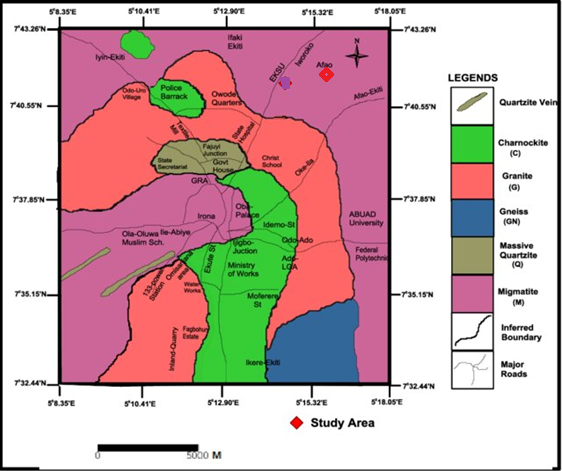
A geophysical investigation was conducted to evaluate groundwater potential and explain anomalous water-table behaviour in hand-dug wells in a new community at Afao Ekiti during the 2023--2024 dry and wet seasons. The study used water-table measurements from ten observatory wells and Vertical Electrical Soundings (VES) data acquired along five traverses with the Schlumberger array. Electrode spacing (AB/2) varied from 1 to 100 m, and the maximum surveyed length was 200 m. Water tables were higher during the dry season than during the rainy season in eight wells, while two wells remained dry in both seasons. The interpreted VES results divided the area into two zones and revealed four lithologic units: topsoil, lateritic layer, weathered layer, and fractured or fresh basement. Two aquifer types were identified: a weathered-basement unconfined aquifer with resistivity values ranging between 50--150 Ωm. and a fractured-basement confined aquifer with resistivity values ranged between 100--250 Ωm. Groundwater potential is higher in Zone 1 than in Zone 2. Boreholes sited within Zone 1 are therefore expected to be productive and to yield groundwater sufficient for community needs.
References
[1] K. E. Welsh & A. P. Pinder-Darling, ``Water availability and access'', in Clean Water and Sanitation, W. Leal Filho, A. M. Azul, L. Brandli, A. Lange Salvia & T. Wall (Eds.), Springer, Cham, Switzerland, 2022, p. 736. https://doi.org/10.1007/978-3-319-95846-0_165.
[2] Z. Liu, Y. Zhang, Z. Guan, J. Li & Y. Huang, ``Impact of hydrogeological conditions on groundwater vulnerability in the Songnen Plain, Jilin, China'', LHB: Hydroscience Journal 111 (2025) 2579898. https://doi.org/10.1080/27678490.2025.2579898.
[3] R. M. Hen-Jones, P. N. Hughes, R. A. Stirling, S. Glendinning, J. E. Chambers, D. A. Gunn & Y. J. Cui, ``Seasonal effects on geophysical--geotechnical relationships and their implications for electrical resistivity tomography monitoring of slopes'', Acta Geotechnica 12 (2017) 1159. https://doi.org/10.1007/s11440-017-0523-7.
[4] M. O. Olorunfemi, J. O. Fatoba & L. O. Ademilua, ``Integrated VLF-electromagnetic and electrical resistivity survey for groundwater in a crystalline basement complex terrain of Southwest Nigeria'', Global Journal of Geological Sciences 3 (2005) 71. https://doi.org/10.4314/gjgs.v3i1.18714.
[5] O. P. Olabode, J. T. Fatoba & S. O. Ariyo, ``Combined VLF-EM and geoelectric sounding for groundwater development in a typical basement complex terrain of Southwestern Nigeria'', FUW Trends in Science & Technology Journal 2 (2017) 496. Available online: https://www.researchgate.net/publication/319154055.
[6] O. P. Olabode & A. Adeniji, ``Application of electrical resistivity in evaluating a section of road conditions--a case study in Ifaki-Oye-Ikole Ekiti Highway, Nigeria'', Arabian Journal of Geosciences 15 (2022) 1169. https://doi.org/10.1007/s12517-022-10449-z.
[7] T. A. Lateef, ``Geophysical investigation for groundwater using electrical resistivity method--a case study of Annunciation Grammar School, Ikere LGA, Ekiti State, Southwestern Nigeria'', IOSR Journal of Applied Physics 2 (2012) 1. https://doi.org/10.9790/4861-0210106.
[8] O. P. Olabode, K. B. Osayomi & O. Bamidele, ``Evaluation of groundwater potential of part of Phase One, Federal University Oye-Ekiti using electromagnetics and electrical resistivity methods'', FUOYE Journal of Pure and Applied Sciences 3 (2019) 334. Available online: https://fjpas.fuoye.edu.ng/index.php/fjpas/article/view/92.
[9] O. Fawale, T. O. Lawal & J. S. Abayomi, ``A geo-electrical survey for groundwater exploration in a part of the Basement Complex terrain, Ilorin Metropolis, Northcentral Nigeria'', Nigerian Journal of Physics 32 (2023) 55. Available online: https://njp.nipngr.org/index.php/njp/article/view/50.
[10] C. A. Ajayi, H. Y. Madukwe, S. O. Ilugbo, B. A. Adebo, A. O. Talabi, A. A. Oyedele, O. F. Ojo, Y. C. Ajisafe & J. I. Talabi, ``Geophysical investigation of post-foundation assessment within Ekiti State University, Ado Ekiti, Southwestern Nigeria'', Malaysian Journal of Geosciences 6 (2022) 88. https://doi.org/10.26480/mjg.02.2022.88.96.
[11] J. M. Reynolds, ``The role of surface geophysics in the assessment of regional groundwater potential in Northern Nigeria'', Geological Society, London, Engineering Geology Special Publications 4 (1987) 185. https://doi.org/10.1144/GSL.ENG.1987.004.01.22.
[12] F. Meng, C. Xiao, X. Liang, G. Wang, Y. Sun & D. Guo, ``Factors influencing surface water and groundwater interaction in alluvial fan'', Journal of Water and Climate Change 12 (2021) 679. https://doi.org/10.2166/wcc.2020.174.
[13] B. Li, Y.-F. Zeng, B.-B. Zhang & X.-Q. Wang, ``A risk evaluation model for karst groundwater pollution based on geographic information system and artificial neural network applications'', Environmental Earth Sciences 77 (2018) 334. https://doi.org/10.1007/s12665-018-7539-7.
[14] E. Kalkan, ``Impact of wetting--drying cycles on swelling behavior of clayey soils modified by silica fume'', Applied Clay Science 52 (2011) 345. https://doi.org/10.1016/j.clay.2011.03.014.
Published
How to Cite
Issue
Section
Copyright (c) 2026 Oladunjoye Peter Olabode, Tokunbo Sanmi Fagbemigun, John Oluwabemiwo Olaleye, Oluwaseyi Elijah Ayobami, Tamarantare Favour Preh, Oluwatimilehin Moses Fadare

This work is licensed under a Creative Commons Attribution 4.0 International License.