Efficient and optimal adsorptive removal of urea from agricultural effluent using acidified ball clay: optimization via response surface methodology
Keywords:
Acid modified, Ball clay, Characterization, Contamination, RemediationAbstract
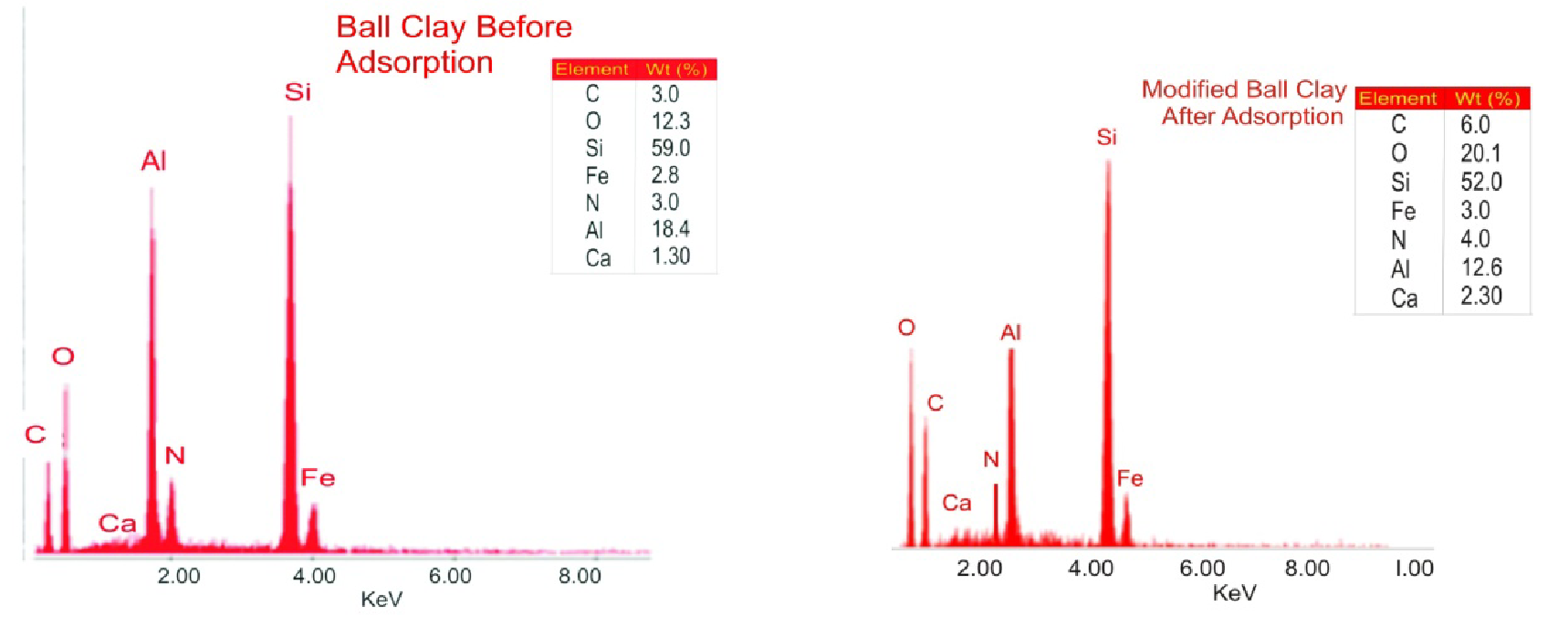
Agricultural runoff rich in urea content poses a threat to the aquatic ecosystems. This study investigated the adsorptive potential of acidified ball clay in removing urea from agricultural effluents as well as the conditions of temperature, adsorbent dosage, time, and pH that will give the optimum removal by adopting response surface methodology (RSM). Characterizations of the acidified ball to understand its adsorptive properties revealed the abundance of visible pores on the acidified ball clay for possible accommodation of adsorbate (urea) by SEM, while after adsorption the initial visible pores are slightly batched, indicating interaction between the adsorbate and adsorbent. The TEM analysis showed a number of spherical-shaped and well-dispersed nanostructures of adsorbent whose number doubles on addition of adsorbate after adsorption. The FTIR spectrum of modified ball clay showed the presence of O-H, Si-O-Si, and Al-OH groups. The EDX spectrum for the acidified ball clay unveils the elemental composition by weight in the order: Si (59.0%) > Al (18.4%) > O (12.3%) > N (3.0%) = C (3.0%) > Fe (2.8%) > Ca (1.3%). The batch process showed that acidified ball clay exhibited good potential for urea adsorption. Achieving a maximum removal efficiency of 89.14% with a corresponding capacity of 1815.3 mg/g from an initial concentration of 152.7 mg/L at optimum conditions of pH =3, temperature = 35°C, dosage 3.75 g, contact time = 30 minutes, and rate of 4.53 min-1.
References
[1] M. Gogoi, P. Bhattacharya, S. K. Sen, I. Mukherjee, S. Bhushan & S. R. Chaudhuri, “Aquaculture effluent treatment with ammonia remover Bacillus albus (ASSF01)”, Journal of Environmental Chemical Engineering 9 (2021) 105697. https://doi.org/10.1016/j.jece.2021.105697.
[2] W.Dilieka, B. Bipai, P. Lokesh, A. Padhye, L. Rachmani, W. James, S. R. Gretel & B. Saeid, “A critical review on current urea removal technologies from water: an approach for pollution prevention and resource recovery”, Separation and Purification Technology 314 (2023) 123652. https://doi.org/10.1016/j.seppur.2023.123652.
[3] G. Faye, W. Bekele & N. Fernandez, “Removal of nitrate ion from aqueous solution by modified Ethiopian bentonite clay”, International Journal of Research in Pharmacy and Chemistry 4 (2014) 201. https://www.ijrpc.com/files/27-453.pdf.
[4] J. W. Joseph & G. M. Ganga, “A review of the latest in phosphorus fertilizer technology: possibilities and pragmatism”, Journal of Environmental Quality 48 (2019) 1313. https://doi.org/10.2134/jeq2019.02.0067.
[5] E. A. Yerima, E. A. Kamba, G. O. Egah, S. P. Maaji, A. I. Ibrahim & S. Zulkifli, “Evaluation of quality index of borehole water in Marmara and New Site communities of Wukari, Nigeria”, University of Management and Technology Science Journal 1 (2022) 121. https://doi.org/10.56919/usci.1122.015.
[6] I. V. Zadinelo, H. J. Alves, A. Moesch, L. M. S. Colpini, L. C. Rosa da Silva & L. D. Santos, “Influence of chemical composition of smectites on the removal of ammonium ions from aquaculture effluents”, Journal of Materials Science 50 (2015) 1875. https://doi.org/10.1007/s10853-014-8749-3.
[7] E. A. Yerima, E. Ogwuche, C. I. Ndubueze, K. A. Muhammed & J. D. Habila, “Photocatalytic degradation of acid blue 25 dye in wastewater by zinc oxide nanoparticles”, Trends in Ecological and Indoor Environment Engineering 2 (2024) 56. https://www.researchgate.net/publication/380406646.
[8] K. A. Galos, “Composition and ceramic properties of ball clays for porcelain stoneware tiles manufacture in Poland”, Applied Clay Science 51 (2011) 85. https://doi.org/10.1016/j.clay.2010.11.004.
[9] E. A. Yerima, H. Ataitiya, B. N. Hikon, G. O. Egah, S. P. Maaji, A. I. Ibrahim, C. O. Ogar & Z. S. Samuel, “Synergistic adsorptive removal of urea from agricultural effluents using ball clay and sepiolite composite”, Journal of Biotechnology Research 10 (2023) 19. https://doi.org/10.32861/jbr.101.9.19.
[10] R. L. Naylor, R. J. Goldburg, J. H. Primavera, N. Kautsky, M. C. M. Beveridge, J. Clay, C. Folke, J. Lubchenco, H. Mooney & M. Troell, “Effect of aquaculture on world fish supplies”, Nature 405 (2000) 1024. https://doi.org/10.1038/35016500.
[11] I. Geremia, J. A. W. van Jong, C. F. van Nostrum, W. E. Hennink, K. G. F. Gerritsen & D. Stamatialis, “New mixed matrix membrane for the removal of urea from dialysate solution”, Separation and Purification Technology 277 (2021) 119408. https://doi.org/10.1016/j.seppur.2021.119408.
[12] J. O. Ighalo, S. Rangabhashiyam, K. Dulta, C. T. Umeh, K. O. Iwuozor, C. O. Aniagor, S. O. Eshiemogie, F. U. Iwuchukwu & C. A. Igwegbe, “Recent advances in hydrochar application for the adsorptive removal of wastewater pollutants”, Chemical Engineering Research and Design 184 (2022) 456. https://doi.org/10.1016/j.cherd.2022.06.028.
[13] D. Abutu, B. O. Aderemi, A. O. Ameh, H. W. Yussof, J. Gbonhinbor, B. Money, F. Nyah, C. Umunnawuike, P. I. Nwaichi & A. Agi, “Optimization of ethanol fermentation in a bubble column bioreactor using response surface methodology with ferric oxide nanoparticle-modified supports”, in Proceedings of the SPE Nigeria Annual International Conference and Exhibition, August 4, Society of Petroleum Engineers, 2025. https://doi.org/10.2118/228638-MS.
[14] D. Abutu, B. O. Aderemi, A. O. Ameh, H. W. Yussof, E. A. Yerima & A. Agi, “Integrated experimental and numerical study of a bubble column bioreactor with immobilized S. cerevisiae for ethanol production in non-Newtonian fermentation broth”, Chemical Engineering Communications (2025) 19. https://doi.org/10.1080/00986445.2025.2572738.
[15] D. Schwante, A. C. Goncalves Jr, G. F. Coelho, M. A. Campagnolo, D. C. T. Dragunski, C. R. Tarley, A. J. Miola & E. A. V. Leismann, “Chemical modification of cassava peel as adsorbent material for metal ions from wastewater”, Journal of Chemistry 2016 (2016) 3694174. http://dx.doi.org/10.1155/2016/3694174.
[16] T. N. M. Ngo, M. N. Nguyen, L. N. H. Cao Luu, T. B. Q. Tran, V. N. H. Nguyen & N. P. L. Tran, “Study of the activation of Truc Thon ball clay by acids”, CTU Journal of Innovation and Sustainable Development 15 (2023) 102. http://dx.doi.org/10.22144/ctujoisd.2023.054.
[17] B. Money, A. B. Qurratu, S. Mahat, N. Ismail, M. R. Hassan, D. Abutu & A. A. Augustine, “Clay-based geopolymers cement for oil wells: a bibliometric analysis and literature review”, in Clay Science—Bridging Geology and Physical Chemistry, IntechOpen, London, United Kingdom, 2025. https://doi.org/10.5772/intechopen.1011806.
[18] D. Abutu, B. O. Aderemi, A. O. Ameh, H. W. Yussof & A. Agi, “Nano-enhanced biocarriers: ferric oxide-modified chitosan and calcium alginate beads for improved fermentation efficiency and reusability in a bubble column bioreactor”, Biotechnology Letters 47 (2025) 70. https://doi.org/10.1007/s10529-025-03611-6.
[19] E. A. Yerima, S. P. Maaji, D. Abutu, H. Ataitiya, O. Ekirigwe, S. N. Johnson & A. Shem, “Adoption of response surface methodology in the optimization of ammonia removal from aquaculture effluent using thermal activated and non-activated ball clay”, IOSR Journal of Environmental Science, Toxicology and Food Technology 18 (2024) 9. https://www.iosrjournals.org/iosr-jestft/papers/Vol18-Issue2/Ser-2/A1802020109.pdf.
[20] A. K. Agarwal & M. S. Kadu, “Kinetics study on the adsorption of Ni2+ ions onto fly ash”, Journal of Chemical Technology and Metallurgy 50 (2015) 605. https://www.researchgate.net/publication/282572056.
[21] T. P. Ara´ujo, L. S. Brighenti, H. B. Santos, A. H. F. Castro & R. G. Thom´e, “Toxicity of nitrogen compounds in fish influenced by physico-chemical water parameters: a review”, Research and Society Development 10 (2021) e359101119779. https://doi.org/10.33448/rsd-v10i11.19779.
[22] M. Naswir, S. A. Rachman, M. Marsi & S. Salni, “Characterization of bentonite by X-ray diffraction and scanning electron microscopy with energy dispersive spectroscopy and use to increase pH and color removal, Fe and organic substances in peat water”, Journal of Clean Energy Technology 1 (2013) 317. https://doi.org/10.7763/JOCET.2013.V1.71.
[23] A. S. Ahmed, A. M. Tantawy, M. E. Abdallah & I. M. Qassim, “Characterization and application of kaolinite clay as solid phase extractor for removal of copper ions from environmental water samples”, International Journal of Advanced Research 3 (2015) 21. https://www.journalijar.com/uploads/2015/03/835_IJAR-5066.pdf.
[24] M. R. Abass, E. H. El-Masry & A. B. Ibrahim, “Preparation, characterization, and applications of polyacrylonitrile/ball clay nanocomposite synthesized by gamma radiation”, Environmental Geochemistry and Health 43 (2021) 3188. https://doi.org/10.1007/s10653-021-00813-5.
[25] D. Kibami, C. Pongener, K. S. Rao & D. Sinha, “Preparation and characterization of activated carbon from Fagopyrum esculentum Moench by HNO3 and H3PO4 chemical activation”, Der Chemica Sinica 5 (2014) 55. https://paperzz.com/doc/9057471/preparation-and-characterization-of-activated-carbon-from.
[26] M. Moradi, A. Dehpahlavan, R. Kalantary, A. Ameri, M. Farzadkia & H. Izanoo, “Application of modified bentonite using sulfuric acid for the removal of hexavalent chromium from aqueous solutions”, Environmental Health Engineering and Management Journal 2 (2015) 106. https://applications.emro.who.int/imemrf/Environ_Health_Eng_Manag_J/Environ_Health_Eng_Manag_J_2015_2_3_99_106.pdf.
[27] G. Dal Poggetto, A. D’Angelo, I. Blanco, S. Piccolella, C. Leonelli & M. Catauro, “FTIR study, thermal analysis, and evaluation of the antibacterial activity of a MK-geopolymer mortar using glass waste as fine aggregate”, Polymers 13 (2021) 2970. https://doi.org/10.3390/polym13172970.
[28] E. Balan, A. M. Saitta, F. Mauri & G. Galas, “First principles modeling of the infrared spectrum of kaolinite”, American Mineralogist 86 (2001) 1330. https://doi.org/10.2138/am-2001-11-1201.
[29] I. R. Wilson, “The constitution, evaluation and ceramic properties of ball clays”, Cerˆamica 44 (1998) 288. https://doi.org/10.1590/S0366-69131998000400002.
[30] M. Molebatsi, B. Nkoane, N. Keroletswe, S. Chigome & M. T. Kabomo, “The use of biosorbents in water treatment”, Environment 12 (2025) 302. https://doi.org/10.3390/environments12090302.
[31] F. Bolat, S. Govori, A. Haziri, S. Spahiu & F. Faiku, “Used tea waste adsorption for removal of phenol from synthetic and Kosovo industrial wastewater”, Journal of Marine Science and Application 5 (2010) 67. https://www.researchgate.net/publication/309994915.
[32] A. Denizli, G. Ozkan & M. Ucar, “Removal of chlorophenols from aquatic systems with dye affinity microbeads”, Separation and Purification Technology 24 (2001) 262. https://doi.org/10.1016/S1383-5866(01)00129-0.
[33] A. A. Adeyemo, I. O. Adeoye & O. S. Bello, “Adsorption of dyes using different types of clay: a review”, Applied Water Science 7 (2017) 568. https://doi.org/10.1007/s13201-015-0322-y.
[34] B.Riebe &C.Bunnenberg, “Influence of temperature pre-treatment and high molar saline solutions on the adsorption capacity of organo-clay minerals”, Physics and Chemistry of the Earth 32 (2007) 587. https://doi.org/10.1016/j.pce.2006.02.060.
Published
How to Cite
Issue
Section
Copyright (c) 2026 E. A. Yerima, S. P. Maaji, C. V. Ogbodo, D. Abutu, S. A. Yakubu, F. O. Nwankwo, S. J. Aboki, J. A. Adamu

This work is licensed under a Creative Commons Attribution 4.0 International License.