
Crop recommendation in precision agriculture: a systematic literature review of methods, trends, and challenges
Keywords:
Precision agriculture, Crop recommendation, Machine learning, Autonomous decision-makingAbstract
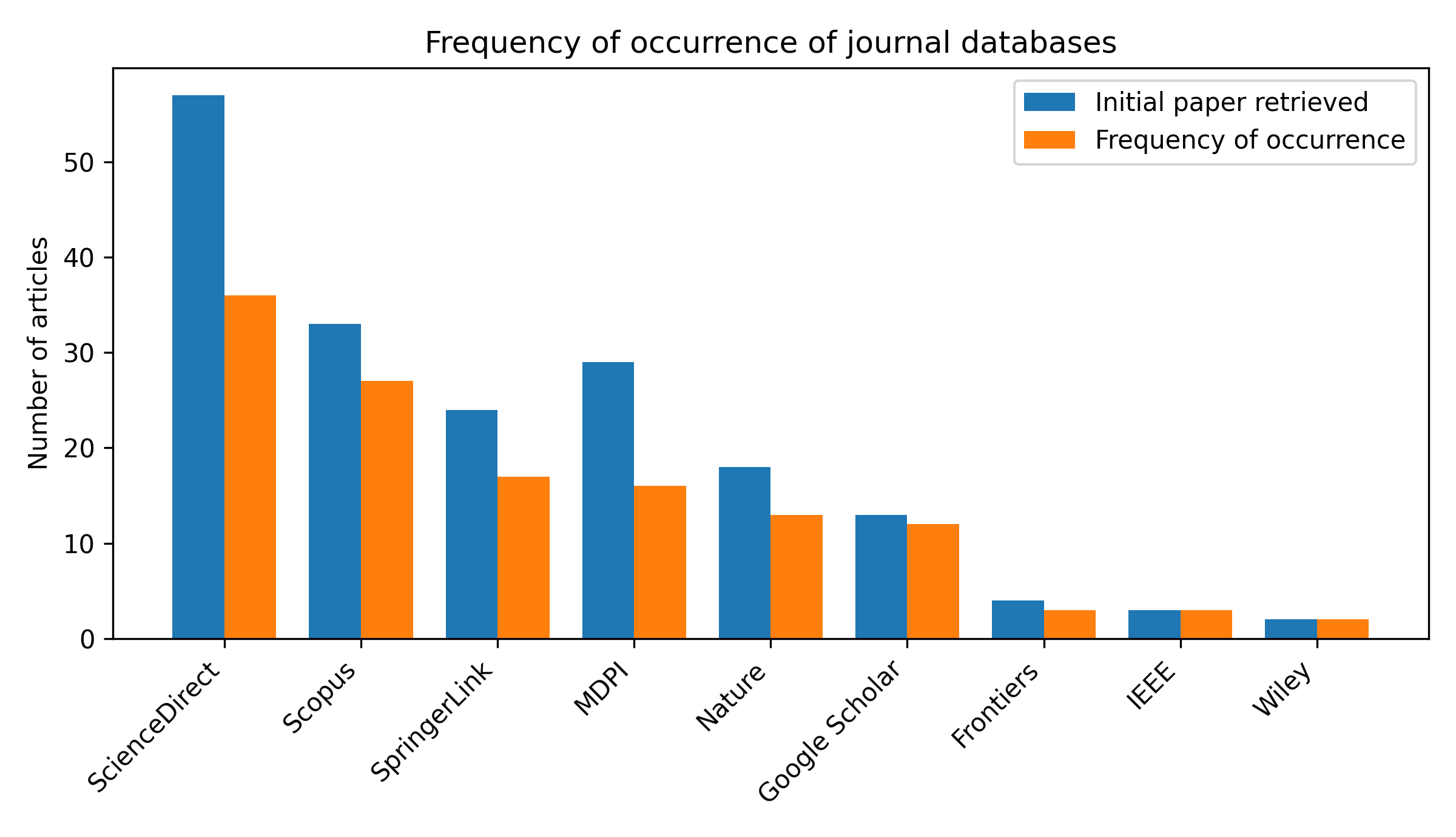
Crop recommendation methods have become an essential component of modern agriculture, helping farmers identify the most suitable crops based on soil, climatic, and environmental conditions. As key applications of precision agriculture, these methods increasingly employ artificial intelligence (AI), particularly machine learning (ML) and deep learning (DL), to improve crop prediction, recommendations, productivity, and farming decision-making. This study presents a systematic literature review (SLR) of ML and DL techniques applied to crop recommendation and related agricultural applications. From 183 identified studies, 129 articles published between 2020 and 2026 were carefully selected through a structured screening process for comprehensive analysis. Relevant studies were retrieved from major academic literature databases and publishing platforms, including ScienceDirect, Scopus, SpringerLink, MDPI, Nature, Frontiers, IEEE, Wiley, and Google Scholar. The review used the PRISMA protocol and showed that ensemble learning-based approaches, particularly Random Forest and Extreme Gradient Boosting (XGBoost), are powerful for predictive performance on various agricultural datasets. Traditional ML approaches such as Support Vector Machines, Decision Trees, and k-Nearest Neighbors are still commonly used. At the same time, Convolutional Neural Networks (CNNs) and Long Short-Term Memory (LSTM) networks are used for remote sensing and time-dependent agricultural analysis. The most frequently used dataset source is Kaggle, and typical inputs include soil nutrients (NPK), soil pH, weather conditions, and satellite indices such as NDVI and EVI. Many studies have achieved high accuracy, but most are based on static datasets, which reduces their reliability in real-world scenarios. The main research gaps are limited real-time deployment, low integration of multiple data sources, low cross-regional validation, and low model interpretability. The review shows the importance of scalable and explainable AI systems for real applications in agriculture.
References
[1] Y. Kang, M. Ozdogan, X. Zhu, Z. Ye, C. Hain & M. Anderson, ``Comparative assessment of environmental variables and machine learning algorithms for maize yield prediction in the US Midwest'', Environmental Research Letters 15 (2020) 064003. https://doi.org/10.1088/1748-9326/ab7df9.
[2] L. Goel, N. Kumar, S. Jain & Y. Agrawal, ``Improving precision agriculture using integrated bio-inspired optimisation models for crop recommendation in Rajasthan, India'', Scientific Reports 16 (2026) 6925. https://doi.org/10.1038/s41598-026-37863-7.
[3] S. Poornima, P. Mishra, R. R. Mahishi, D. C. Chaganti, M. Pushpalatha & R. B. Jana, ``Optimising crop selection for sustainable agriculture: A compound ensemble approach integrating machine learning and IoT-based sensors'', Scientific Reports 16 (2026) 11350. https://doi.org/10.1038/s41598-026-40772-4.
[4] X. Fan & C. Li, ``A simulated framework for China's rural revitalisation enabled by big data and smart agriculture under the perspective of new quality productivity'', Discover Artificial Intelligence 6 (2026) 25. https://doi.org/10.1007/s44163-025-00714-x.
[5] N. L. P. Swati, S. V. Gupta, N. S. Duddela & L. R. Parvathy, ``Agentic AI-driven autonomous decision support system for smart agriculture'', Scientific Reports 16 (2026) 9972. https://doi.org/10.1038/s41598-026-39472-w.
[6] M. Jahan & M. Nassiri-Mahallati, ``An interdisciplinary machine learning-based approach for predicting corn grain yield under biofertiliser applications'', Scientific Reports 16 (2026) 9912. https://doi.org/10.1038/s41598-026-40919-3.
[7] A. Raza, M. A. Shahid, M. Zaman, Y. Miao, Y. Huang, M. Safdar, S. Maqbool & N. E. Muhammad, ``Improving wheat yield prediction with multi-source remote sensing data and machine learning in arid regions'', Remote Sensing 17 (2025) 774. https://doi.org/10.3390/rs17050774.
[8] T. Kehkashan, M. Abdelhaq, A. S. Al-Shamayleh, M. Hamza, M. A. Khan, S. Z. Alharthi & A. Akhunzada, ``Sustainable regional corn yield prediction for the United States through interpretable machine learning approach'', Scientific Reports 16 (2026) 13942. https://doi.org/10.1038/s41598-026-43213-4.
[9] C. R. Screpnik, E. Zamudio & L. I. Gimenez, ``Artificial Intelligence in Agriculture: A Systematic Review of Crop Yield Prediction and Optimisation'', IEEE Access 13 (2025) 70691. https://doi.org/10.1109/ACCESS.2025.3560631.
[10] R. K. Sharma, J. Kaur, G. Feng, Y. Huang, C. Kumar, Y. Wang, S. Sharma, J. Jenkins & J. Dhillon, ``Maize and soybean yield prediction using machine learning methods: a systematic literature review'', Discover Agriculture 3 (2025) 64. https://doi.org/10.1007/s44279-025-00215-6.
[11] P. Muruganantham, S. Wibowo, S. Grandhi, N. H. Samrat & N. Islam, ``A Systematic Literature Review on Crop Yield Prediction with Deep Learning and Remote Sensing'', Remote Sensing 14 (2022) 1990. https://doi.org/10.3390/rs14091990.
[12] M. Rashid, B. S. Bari, Y. Yusup, M. A. Kamaruddin & N. Khan, ``A Comprehensive Review of Crop Yield Prediction Using machine learning Approaches with Special Emphasis on Palm Oil Yield Prediction'', IEEE Access 9 (2021) 63406. https://doi.org/10.1109/ACCESS.2021.3075159.
[13] A. P. Singh, P. Sahu, A. Chug & D. Singh, ``A Systematic Literature Review of machine learning Techniques Deployed in Agriculture: A Case Study of Banana Crop'', IEEE Access 10 (2022) 87333. https://doi.org/10.1109/ACCESS.2022.3199926.
[14] A. Gupta, D. Nagda, P. Nikhare & A. Sandbhor, ``Smart crop prediction using IoT and machine learning'', International Journal of Engineering Research & Technology (IJERT) 9 (2020) 18. https://doi.org/10.17577/IJERTCONV9IS03005.
[15] A. Gutiérrez, K. Bakthavatchalam, B. Karthik, V. Thiruvengadam, S. Muthal, D. Jose, K. Kotecha & V. Varadarajan, ``IoT Framework for Measurement and Precision Agriculture: Predicting the Crop Using Machine Learning Algorithms'', Technologies 10 (2022) 13. https://www.mdpi.com/2227-7080/10/1/13.
[16] A. K. K. Kouame, G. B. M. Heuvelink & P. S. Bindraban, ``Unravelling drivers of maize (Zea mays L.) yield variability in Ghana: A machine learning approach'', Computers and Electronics in Agriculture 237 (2025) 110647. https://doi.org/10.1016/j.compag.2025.110647.
[17] A. K. Pal, B. D. K. Patro & S. Chaube, ``Design and implementation of a deep learning framework for automated crop classification and health diagnosis in precision agriculture'', Scientific Reports 16 (2026) 11436. https://doi.org/10.1038/s41598-026-42151-5.
[18] A. K. Soni, P. Singh & A. A. Waoo, ``Machine Learning Approaches for Climate-Smart Crop Recommendation'', International Journal of Scientific Research in Computer Science, Engineering and Information Technology 12 (2026) 175. https://doi.org/10.32628/CSEIT2612327.
[19] A. Oikonomidis, C. Catal & A. Kassahun, ``Hybrid Deep Learning-based Models for Crop Yield Prediction'', Applied Artificial Intelligence 36 (2022) 2031823. https://doi.org/10.1080/08839514.2022.2031823.
[20] A. Punitha & V. Geetha, ``Gorilla troops optimisation with deep learning based crop recommendation and yield prediction'', International Journal of Cognitive Computing in Engineering 5 (2024) 494. https://doi.org/10.1016/j.ijcce.2024.09.006.
[21] A. Suruliandi, G. Mariammal & S. P. Raja, ``Crop prediction based on soil and environmental characteristics using feature selection techniques'', Mathematical and Computer Modelling of Dynamical Systems 27 (2021) 117. https://doi.org/10.1080/13873954.2021.1882505.
[22] A. Umera, Z. Khalid, S. Qamar, Z. Iqbal, M. Saeed & M. Yousif, ``Smart Crop Recommendation Using Ensemble Machine Learning Models'', Journal of Computing and Biomedical Informatics 9 (2025) 1016. https://doi.org/10.56979/901/2025.
[23] A. Wolanin, G. Mateo-Garciá, G. Camps-Valls, L. Gómez-Chova, M. Meroni, G. Duveiller, Y. Liangzhi & L. Guanter, ``Estimating and understanding crop yields with explainable deep learning in the Indian Wheat Belt'', Environmental Research Letters 15 (2020) 024003. https://doi.org/10.1088/1748-9326/ab68ac.
[24] A. Yaganteeswarudu, S. K. Biswas, V. Aruna & D. Tripathi, ``Enhancing Transparency in Smart Farming: Local Explanations for Crop Recommendations Using LIME'', Procedia Computer Science 258 (2025) 1993. https://doi.org/10.1016/j.procs.2025.04.450.
[25] Ayushi & P. K. Buttar, ``Satellite Imagery Analysis for Crop Type Segmentation Using U-Net Architecture'', Procedia Computer Science 235 (2024) 3418. https://doi.org/10.1016/j.procs.2024.04.322.
[26] B. Dey, J. Ferdous & R. Ahmed, ``machine learning-based recommendation of agricultural and horticultural crop farming in India under the regime of NPK, soil pH and three climatic variables'', Heliyon 10 (2024) e25112. https://doi.org/10.1016/j.heliyon.2024.e25112.
[27] B. M. Lionel, R. Musabe, O. Gatera & C. Twizere, ``A comparative study of machine learning models in predicting crop yield'', Discover Agriculture 3 (2025) 151. https://doi.org/10.1007/s44279-025-00335-z.
[28] B. Panigrahi, K. C. R. Kathala & M. Sujatha, ``A machine learning-Based Comparative Approach to Predict the Crop Yield Using Supervised Learning with Regression Models'', Procedia Computer Science 218 (2023) 2684. https://doi.org/10.1016/j.procs.2023.01.241.
[29] B. Peng, K. Guan, W. Zhou, C. Jiang, C. Frankenberg, Y. Sun, L. He & P. Köhler, ``Assessing the benefit of satellite-based Solar-Induced Chlorophyll Fluorescence in crop yield prediction'', International Journal of Applied Earth Observation and Geoinformation 90 (2020) 102126. https://doi.org/10.1016/j.jag.2020.102126.
[30] B. S. Anami, N. N. Malvade & S. Palaiah, ``Deep learning approach for recognition and classification of yield affecting paddy crop stresses using field images'', Artificial Intelligence in Agriculture 4 (2020) 12. https://doi.org/10.1016/j.aiia.2020.03.001.
[31] C. Musanase, A. Vodacek, D. Hanyurwimfura, A. Uwitonze & I. Kabandana, ``Data-Driven Analysing and Machine Learning-Based Crop and Fertiliser Recommendation System for Revolutionising Farming Practices'', Agriculture (Switzerland) 13 (2023) 2141. https://doi.org/10.3390/agriculture13112141.
[32] D. Batool, M. Shahbaz, H. S. Asif, K. Shaukat, T. M. Alam, I. A. Hameed, Z. Ramzan, A. Waheed, H. Aljuaid & S. Luo, ``A Hybrid Approach to Tea Crop Yield Prediction Using Simulation Models and Machine Learning'', Plants 11 (2022) 1925. https://doi.org/10.3390/plants11151925.
[33] D. Dahiphale, P. Shinde, K. Patil & V. Dahiphale, ``Smart farming: Crop recommendation using machine learning with challenges and future ideas'', Artificial Intelligence and Applications 4 (2026) 323. https://doi.org/10.47852/bonviewAIA52026214.
[34] D. Elavarasan & P. M. D. Vincent, ``Crop Yield Prediction Using Deep Reinforcement Learning Model for Sustainable Agrarian Applications'', IEEE Access 8 (2020) 86886. https://doi.org/10.1109/ACCESS.2020.2992480.
[35] D. Garg & M. Alam, ``An effective crop recommendation method using machine learning techniques'', International Journal of Advanced Technology and Engineering Exploration 10 (2023) 498. https://doi.org/10.19101/IJATEE.2022.10100456.
[36] D. Gosai, C. Raval, R. Nayak, H. Jayswal & A. Patel, ``Crop Recommendation System using machine learning'', International Journal of Scientific Research in Computer Science, Engineering and Information Technology 7 (2021) 554. https://doi.org/10.32628/CSEIT2173129.
[37] D. Li, Y. Miao, S. K. Gupta, C. J. Rosen, F. Yuan, C. Wang, L. Wang & Y. Huang, ``Improving potato yield prediction by combining cultivar information and uav remote sensing data using machine learning'', Remote Sensing 13 (2021) 3322. https://doi.org/10.3390/rs13163322.
[38] D. Paudel, H. Boogaard, A. de Wit, M. van der Velde, M. Claverie, L. Nisini, S. Janssen, S. Osinga & I. N. Athanasiadis, ``machine learning for regional crop yield forecasting in Europe'', Field Crops Research 276 (2022) 108377. https://doi.org/10.1016/j.fcr.2021.108377.
[39] D. Taremwa, E. Ahishakiye, A. Obbo, P. K. Kisozi & F. Kaggwa, ``Prediction of maize yield in Uganda using CNN-LSTM architecture on a multimodal climate and remote sensing dataset'', Discover Artificial Intelligence 6 (2026) 164. https://doi.org/10.1007/s44163-026-00855-7.
[40] E. Cheng, B. Zhang, D. Peng, L. Zhong, L. Yu, Y. Liu, C. Xiao, C. Li, X. Li, Y. Chen, H. Ye, H. Wang, R. Yu, J. Hu & S. Yang, ``Wheat yield estimation using remote sensing data based on machine learning approaches'', Frontiers in Plant Science 13 (2022) 1090970. https://doi.org/10.3389/fpls.2022.1090970.
[41] E. Elbasi, N. Mostafa, C. Zaki, Z. AlArnaout, A. E. Topcu & L. Saker, ``Optimising Agricultural Data Analysis Techniques through AI-Powered Decision-Making Processes'', Applied Sciences (Switzerland) 14 (2024) 8018. https://doi.org/10.3390/app14178018.
[42] E. S. M. El-Kenawy, A. A. Alhussan, N. Khodadadi, S. Mirjalili & M. M. Eid, ``Predicting Potato Crop Yield with machine learning and Deep Learning for Sustainable Agriculture'', Potato Research 68 (2025) 759. https://doi.org/10.1007/s11540-024-09753-w.
[43] F. Abbas, H. Afzaal, A. A. Farooque & S. Tang, ``Crop yield prediction through proximal sensing and machine learning algorithms'', Agronomy 10 (2020) 1046. https://doi.org/10.3390/AGRONOMY10071046.
[44] F. Imtiaz, A. A. Farooque, G. S. Randhawa, X. Wang, T. J. Esau, S. E. H. Garmdareh & B. Acharya, ``Optimising potato yield mapping and prediction: Integrating satellite-based remote sensing and machine learning for sustainable agriculture'', Computers and Electronics in Agriculture 237 (2025) 110636. https://doi.org/10.1016/j.compag.2025.110636.
[45] F. M. Talaat, ``Crop yield prediction algorithm (CYPA) in precision agriculture based on IoT techniques and climate changes'', Neural Computing and Applications 35 (2023) 17281. https://doi.org/10.1007/s00521-023-08619-5.
[46] G. Alp & F. Soygazi, ``Enhancing Crop Recommendation with SMOTE-Augmented Machine Learning Algorithms'', Turkish Journal of Engineering 9 (2025) 612--620. https://www.researchgate.net/publication/396252511_Enhancing_Crop_Recommendation_with_SMOTE-Augmented_Machine_Learning_Algorithms.
[47] G. Rajendiran, J. Rethnaraj, S. Zade, R. Guttula & K. K. Pandey, ``UniTriRob: A robust machine learning regression model for predicting lettuce yields in aeroponic vertical farming'', Scientific Reports 16 (2026) 15791. https://doi.org/10.1038/s41598-026-44564-8.
[48] G. Singh & S. Sharma, ``Enhancing precision agriculture through cloud-based transformative crop recommendation model'', Scientific Reports 15 (2025) 9138. https://doi.org/10.1038/s41598-025-93417-3.
[49] G. V. Reddy, M. V. K. Reddy, K. Spandana, Y. Subbarayudu, A. Albawi, R. Chandrashekar, A. Singla & Praveen, ``Precision farming practices with data-driven analysis and machine learning-Based Crop and Fertiliser Recommendation System'', E3S Web of Conferences 507 (2024) 01078. https://doi.org/10.1051/e3sconf/202450701078.
[50] H. Afzal, M. Amjad, A. Raza, K. Munir, S. G. Villar, L. A. D. Lopez & I. Ashraf, ``Incorporating soil information with machine learning for crop recommendation to improve agricultural output'', Scientific Reports 15 (2025) 8560. https://doi.org/10.1038/s41598-025-88676-z.
[51] H. C. de C. Filho, O. A. de C. Júnior, O. L. F. de Carvalho, P. P. de Bem, R. dos S. de Moura, A. O. de Albuquerque, C. R. Silva, P. H. G. Ferreira, R. F. Guimarães & R. A. T. Gomes, ``Rice crop detection using LSTM, Bi-LSTM, and machine learning models from Sentinel-1 time series'', Remote Sensing 12 (2020) 2655. https://doi.org/10.3390/RS12162655.
[52] H. Sahu, P. K. Garg, S. Vijay & A. Dasgupta, ``Predictive drivers and transferability of multi-scale machine learning-based crop yield prediction under drought across European and Asian climates'', Agricultural Water Management 327 (2026) 110254. https://doi.org/10.1016/j.agwat.2026.110254.
[53] H. Wang, E. Cimen, N. Singh & E. Buckler, ``Deep learning for plant genomics and crop improvement'', Current Opinion in Plant Biology 54 (2020) 34. https://doi.org/10.1016/j.pbi.2019.12.010.
[54] J. Ansarifar, L. Wang & S. v. Archontoulis, ``An interaction regression model for crop yield prediction'', Scientific Reports 11 (2021) 97221. https://doi.org/10.1038/s41598-021-97221-7.
[55] J. P. Bharadiya, N. T. Tzenios & M. Reddy, ``Predicting Crop Yield Using Deep Learning and Remote Sensing'', Journal of Engineering Research and Reports 24 (2023) 29. https://doi.org/10.9734/jerr/2023/v24i12858.
[56] J. Shook, T. Gangopadhyay, L. Wu, B. Ganapathysubramanian, S. Sarkar & A. K. Singh, ``Crop yield prediction integrating genotype and weather variables using deep learning'', PLoS ONE 16 (2021) e0252402. https://doi.org/10.1371/journal.pone.0252402.
[57] K. Alibabaei, P. D. Gaspar & T. M. Lima, ``Crop yield estimation using deep learning based on climate big data and irrigation scheduling'', Energies 14 (2021) 3004. https://doi.org/10.3390/en14113004.
[58] K. Janani, R. Alageswaran & R. Amirtharajan, ``Dynamic SG-SKRDX hybrid framework for precision weather forecasting and crop suitability in the Cauvery Delta'', Scientific Reports 16 (2026) 2042. https://doi.org/10.1038/s41598-025-31717-4.
[59] K. Jhajharia, P. Mathur, S. Jain & S. Nijhawan, ``Crop Yield Prediction using machine learning and deep learning techniques'', Procedia Computer Science 218 (2023) 406. https://doi.org/10.1016/j.procs.2023.01.023.
[60] K. Kindra, N. G. B. Amma & N. G. N. Amma, ``Towards enhancing the performance of crop prediction system for precision agriculture using feature correlation square-based nearest neighbor classifier'', Scientific Reports 16 (2026) 8807. https://doi.org/10.1038/s41598-026-35212-2.
[61] K. Nischitha, D. Vishwakarma, Ashwini, N. Mahendra & M. R. Manjuraju, ``Crop prediction using machine learning approaches'', International Journal of Engineering Research & Technology (IJERT) 9 (2020) IJERTV9IS080029. https://doi.org/10.17577/IJERTV9IS080029.
[62] K. Rangarajan Aravind & P. Raja, ``Automated disease classification in (Selected) agricultural crops using transfer learning'', Automatika 61 (2020) 260. https://doi.org/10.1080/00051144.2020.1728911.
[63] L. Gong, M. Yu, S. Jiang, V. Cutsuridis & S. Pearson, ``Deep learning-based prediction on greenhouse crop yield combined TCN and RNN'', Sensors 21 (2021) 4537. https://doi.org/10.3390/s21134537.
[64] L. Stracqualursi, ``A Lightweight Exponential-Weighted Ensemble for Crop Recommendation'', Journal of Agricultural, Biological, and Environmental Statistics (2025). https://doi.org/10.1007/s13253-025-00694-6.
[65] L. Wang, J. Wang, Z. Liu, J. Zhu & F. Qin, ``Evaluation of a deep-learning model for multispectral remote sensing of land use and crop classification'', Crop Journal 10 (2022) 1435. https://doi.org/10.1016/j.cj.2022.01.009.
[66] M. A. Razavi, A. P. Nejadhashemi, B. Majidi, H. S. Razavi, J. Kpodo, R. Eeswaran, I. Ciampitti & P. V. V. Prasad, ``Enhancing crop yield prediction in Senegal using advanced machine learning techniques and synthetic data'', Artificial Intelligence in Agriculture 14 (2024) 99. https://doi.org/10.1016/j.aiia.2024.11.005.
[67] M. Bouni, B. Hssina, K. Douzi & S. Douzi, ``Interpretable machine learning Techniques for an Advanced Crop Recommendation Model'', Journal of Electrical and Computer Engineering 2024 (2024) 7405217. https://doi.org/10.1155/2024/7405217.
[68] M. Bouni, B. Hssina, K. Douzi & S. Douzi, ``Towards an Efficient Recommender Systems in Smart Agriculture: A deep reinforcement learning approach'', Procedia Computer Science 203 (2022) 825. https://doi.org/10.1016/j.procs.2022.07.124.
[69] M. Herrero-Huerta, P. Rodriguez-Gonzalvez & K. M. Rainey, ``Yield prediction by machine learning from UAS-based multi-sensor data fusion in soybean'', Plant Methods 16 (2020) 78. https://doi.org/10.1186/s13007-020-00620-6.
[70] M. K. Senapaty, A. Ray & N. Padhy, ``A Decision Support System for Crop Recommendation Using Machine Learning Classification Algorithms'', Agriculture (Switzerland) 14 (2024) 1256. https://doi.org/10.3390/agriculture14081256.
[71] M. K. Senapaty, A. Ray & N. Padhy, ``IoT-Enabled Soil Nutrient Analysing and Crop Recommendation Model for Precision Agriculture'', Computers 12 (2023) 61. https://doi.org/10.3390/computers12030061.
[72] M. Kuradusenge, E. Hitimana, D. Hanyurwimfura, P. Rukundo, K. Mtonga, A. Mukasine, C. Uwitonze, J. Ngabonziza & A. Uwamahoro, ``Crop Yield Prediction Using machine learning Models: Case of Irish Potato and Maize'', Agriculture (Switzerland) 13 (2023) 225. https://doi.org/10.3390/agriculture13010225.
[73] M. Maimaitijiang, V. Sagan, P. Sidike, A. M. Daloye, H. Erkbol & F. B. Fritschi, ``Crop monitoring using satellite/UAV data fusion and machine learning'', Remote Sensing 12 (2020) 1357. https://doi.org/10.3390/RS12091357.
[74] M. Marshall, M. Belgiu, M. Boschetti, M. Pepe, A. Stein & A. Nelson, ``Field-level crop yield estimation with PRISMA and Sentinel-2'', ISPRS Journal of Photogrammetry and Remote Sensing 187 (2022) 191. https://doi.org/10.1016/j.isprsjprs.2022.03.008.
[75] M. N. Navidi, E. Fazli, R. Kharazmi & J. Seyedmohammadi, ``Wheat yield prediction using integrated optical and radar remote sensing with machine learning across key phenological stages'', Scientific Reports 16 (2026) 10470. https://doi.org/10.1038/s41598-026-41501-7.
[76] M. O. Abdullahi, A. D. Jimale, Y. A. Ahmed & A. Y. Nageye, ``Revolutionising Somali agriculture: harnessing machine learning and IoT for optimal crop recommendations'', Discover Applied Sciences 6 (2024) 77. https://doi.org/10.1007/s42452-024-05739-y.
[77] F. Zhang, S. Liang, H. Ma, W. Li, Y. Chen, T. He, F. Tian, J. Xu, H. Fang, H. Liang, Y. Ma, A. Jia & Y. Zhang, ``A review of crop yield estimation on pixel and field scales from remotely sensed data'', in Science of Remote Sensing (Vol. 13), Elsevier B.V., 2026. https://doi.org/10.1016/j.srs.2025.100342.
[78] M. R. Islam, K. Oliullah, M. M. Kabir, M. Alom & M. F. Mridha, ``machine learning enabled IoT system for soil nutrients monitoring and crop recommendation'', Journal of Agriculture and Food Research 14 (2023) 100880. https://doi.org/10.1016/j.jafr.2023.100880.
[79] M. S. Naik, P. Raguraman, P. Ramisetty, K. Leha & M. S. Gayathri, Crop yield prediction and fertiliser recommendation using machine learning and remote sensing devices, in Challenges in Information, Communication and Computing Technology 1st ed. CRC Press (2024). https://doi.org/10.1201/9781003559092-50.
[80] M. S. Rao, A. Singh, N. V. S. Reddy & D. U. Acharya, ``Crop prediction using machine learning'', Journal of Physics: Conference Series 2161 (2022) 012033. https://doi.org/10.1088/1742-6596/2161/1/012033.
[81] M. Shahhosseini, G. Hu & S. v. Archontoulis, ``Forecasting Corn Yield With machine learning Ensembles'', Frontiers in Plant Science 11 (2020) 01120. https://doi.org/10.3389/fpls.2020.01120.
[82] M. Shahhosseini, G. Hu, I. Huber & S. v. Archontoulis, ``Coupling machine learning and crop modeling improves crop yield prediction in the US Corn Belt'', Scientific Reports 11 (2021) 1606. https://doi.org/10.1038/s41598-020-80820-1.
[83] M. Snehalatha & A. Patil, ``AgriYieldAI an AI driven decision support system for crop yield prediction using YieldFusionNet'', Discover Computing 29 (2026) 222. https://doi.org/10.1007/s10791-026-10096-y.
[84] M. T. Ahmed, M. S. Hossen, F. R. Annasha, M. S. Moni & M. A. A. Mridha, ``Crop Recommendation System Using Machine Learning Classifiers'', UCICS (2025). https://ucics.org/.
[85] M. Tamilselvi, S. Vishnupriya, K. Ushanandhini & A. Dhanamathi, ``A Robust Lemuria Framework for efficient crop prediction'', Scientific Reports 16 (2026) 9615. https://doi.org/10.1038/s41598-025-33811-z.
[86] M. Y. Shams, S. A. Gamel & F. M. Talaat, ``Enhancing crop recommendation systems with explainable artificial intelligence: a study on agricultural decision-making'', Neural Computing and Applications 36 (2024) 5695. https://doi.org/10.1007/s00521-023-09391-2.
[87] N. Bali & A. Singla, ``Deep Learning Based Wheat Crop Yield Prediction Model in Punjab Region of North India'', Applied Artificial Intelligence 35 (2021) 1304. https://doi.org/10.1080/08839514.2021.1976091.
[88] N. Emmanuel, N. Gabriel, R. Gad, D. Bwiza, J. K. Manzi & C. Kennet, ``Crop Recommendation Model Using Machine Learning'', International Journal of Life Science and Agriculture Research 04 (2025) 707. https://doi.org/10.55677/ijlsar/V04I11Y2025-11.
[89] N. Farmonov, K. Amankulova, J. Szatmari, A. Sharifi, D. Abbasi-Moghadam, S. M. M. Nejad & L. Mucsi, ``Crop Type Classification by DESIS Hyperspectral Imagery and Machine Learning Algorithms'', IEEE Journal of Selected Topics in Applied Earth Observations and Remote Sensing 16 (2023) 1576. https://doi.org/10.1109/JSTARS.2023.3239756.
[90] N. N. Thilakarathne, M. S. A. Bakar, P. E. Abas & H. Yassin, ``A Cloud Enabled Crop Recommendation Platform for Machine Learning-Driven Precision Farming'', Sensors 22 (2022) 6299. https://doi.org/10.3390/s22166299.
[91] N. R. Sawant, A. Kumar, S. Pant & K. Kotecha, ``An IoT-driven machine learning system for real-time smart crop recommendation and optimisation in precision agriculture'', Discover Artificial Intelligence 6 (2026) 194. https://doi.org/10.1007/s44163-026-00896-y.
[92] P. Chaudhary, P. Gulia, N. S. Gill, N. Alduaiji, P. K. Shukla & S. Vishnoi, ``An evaluation of machine learning for soil analysis in internet of things-enabled smart farming'', Scientific Reports 16 (2026) 10318. https://doi.org/10.1038/s41598-026-36017-z.
[93] P. D. Reddy, K. S. S. Reddy, P. Jayanth, B. P. Kakarla & R. M. Balakrishnan, ``Agri Assist: An AI Integrated Farmer Assistant'', Procedia Computer Science 258 (2025) 3510. https://doi.org/10.1016/j.procs.2025.04.607.
[94] P. Nevavuori, N. Narra, P. Linna & T. Lipping, ``Crop yield prediction using multitemporal UAV data and spatio-temporal deep learning models'', Remote Sensing 12 (2020) 4000. https://doi.org/10.3390/rs12234000.
[95] P. Sharma, P. Dadheech, N. Aneja & S. Aneja, ``Predicting Agriculture Yields Based on Machine Learning Using Regression and Deep Learning'', IEEE Access 11 (2023) 111255. https://doi.org/10.1109/ACCESS.2023.3321861.
[96] Q. Li, X. Liang, M. Gao, Y. Li, I. R. Willett, H. Suter, A. Pang, M. Zhang, P. Xangsayasane, Z. Wang & D. Chen, ``A hybrid machine-learning and process-based regional crop modelling framework to improve rice production strategies under data constraints'', Computers and Electronics in Agriculture 249 (2026) 111885. https://doi.org/10.1016/j.compag.2026.111885.
[97] R. A. Ahmed, W. El-Shafai, Z. A. Ahmed, E.-S. M. El-Rabaie & F. E. Abd El-Samie, ``High-precision crop recommendation system with stacking ensemble classifiers for optimising agricultural productivity'', Scientific Reports 15 (2025) 43377. https://doi.org/10.1038/s41598-025-09640-5.
[98] R. Akhter & S. A. Sofi, ``Precision agriculture using IoT data analytics and machine learning'', Journal of King Saud University - Computer and Information Sciences 34 (2022) 5602. https://doi.org/10.1016/j.jksuci.2021.05.013.
[99] R. Aworka, L. S. Cedric, W. Y. H. Adoni, J. T. Zoueu, F. K. Mutombo, C. L. M. Kimpolo, T. Nahhal & M. Krichen, ``Agricultural decision system based on advanced machine learning models for yield prediction: Case of East African countries'', Smart Agricultural Technology 2 (2022) 100048. https://doi.org/10.1016/j.atech.2022.100048.
[100] R. K. Dhanaraj, M. Maragatharajan, A. Sureshkumar & S. P. Balakannan, ``On-device AI for climate-resilient farming with intelligent crop yield prediction using lightweight models on smart agricultural devices'', Scientific Reports 15 (2025) 31195. https://doi.org/10.1038/s41598-025-16014-4.
[101] S. A. Mohamed, O. O. A. Maksoud, A. Fathy, A. S. Mohamed, K. Hosny, H. M. Keshk & S. A. Mohamed, ``A hybrid deep learning and rule-based model for smart weather forecasting and crop recommendation using satellite imagery'', Scientific Reports 15 (2025) 36102. https://doi.org/10.1038/s41598-025-21506-4.
[102] S. Agarwal & S. Tarar, ``A hybrid approach for crop yield prediction using machine learning and deep learning algorithms'', Journal of Physics: Conference Series 1714 (2021) 012012. https://doi.org/10.1088/1742-6596/1714/1/012012.
[103] S. C. Ramu, D. Raman, K. Ramana, A. V. Krishna, A. A. Khan, S. Khan & S. M. Abdu, ``A lightweight deep learning and whale optimisation framework for sustainable precision agriculture'', Discover Computing 29 (2026) 73. https://doi.org/10.1007/s10791-026-09952-8.
[104] S. Chor, B. Dandekar, S. Prerna, S. Shelke & S. Divekar, ``IOT-based crop recommendation using machine learning'', International Journal of Scientific Research in Science, Engineering and Technology 12 (2025) 272. https://ijsrset.com/home/article/view/IJSRSET2512307.
[105] S. Das & M. Ambika, ``Revolutionising Indian Farming: machine learning-Powered NLP for Optimal Crop Recommendations'', Procedia Computer Science 258 (2025) 2040. https://doi.org/10.1016/j.procs.2025.04.454.
[106] S. Fathololoumi, A. Gillespie & A. Biswas, ``Enhancing crop yield predictions through spectral-temporal integration across multiple agricultural fields'', Computers and Electronics in Agriculture 245 (2026) 111552. https://doi.org/10.1016/j.compag.2026.111552.
[107] S. Gupta, A. Geetha, K. S. Sankaran, A. S. Zamani, M. Ritonga, R. Raj, S. Ray & H. S. Mohammed, ``machine learning-and Feature Selection-Enabled Framework for Accurate Crop Yield Prediction'', Journal of Food Quality 2022 (2022) 6293985. https://doi.org/10.1155/2022/6293985.
[108] S. Jeong, J. Ko & J. M. Yeom, ``Predicting rice yield at pixel scale through synthetic use of crop and deep learning models with satellite data in South and North Korea'', Science of the Total Environment 802 (2022) 149726. https://doi.org/10.1016/j.scitotenv.2021.149726.
[109] S. K. S. Durai & M. D. Shamili, ``Smart farming using machine learning and Deep Learning techniques'', Decision Analytics Journal 3 (2022) 100041. https://doi.org/10.1016/j.dajour.2022.100041.
[110] S. Khaki, L. Wang & S. v. Archontoulis, ``A CNN-RNN Framework for Crop Yield Prediction'', Frontiers in Plant Science 10 (2020) 1750. https://doi.org/10.3389/fpls.2019.01750.
[111] S. Koparde, A. Behare, S. Kasare, J. Patil & K. Nadar, Crop Yield Prediction for Cereals using machine learning, in Advancements in Communication and Systems, Soft Computing Research Society (2024) pp. 407-418. https://doi.org/10.56155/978-81-955020-7-3-36.
[112] S. M. M. Nejad, D. Abbasi-Moghadam, A. Sharifi, N. Farmonov, K. Amankulova & M. Laszlz, ``Multispectral Crop Yield Prediction Using 3D-Convolutional Neural Networks and Attention Convolutional LSTM Approaches'', IEEE Journal of Selected Topics in Applied Earth Observations and Remote Sensing 16 (2023) 254. https://doi.org/10.1109/JSTARS.2022.3223423.
[113] S. Murgod, T. Kabbur, B. Matte, V. Mujumdar & M. M. Raikar, ``IoT-Driven Smart Farming with machine learning for Sustainable Food Systems'', Procedia Computer Science 260 (2025) 552. https://doi.org/10.1016/j.procs.2025.03.233.
[114] S. P. Raja, B. Sawicka, Z. Stamenkovic & G. Mariammal, ``Crop prediction based on characteristics of the agricultural environment using various feature selection techniques and classifiers'', IEEE Access 10 (2022) 23625. https://doi.org/10.1109/ACCESS.2022.3154350.
[115] S. Ramzan, Y. Y. Ghadi, H. Aljuaid, A. Mahmood & B. Ali, ``An Ingenious IoT Based Crop Prediction System Using ML and EL'', Computers, Materials and Continua 79 (2024) 183. https://doi.org/10.32604/cmc.2024.047603.
[116] S. Rani, A. K. Mishra, A. Kataria, S. Mallik & H. Qin, ``machine learning-based optimal crop selection system in smart agriculture'', Scientific Reports 13 (2023) 15997. https://doi.org/10.1038/s41598-023-42356-y.
[117] S. S. Rajest, S. S. Priscila, R. Regin T. Shynu & R. Steffi, ``Application of machine learning to the Process of Crop Selection Based on Land Dataset'', International Journal on Orange Technology 5 (2023) 1. https://journals.researchparks.org/index.php/IJOT.
[118] S. Sambare, R. Patil & T. Sambare, ``Investigation and classification of soil using distance method and Crop Prediction'', Procedia Computer Science 259 (2025) 473. https://doi.org/10.1016/j.procs.2025.03.349.
[119] S. Solanki & S. Verma, ``DFI-ADR: Fuzzy Logic-Driven Information Retrieval and machine learning for Environmental and Crop Prediction to Optimise Farming Decisions'', International Journal of Information Engineering and Electronic Business 17 (2025) 48. https://doi.org/10.5815/ijieeb.2025.06.04.
[120] S. Sukriadi, A. Adawiah & A. M. N. Afdhal, ``Integrating Big Data and machine learning to support smart village decisions for agricultural productivity improvement'', Discover Global Society 4 (2026) 33. https://doi.org/10.1007/s44282-026-00360-3.
[121] S. Sukriadi, A. Adawiah & I. Ismail, ``Leveraging machine learning for sustainable smart farming in rural landscapes'', Discover Food 6 (2026) 168. https://doi.org/10.1007/s44187-026-00888-y.
[122] S. V. Joshua, A. S. M. Priyadharson, R. Kannadasan, A. A. Khan, W. Lawanont, F. A. Khan, A. U. Rehman & M. J. Ali, ``Crop Yield Prediction Using Machine Learning Approaches on a Wide Spectrum'', Computers, Materials and Continua 72 (2022) 5663--5679. https://doi.org/10.32604/cmc.2022.027178.
[123] T. R. Mahesh & G. S. Madhuri, ``Prediction of Crop Yield Based on Soil Moisture using machine learning Algorithms'', International Journal of Information Technology, Research and Applications 2 (2023) 33. https://doi.org/10.59461/ijitra.v2i1.30.
[124] T. Zhang, Q. Yang, X. Tong, L. Hu & J. Shao, ``DualSpinNet: A crop yield prediction model based on LSTM and GRU'', Cognitive Robotics 6 (2026) 32. https://doi.org/10.1016/j.cogr.2025.12.001.
[125] U. Bhimavarapu, G. Battineni & N. Chintalapudi, ``Improved Optimisation Algorithm in LSTM to Predict Crop Yield'', Computers 12 (2023) 10. https://doi.org/10.3390/computers12010010.
[126] V. Pandith, H. Kour, S. Singh, J. Manhas & V. Sharma, ``Performance Evaluation of machine learning Techniques for Mustard Crop Yield Prediction from Soil Analysis'', Journal of Scientific Research 64 (2020) 394. https://doi.org/10.37398/jsr.2020.640254.
[127] W. Xu, P. Chen, Y. Zhan, S. Chen, L. Zhang & Y. Lan, ``Cotton yield estimation model based on machine learning using time series UAV remote sensing data'', International Journal of Applied Earth Observation and Geoinformation 104 (2021) 102511. https://doi.org/10.1016/j.jag.2021.102511.
[128] W. Zhou, Y. Liu, S. T. Ata-Ul-Karim, Q. Ge, X. Li & J. Xiao, ``Integrating climate and satellite remote sensing data for predicting county-level wheat yield in China using machine learning methods'', International Journal of Applied Earth Observation and Geoinformation 111 (2022) 102861. https://doi.org/10.1016/j.jag.2022.102861.
[129] Y. A. Mari, F. Talpur, R. Kumar, H. Shafi, A. H. Soomro & S. H. Talpur, ``Crop Recommendation System Using Machine Learning'', Research Journal for Social Affairs 4 (2026) 149. https://doi.org/10.71317/RJSA.004.02.0779.
[130] Y. Guo, Y. Fu, F. Hao, X. Zhang, W. Wu, X. Jin, C. R. Bryant & J. Senthilnath, ``Integrated phenology and climate in rice yields prediction using machine learning methods'', Ecological Indicators 120 (2021) 106935. https://doi.org/10.1016/j.ecolind.2020.106935.
[131] Y. Mahale, N. Khan, K. Kulkarni, S. A. Wagle, P. Pareek, K. Kotecha, T. Choudhury & A. Sharma, ``Crop recommendation and forecasting system for Maharashtra using machine learning with LSTM: a novel expectation-maximisation technique'', Discover Sustainability 5 (2024) 134. https://doi.org/10.1007/s43621-024-00292-5.
[132] Z. Sun, L. Di, H. Fang & A. Burgess, ``Deep learning classification for crop types in North Dakota'', IEEE Journal of Selected Topics in Applied Earth Observations and Remote Sensing 13 (2020) 2200. https://doi.org/10.1109/JSTARS.2020.2990104.
Published
How to Cite
Issue
Section
Copyright (c) 2026 Ebenezer O. Oladipe, Sunday E. Adewumi, Taiwo Kolajo, Joshua B. Agbogun

This work is licensed under a Creative Commons Attribution 4.0 International License.