
A delay differential approach with sensitivity analysis for tuberculosis transmission and control

Authors

  • Abidah Amir
    School of Mathematical Sciences, Universiti Sains Malaysia, Minden, USM 11800, Penang, Malaysia
  • Awais Ahmad
    Department of Mathematics, Government College University Faisalabad, 38000, Pakistan
  • Shah Zeb
    School of Distance Education, Universiti Sains Malaysia, Minden, USM 11800, Penang, Malaysia
  • Siti Ainor Mohd Yatim
    School of Distance Education, Universiti Sains Malaysia, Minden, USM 11800, Penang, Malaysia
  • Farah Aini Abdullah
    School of Mathematical Sciences, Universiti Sains Malaysia, Minden, USM 11800, Penang, Malaysia;
    Nonlinear Dynamics Research Center (NDRC), Ajman University, Ajman, United Arab Emirates

Keywords:

Tuberculosis, Basic reproduction number, Sensitivity analysis, Time-delay model, Infectious disease modeling

Abstract

Tuberculosis (TB) is considered a severe disease and remains a serious public health problem in developing regions, especially in Khyber Pakhtunkhwa (KPK), Pakistan, where the failure to timely diagnose the disease, poor access to healthcare, poverty, and treatment interruptions significantly contribute to the disease's transmission and persistence. The main goal of this research is to investigate the transmission and control dynamics of TB using a nonlinear delayed compartmental mathematical model, with particular interest in the surge of TB in the KPK region. In view of the rising burden of TB in the region, this study proposes a nonlinear delayed compartmental mathematical model of the spread behavior of TB. The proposed model includes two biologically relevant time delays, those of latent disease progression and treatment monitoring mechanisms. The qualitative analysis of the model is rigorously investigated. The basic mathematical properties, including positivity, boundedness, and existence of solutions, are established. The threshold dynamics of the disease is determined by the basic reproduction number (mathcal{R}_0), which is computed by the next-generation matrix method, and the disease-free equilibrium (DFE) and endemic equilibrium (EE) points are derived. Moreover, the stability of the equilibrium states is examined by using Lyapunov techniques and stability theory both locally and globally. A sensitivity analysis is conducted to determine the most important epidemiological parameters defining the spread of TB. The results obtained reveal that low values of (mathcal{R}_0) are obtained when the transmission-associated parameters are low, whereas high values associated with treatment efficiency and the delay associated with the control mechanism lead to low transmission of the disease. In particular, it is shown that the presence of the second delay parameter related to the supervised treatment and monitoring shows a significant decrease in the effective (mathcal{R}_0), thus highlighting the need for continuous treatment monitoring and patient follow-up programs. Numerical simulation is carried out using the nonstandard finite difference (NSFD) method to validate the theoretical results. The NSFD scheme is able to maintain mathematical consistency of the model solutions for all the selected step sizes, leading to stable numerical behavior. The results of the simulations are also consistent with the DFE being achieved for (mathcal{R}_0 < 1) and the persistence of the disease for (mathcal{R}_0 > 1). This study's findings highlight the importance of early diagnosis, successful supervision of treatment, controlled drug utilization and ongoing patient monitoring to significantly reduce TB transmission in KPK, Pakistan. The delayed tuberculosis model might be helpful for designing more effective disease control and intervention strategies by healthcare authorities and policymakers. Moreover, this work advances biomathematical modeling by merging the incorporation of biologically relevant time lags and the use of rigorous stability, sensitivity and dynamically consistent numerical simulations in a coherent framework for modeling infectious diseases.
Dimensions

[1] M. A. Khan, M. Ahmad, S. Ullah, M. Farooq & T. Gul, ``Modeling the transmission dynamics of tuberculosis in Khyber Pakhtunkhwa Pakistan'', Advances in Mechanical Engineering 11 (2019) 168781401985483. https://doi.org/10.1177/1687814019854835.

[2] World Health Organization, Global tuberculosis report, 2019. https://www.who.int/publications/i/item/global-tuberculosis-report-2019.

[3] M. S. Said, R. Fatima, R. Ahmad, M. B. A. Al Rawi, F. Jan, S. Faisal, I. Khan & A. H. Khan, ``Evaluation of social and clinical factors associated with adverse drug reactions among children with drug-resistant tuberculosis in Pakistan'', Tropical Medicine and Infectious Disease 10 (2025) 176. https://doi.org/10.3390/tropicalmed10070176.

[4] World Health Organization, Tuberculosis country profiles, 2018. Available online: https://www.who.int/tb/country/data/profiles/en/.

[5] S. Ullah, H. Daud, S. Dass, H. Fanaee-T, H. Kausarian & Alamgir, ``Space-time clustering characteristics of tuberculosis in khyber pakhtunkhwa province, pakistan, 2015-2019'', International Journal of Environmental Research and Public Health 17 (2020) 1413. https://doi.org/10.3390/ijerph17041413.

[6] World Health Organization, ``WHO country cooperation strategy at a glance: Pakistan'', World Health Organization, 2018. https://www.who.int/publications/i/item/WHO-CCU-18.02-Pakistan.

[7] S. Falahuddin, L. Khan, M. Iqbal & N. Salahuddin, ``Statistical analysis of various risk factors of tuberculosis in district Mardan, Pakistan'', Journal of Biostatistics and Epidemiology 2 (2016) 47. https://scispace.com/pdf/statistical-analysis-of-various-risk-factors-of-tuberculosis-451sbtmxwp.pdf.

[8] I. Khattak, M. H. Mushtaq, M. U. D. Ahmad, M. S. Khan & J. Haider, ``Zoonotic tuberculosis in occupationally exposed groups in Pakistan'', Occupational Medicine 66 (2016) 371. https://doi.org/10.1093/occmed/kqw039.

[9] H. Ahmad, I. Inamullah, I. Ali, T. Ahmad, M. Tufail, K. Ahmad & B. N. Murtaza, ``Prevalence of brucellosis in human population of district Swat, Pakistan'', Pakistan Journal of Zoology 49 (2017) 391. https://doi.org/10.17582/journal.pjz/2017.49.1.sc11.

[10] S. Ullah, H. Daud, S. C. Dass, H. Fanaee-T & A. Khalil, ``An eigenspace approach for detecting multiple space-time disease clusters: application to measles hotspots detection in Khyber-Pakhtunkhwa, pakistan'', PLOS ONE 13 (2018) e0199176. https://doi.org/10.1371/journal.pone.0199176.

[11] M. Kulldorff & U. Hjalmars, ``The knox method and other tests for space-time interaction'', Biometrics 55 (1999) 544. https://doi.org/10.1111/j.0006-341x.1999.00544.x.

[12] N. Mantel, ``The detection of disease clustering and a generalized regression approach'', Cancer research 27 (1967) 209. https://aacrjournals.org/cancerres/article/27/2_Part_1/209/476508/The-Detection-of-Disease-Clustering-and-a.

[13] M. Kulldorff, W. F. Athas, E. J. Feurer, B. A. Miller & C. R. Key, ``Evaluating cluster alarms: a space-time scan statistic and brain cancer in Los Alamos, New Mexico'', American Journal of Public Health 88 (1998) 1377. https://doi.org/10.2105/ajph.88.9.1377.

[14] D. Birant & A. Kut, ``ST-DBSCAN: an algorithm for clustering spatial-temporal data'', Data & Knowledge Engineering 60 (2007) 208. https://doi.org/10.1016/j.datak.2006.01.013.

[15] S. Zeb, S. A. Mohd Yatim, S. Lal, A. Kamran, A. Ahmad & M. Rafiq, ``Numerical analysis of the NSP epidemic model for campus drinking dynamics'', Semarak International Journal of Fundamental and Applied Mathematics 4 (2024) 48. https://doi.org/10.37934/sijfam.4.1.4860.

[16] S. Zeb, M. Bilal, M. Rafiq, S. A. Mohd Yatim, A. Ahmad, M. Irfan & M. S. Ehsan, ``Mathematical modeling for transmission dynamics of hepatitis B virus'', Punjab University Journal of Mathematics 57 (2025) 964. https://doi.org/10.52280/19zged66.

[17] S. Zeb, S. A. Mohd Yatim, A. Kamran, S. Zulfiqar, M. Rafiq & N. Mohamad Noor, ``A nonlinear delay mathematical model for predicting chlamydia dynamics and intervention effects'', Communication in Biomathematical Sciences 8 (2025) 132. https://doi.org/10.5614/cbms.2025.8.2.1.

[18] H. Waaler, A. Geser & S. Andersen, ``The use of mathematical models in the study of the epidemiology of tuberculosis'', American Journal of Public Health and the Nations Health 52 (1962) 1002. https://pmc.ncbi.nlm.nih.gov/articles/PMC1523050/.

[19] C. S. Revelle, W. R. Lynn & F. Feldmann, ``Mathematical models for the economic allocation of tuberculosis control activities in developing nations'', American review of respiratory disease 96 (1967) 893. https://pubmed.ncbi.nlm.nih.gov/6059199/.

[20] C. Castillo-Chavez & Z. Feng, Mathematical models for the disease dynamics of tuberculosis, 1996. https://www.researchgate.net/publication/216082926_Mathematical_models_for_the_disease_dynamics_of_tuberculosis#full-text.

[21] Y. Yang, J. Li, Z. Ma & L. Liu, ``Global stability of two models with incomplete treatment for tuberculosis'', Chaos, Solitons & Fractals 43 (2010) 79. https://doi.org/10.1016/j.chaos.2010.09.002.

[22] J. M. Trauer, J. T. Denholm & E. S. McBryde, ``Construction of a mathematical model for tuberculosis transmission in highly endemic regions of the Asia-Pacific'', Journal of Theoretical Biology 358 (2014) 74. https://doi.org/10.1016/j.jtbi.2014.05.023.

[23] J. Zhang, Y. Li & X. Zhang, ``Mathematical modeling of tuberculosis data of china'', Journal of Theoretical Biology 365 (2015) 159. https://doi.org/10.1016/j.jtbi.2014.10.019.

[24] S. Kim, A. A. V. de los Reyes & E. Jung, ``Mathematical model and intervention strategies for mitigating tuberculosis in the Philippines'', Journal of Theoretical Biology 443 (2018) 100. https://doi.org/10.1016/j.jtbi.2018.01.026.

[25] E. Jung, S. Lenhart & Z. Feng, ``Optimal control of treatments in a two-strain tuberculosis model'', Discrete and Continuous Dynamical Systems Series B 2 (2002) 473. https://www.math.purdue.edu/~fengz/documents/publications/jlf.pdf.

[26] S. Whang, S. Choi & E. Jung, ``A dynamic model for tuberculosis transmission and optimal treatment strategies in South Korea'', Journal of Theoretical Biology 279 (2011) 120. https://doi.org/10.1016/j.jtbi.2011.03.009.

[27] S. Choi, E. Jung & S.-M. Lee, ``Optimal intervention strategy for prevention tuberculosis using a smoking-tuberculosis model'', Journal of Theoretical Biology 380 (2015) 256. https://doi.org/10.1016/j.jtbi.2015.05.022.

[28] K. J. B. Villasin, A. R. Lao & E. M. Rodriguez, ``A dynamical analysis of tuberculosis in the philippines'', Philipp Sci Lett 10 (2017) 29. https://scienggj.org/2017/PSL%202017-vol10-no01-p29-37%20Rodriguez.pdf.

[29] J. Liu & T. Zhang, ``Global stability for a tuberculosis model'', Mathematical and Computer Modelling 54 (2011) 836. https://doi.org/10.1016/j.mcm.2011.03.033.

[30] D. Okuonghae, ``A mathematical model of tuberculosis transmission with heterogeneity in disease susceptibility and progression under a treatment regime for infectious cases'', Applied Mathematical Modelling 37 (2013) 6786. https://doi.org/10.1016/j.apm.2013.01.039.

[31] A. O. Egonmwan & D. Okuonghae, ``Analysis of a mathematical model for tuberculosis with diagnosis'', Journal of Applied Mathematics and Computing 59 (2018) 129. https://doi.org/10.1007/s12190-018-1172-1.

[32] M. Caputo & M. Fabrizio, ``A new definition of fractional derivative without singular kernel'', Progress in fractional differentiation & applications 1 (2015) 73. https://www.naturalspublishing.com/files/published/0gb83k287mo759.pdf.

[33] T. Akman Yildiz, A. Jajarmi, B. Yildiz & D. Baleanu, ``New aspects of time fractional optimal control problems within operators with nonsingular kernel'', Discrete and Continuous Dynamical Systems 13 (2020) 407. https://doi.org/10.3934/dcdss.2020023.

[34] A. Atangana & D. Baleanu, ``New fractional derivatives with nonlocal and non-singular kernel: theory and application to heat transfer model (Version 1)'', arXiv (2016). https://doi.org/10.48550/ARXIV.1602.03408.

[35] A. Akgul, ``A novel method for a fractional derivative with non-local and non-singular kernel'', Chaos, Solitons & Fractals 114 (2018) 478. https://doi.org/10.1016/j.chaos.2018.07.032.

[36] S. C. Brailsford, P. R. Harper, B. Patel & M. Pitt, ``An analysis of the academic literature on simulation and modelling in health care'', Journal of Simulation 3 (2009) 130. https://doi.org/10.1057/jos.2009.10.

[37] R. K. Alhefthi, M. A. ur Rehman, N. Ahmed, Z. Iqbal, M. Inc, M. Iqbal, M. S. Iqbal, A. Raza & M. Rafiq, ``Developing a computational framework for accurately solving a mathematical model of streptococcus pneumonia infection'', Biomedical Signal Processing and Control 103 (2025) 107427. https://doi.org/10.1016/j.bspc.2024.107427.

[38] S. Salim, F. Dayan, M. A. U. Rehman & H. A. Neamah, ``Optimization and control in rubella transmission dynamics: a boundedness-preserving numerical model with vaccination'', Informatics in Medicine Unlocked 51 (2024) 101595. https://doi.org/10.1016/j.imu.2024.101595.

[39] M. Yavuz, F. Ozkose, M. Akman & Z. T. Tastan, ``A new mathematical model for tuberculosis epidemic under the consciousness effect'', Mathematical Modelling and Control 3 (2023) 88. https://doi.org/10.3934/mmc.2023009.

[40] A. Akgul, M. Sajid Iqbal, U. Fatima, N. Ahmed, Z. Iqbal, A. Raza, M. Rafiq & M. A. Rehman, ``Optimal existence of fractional order computer virus epidemic model and numerical simulations'', Mathematical Methods in the Applied Sciences 44 (2021) 10673. https://doi.org/10.1002/mma.7437.

[41] A. Ahmad, M. Uzair Awan, S. Zeb, B. Ceesay, M. Rafiq, A. Kamran & A. Shaukat, ``A delay mathematical model to examine control strategies of the coronavirus pandemic with an efficient approach'', Advances in Differential Equations and Control Processes, 32 (2025), 3703. https://doi.org/10.59400/adecp3703.

[42] S. Zeb, S. A. Mohd Yatim, A. Kamran, M. Rafiq & Y. Wee Ping, ``A review of Malaysian epidemiological dengue control models data and future directions for sustainable dengue management'', Journal of Sustainability Science and Management 21 (2026) 984. https://doi.org/10.46754/jssm.2026.04.012.

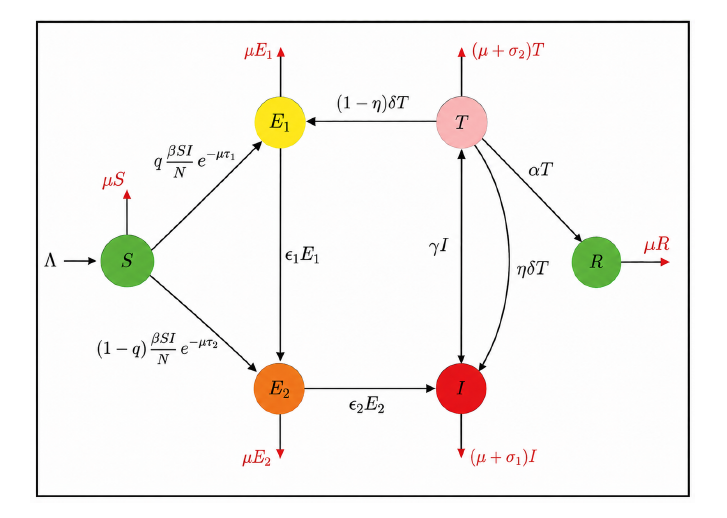
fig 1

Published

2026-08-12

How to Cite

A delay differential approach with sensitivity analysis for tuberculosis transmission and control. (2026). African Scientific Reports, 5(2), 565. https://doi.org/10.46481/asr.2026.5.2.565

Issue

Section

MATHEMATICAL SCIENCES SECTION

How to Cite

A delay differential approach with sensitivity analysis for tuberculosis transmission and control. (2026). African Scientific Reports, 5(2), 565. https://doi.org/10.46481/asr.2026.5.2.565

Similar Articles

81-90 of 103

You may also start an advanced similarity search for this article.