
A delay differential approach with sensitivity analysis for tuberculosis transmission and control
Keywords:
Tuberculosis, Basic reproduction number, Sensitivity analysis, Time-delay model, Infectious disease modelingAbstract
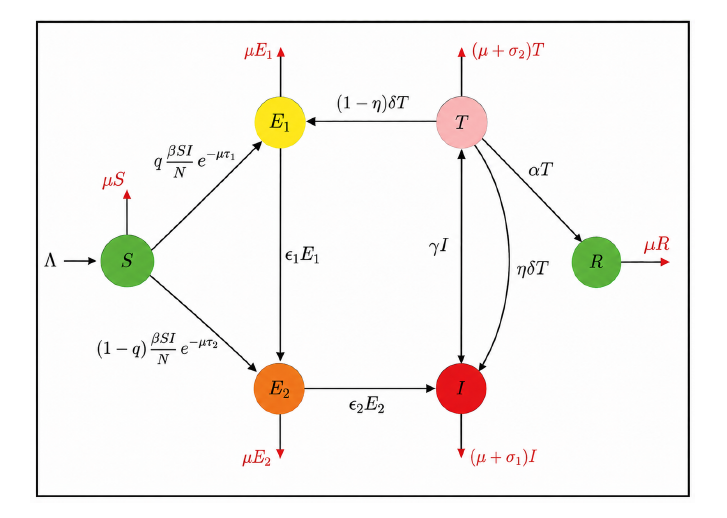
Tuberculosis (TB) is considered a severe disease and remains a serious public health problem in developing regions, especially in Khyber Pakhtunkhwa (KPK), Pakistan, where the failure to timely diagnose the disease, poor access to healthcare, poverty, and treatment interruptions significantly contribute to the disease's transmission and persistence. The main goal of this research is to investigate the transmission and control dynamics of TB using a nonlinear delayed compartmental mathematical model, with particular interest in the surge of TB in the KPK region. In view of the rising burden of TB in the region, this study proposes a nonlinear delayed compartmental mathematical model of the spread behavior of TB. The proposed model includes two biologically relevant time delays, those of latent disease progression and treatment monitoring mechanisms. The qualitative analysis of the model is rigorously investigated. The basic mathematical properties, including positivity, boundedness, and existence of solutions, are established. The threshold dynamics of the disease is determined by the basic reproduction number (mathcal{R}_0), which is computed by the next-generation matrix method, and the disease-free equilibrium (DFE) and endemic equilibrium (EE) points are derived. Moreover, the stability of the equilibrium states is examined by using Lyapunov techniques and stability theory both locally and globally. A sensitivity analysis is conducted to determine the most important epidemiological parameters defining the spread of TB. The results obtained reveal that low values of (mathcal{R}_0) are obtained when the transmission-associated parameters are low, whereas high values associated with treatment efficiency and the delay associated with the control mechanism lead to low transmission of the disease. In particular, it is shown that the presence of the second delay parameter related to the supervised treatment and monitoring shows a significant decrease in the effective (mathcal{R}_0), thus highlighting the need for continuous treatment monitoring and patient follow-up programs. Numerical simulation is carried out using the nonstandard finite difference (NSFD) method to validate the theoretical results. The NSFD scheme is able to maintain mathematical consistency of the model solutions for all the selected step sizes, leading to stable numerical behavior. The results of the simulations are also consistent with the DFE being achieved for (mathcal{R}_0 < 1) and the persistence of the disease for (mathcal{R}_0 > 1). This study's findings highlight the importance of early diagnosis, successful supervision of treatment, controlled drug utilization and ongoing patient monitoring to significantly reduce TB transmission in KPK, Pakistan. The delayed tuberculosis model might be helpful for designing more effective disease control and intervention strategies by healthcare authorities and policymakers. Moreover, this work advances biomathematical modeling by merging the incorporation of biologically relevant time lags and the use of rigorous stability, sensitivity and dynamically consistent numerical simulations in a coherent framework for modeling infectious diseases.
Published
How to Cite
Issue
Section
Copyright (c) 2026 Abidah Amir, Awais Ahmad, Shah Zeb, Siti Ainor Mohd Yatim, Farah Aini Abdullah

This work is licensed under a Creative Commons Attribution 4.0 International License.
How to Cite
Similar Articles
- E. Agboeze, N. P. Ani, E. O. Omeje, Extraction and Characterization of Pharmaceutical Grade Microcrystalline Cellulose From Bambara Nut (Voandzeia Subterranean (L) Thousars) Husk , African Scientific Reports: Volume 1, Issue 2, August 2022
- Ifeanyi Edozie Otuokere, Onyinye Uloma Akoh, Felix Chigozie Nwadire, Chinedum Ifeanyi Nwankwo, Joy Nwachukwu Egbucha, Chiemela Wisdom, Ogbonna Augustine Okwudiri, GC-MS Profiling and In Silico Studies to Identify Potential SARS-CoV-2 Nonstructural Protein Inhibitors from Psidium guajava , African Scientific Reports: Volume 1, Issue 3, December 2022
- Ezenwa Kelvin Iheanacho, Okenwa Uchenna Igwe, Princewill Ezenwa Ndubueze Onyemachi, GC-MS analysis and hypoglycemic properties of methanolic leaf extract of Cnidoscolus aconitifolius onalloxan-induced diabetic Wistar rats , African Scientific Reports: Volume 2, Issue 3, December 2023
- K. Issa, R. A. Bello, M. H. Sulaiman, Approximate solution of time-fractional non-linear parabolic equations arising in Mathematical Physics , African Scientific Reports: Volume 3, Issue 2, August 2024
- Justine Utsu Undiandeye, Moses Adah Agana, Towards strengthening edge computing security through stack protection mechanisms , African Scientific Reports: Volume 5, Issue 2, August 2026
- Ahmed Mahi Shuaibu, Bathymetric survey and volumetric analysis of Bakolori dam reservoir North West Nigeria , African Scientific Reports: Volume 3, Issue 2, August 2024
- J. E. Moyegbone, P. Onyema, O. C. Madubuattah, E. O. Emurotu, E. E. Oronsaye, P. T. Osunu, J. A. Ebeigbe, E. U. Nwose, Prevalence and driving-related factors influencing prediabetes and diabetes among commercial drivers in Benin City metropolis, Edo State, Nigeria , African Scientific Reports: Volume 5, Issue 1, April 2026
- Samson A. Aasa, Regan K. Dunne, Dawood A. Desai, Aspect ratio of thermo-hydraulic performance of periodically prescribed semi-circular groove in rectangular channel , African Scientific Reports: Volume 4, Issue 3, December 2025
- Akpaneno A. Francis, Ahmad Abdulhakim, Integrated geophysical, geochemical and remote sensing assessment of soil corrosion susceptibility in Sabon Gida, Katsina State, Northwestern Nigeria , African Scientific Reports: Volume 5, Issue 2, August 2026
- E. K. Ukpoko, I. S. Eneji, Q. M. Amua, R. A. Wuana, Analysis of some heavy metals in foodstuffs contaminated with pesticides using a developed spot-test method , African Scientific Reports: Volume 4, Issue 1, April 2025
You may also start an advanced similarity search for this article.