
A delay differential approach with sensitivity analysis for tuberculosis transmission and control
Keywords:
Tuberculosis, Basic reproduction number, Sensitivity analysis, Time-delay model, Infectious disease modelingAbstract
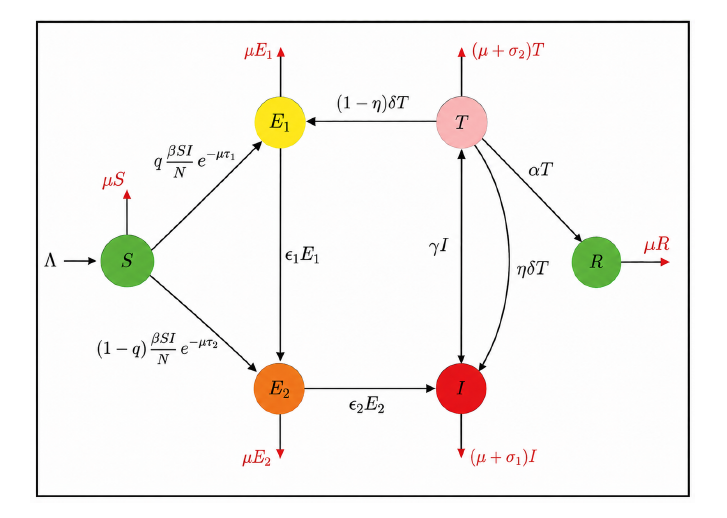
Tuberculosis (TB) is considered a severe disease and remains a serious public health problem in developing regions, especially in Khyber Pakhtunkhwa (KPK), Pakistan, where the failure to timely diagnose the disease, poor access to healthcare, poverty, and treatment interruptions significantly contribute to the disease's transmission and persistence. The main goal of this research is to investigate the transmission and control dynamics of TB using a nonlinear delayed compartmental mathematical model, with particular interest in the surge of TB in the KPK region. In view of the rising burden of TB in the region, this study proposes a nonlinear delayed compartmental mathematical model of the spread behavior of TB. The proposed model includes two biologically relevant time delays, those of latent disease progression and treatment monitoring mechanisms. The qualitative analysis of the model is rigorously investigated. The basic mathematical properties, including positivity, boundedness, and existence of solutions, are established. The threshold dynamics of the disease is determined by the basic reproduction number (mathcal{R}_0), which is computed by the next-generation matrix method, and the disease-free equilibrium (DFE) and endemic equilibrium (EE) points are derived. Moreover, the stability of the equilibrium states is examined by using Lyapunov techniques and stability theory both locally and globally. A sensitivity analysis is conducted to determine the most important epidemiological parameters defining the spread of TB. The results obtained reveal that low values of (mathcal{R}_0) are obtained when the transmission-associated parameters are low, whereas high values associated with treatment efficiency and the delay associated with the control mechanism lead to low transmission of the disease. In particular, it is shown that the presence of the second delay parameter related to the supervised treatment and monitoring shows a significant decrease in the effective (mathcal{R}_0), thus highlighting the need for continuous treatment monitoring and patient follow-up programs. Numerical simulation is carried out using the nonstandard finite difference (NSFD) method to validate the theoretical results. The NSFD scheme is able to maintain mathematical consistency of the model solutions for all the selected step sizes, leading to stable numerical behavior. The results of the simulations are also consistent with the DFE being achieved for (mathcal{R}_0 < 1) and the persistence of the disease for (mathcal{R}_0 > 1). This study's findings highlight the importance of early diagnosis, successful supervision of treatment, controlled drug utilization and ongoing patient monitoring to significantly reduce TB transmission in KPK, Pakistan. The delayed tuberculosis model might be helpful for designing more effective disease control and intervention strategies by healthcare authorities and policymakers. Moreover, this work advances biomathematical modeling by merging the incorporation of biologically relevant time lags and the use of rigorous stability, sensitivity and dynamically consistent numerical simulations in a coherent framework for modeling infectious diseases.
Published
How to Cite
Issue
Section
Copyright (c) 2026 Abidah Amir, Awais Ahmad, Shah Zeb, Siti Ainor Mohd Yatim, Farah Aini Abdullah

This work is licensed under a Creative Commons Attribution 4.0 International License.
How to Cite
Similar Articles
- Solomon Denen Igba, Idugba Mathias Echi, Emmanuel Vezua Tikyaa, Simulation of thermochemical effects on unsteady magneto hydrodynamics fluids flow in two dimensional nonlinear permeable media , African Scientific Reports: Volume 3, Issue 3, December 2024
- E. U. Chukwuegbo, E. Agboeze, C. C. Ogbuanu, S. Amujiogu, Effect of Phthalonitrile and Alum on Flame Retardation Properties of 100% Cotton Fabric , African Scientific Reports: Volume 1, Issue 2, August 2022
- Grace Adebayo-Gege, James Adiwu, Abednego Ovey Angbashim, Toyin Dorcas Alabi, Murtala Ngabea Audu , Frank Abimbola Ogundolie, Attenuation of indomethacin-induced gastric ulceration by methanolic extract of Cucumis Melo (L. indorous) seeds in male Wistar rats , African Scientific Reports: Volume 3, Issue 3, December 2024
- Taiwo Stephen Fayose, Kayode Ayinde, Olatayo Olusegun Alabi, M Robust Weighted Ridge Estimator in Linear Regression Model , African Scientific Reports: Volume 2, Issue 2, August 2023
- Abayomi Ajayi, Olaniyi Olayiwola, Fadeke Apantaku, Idowu Osinuga, Oluwaseun Wale-Orojo, Predicting the needs of people living with a disability using the two-level logit-skewed exponential power model , African Scientific Reports: Volume 3, Issue 2, August 2024
- Taiwo Stephen Fayose, Kayode Ayinde, Olatayo Olusegun Alabi, Abimbola Hamidu Bello, Robust weighted ridge regression based on S – estimator , African Scientific Reports: Volume 2, Issue 3, December 2023
- M. C. Owosen, A. W. Jik, D. D. Odonye, E. B. Ogundeji, Challenges and advances in anti-rabies vaccine development in sub-saharan Africa , African Scientific Reports: Volume 4, Issue 3, December 2025
- E. Agboeze, N. P. Ani, E. O. Omeje, Extraction and Characterization of Pharmaceutical Grade Microcrystalline Cellulose From Bambara Nut (Voandzeia Subterranean (L) Thousars) Husk , African Scientific Reports: Volume 1, Issue 2, August 2022
- Samson A. Aasa, Regan K. Dunne, Dawood A. Desai, Aspect ratio of thermo-hydraulic performance of periodically prescribed semi-circular groove in rectangular channel , African Scientific Reports: Volume 4, Issue 3, December 2025
- Justine Utsu Undiandeye, Moses Adah Agana, Towards strengthening edge computing security through stack protection mechanisms , African Scientific Reports: Volume 5, Issue 2, August 2026
You may also start an advanced similarity search for this article.