
Numerical optimization of photovoltaic performance of cesium titanium bromide perovskite solar cells using dual copper oxide hole transport layers

Authors

  • P. R. Jubu
    Africa Centre of Excellence in Future Energies and Electrochemical Systems (ACE-FUELS), Federal University of Technology Owerri (FUTO), P.M.B. 1526 Owerri, Imo State, Nigeria;
    Department of Industrial Physics, Joseph Sarwuan Tarka University Makurdi (Federal University of Agriculture Makurdi) P.M.B. 2373, Makurdi, Benue State, Nigeria
  • O. D. Abi
    Department of Physics, Joseph Sarwuan Tarka University P.M.B. 2373, Makurdi, Benue State, Nigeria
  • Z. S. Mbalaha
    Department of Industrial Physics, Joseph Sarwuan Tarka University Makurdi (Federal University of Agriculture Makurdi) P.M.B. 2373, Makurdi, Benue State, Nigeria
  • I. K. Nwokolo
    Africa Centre of Excellence in Future Energies and Electrochemical Systems (ACE-FUELS), Federal University of Technology Owerri (FUTO), P.M.B. 1526 Owerri, Imo State, Nigeria
  • A. O. Aransiola
    Africa Centre of Excellence in Future Energies and Electrochemical Systems (ACE-FUELS), Federal University of Technology Owerri (FUTO), P.M.B. 1526 Owerri, Imo State, Nigeria;
    Department of Electronic and Electrical Engineering, Obafemi Awolowo University, Ile-Ife, Nigeria
  • C. Amakom
    Africa Centre of Excellence in Future Energies and Electrochemical Systems (ACE-FUELS), Federal University of Technology Owerri (FUTO), P.M.B. 1526 Owerri, Imo State, Nigeria;
    Department of Physics, Federal University of Technology Owerri (FUTO), P.M.B. 1526 Owerri, Imo State, Nigeria
  • K. Udofia
    Africa Centre of Excellence in Future Energies and Electrochemical Systems (ACE-FUELS), Federal University of Technology Owerri (FUTO), P.M.B. 1526 Owerri, Imo State, Nigeria;
    Department of Physics, Akwa Ibom State University, Akwa Ibom State, Nigeria
  • A. A. Goje
    Africa Centre of Excellence in Future Energies and Electrochemical Systems (ACE-FUELS), Federal University of Technology Owerri (FUTO), P.M.B. 1526 Owerri, Imo State, Nigeria;
    Department of Applied Physics, Federal Polytechnic Damaturu, Nigeria
  • I. I. Ayogu
    Africa Centre of Excellence in Future Energies and Electrochemical Systems (ACE-FUELS), Federal University of Technology Owerri (FUTO), P.M.B. 1526 Owerri, Imo State, Nigeria
  • D. S. Igba
    Department of Industrial Physics, Joseph Sarwuan Tarka University Makurdi (Federal University of Agriculture Makurdi) P.M.B. 2373, Makurdi, Benue State, Nigeria
  • M. M. Gururani
    Department of Physics, M.B. Government P.G. College, Haldwani (Uttarakhand), India
  • E. E. Oguzie
    Africa Centre of Excellence in Future Energies and Electrochemical Systems (ACE-FUELS), Federal University of Technology Owerri (FUTO), P.M.B. 1526 Owerri, Imo State, Nigeria;
    Department of Chemistry, Federal University of Technology Owerri (FUTO), P.M.B. 1526 Owerri, Imo State, Nigeria

Keywords:

Cs2TiBr6 perovskite, Perovskite solar cell, Cu2O/CuO, HTL-free perovskite solar cell

Abstract

This work provides a comprehensive numerical evaluation by using SCAPS-1D software for designing efficient lead-free Cs2TiBr6-based perovskite solar cells (PSCs) based on all-inorganic carrier transport layers. The copper oxide hole transport layer (HTL) is introduced in the Cs2TiBr6-based PSC for the first time, recording a power conversion efficiency (PCE) that is superior to the values reported in the literature. The prototype FTO/CeOx/Cs2TiBr6/Cu2O/CuO/Au cell achieved a power conversion efficiency (PCE) of 8.67%. Optimization of several factors, including layer thickness, defect density, interface defect density, back metal contact, electron capture cross-section, and absorber bandgap, yielded an enhanced PCE of 30.75% for the optimized FTO/CeOx/Cs2TiBr6/Cu2O/CuO/Pt PSC. Simplified device architectures were investigated. The simple FTO/CeOx/Cs2TiBr6/Cu2O/Pt cell delivered a comparable PCE of 30.76%. The HTL-free FTO/CeOx/Cs2TiBr6/Pt design recorded a lower PCE of 22.32%. The optimized Cu2O/CuO HTL-assisted device exhibited robust thermal performance, with only a modest decrease in PCE (30.99% to 28.16%) with increasing temperature (290 K--400 K). The improved photovoltaic performance of the optimized HTL-assisted devices can be attributed to enhancement in light absorption and carrier generation. An increased built-in field and improved carrier collection also contributed to this improvement. The higher work function of Pt (5.7 eV) formed a better ohmic back contact with the optimized devices, further improving carrier collection.
Dimensions

[1] F. Zhou, Y. Zhang, J. Wu, W. Yang, X. Fang, T. Jia, Y. Ling, P. He, Q. Liu & J. Lin, “Utilizing Er-doped ZnIn₂S₄ for efficient photocatalytic CO₂ conversion”, Applied catalysis B 341 (2024) 123347. https://doi.org/10.1016/j.apcatb.2023.123347.

[2] P. R. Jubu, Z. S. Mbalaha, E. V. Tikyaa, O. S. Obaseki, K. O. Ighodalo, O. Adedokun, A. Nathan-Abutu, M. B. Ochang, Y. Yusof & M. Z. Pakhuruddin, “High-efficiency hole transport layer-free perovskite solar cells utilizing TiO₂, ZnO and bilayer TiO₂/ZnO electron transport layers: a simulation approach”, Next materials 9 (2025) 101166. https://doi.org/10.1016/j.nxmate.2025.101166.

[3] W. Lin, X. Chen, Z. Ji, W. Gao, N. Zhao, M. Li, D. Zhang, Y. Ling, J. Wu, K. Huang & J. Yu, “Optimization of Cs₂TiBr₆-based perovskite solar cells with double hole transport layer by SCAPS-1D simulation”, Materials today communications 46 (2025) 112841. https://doi.org/10.1016/j.mtcomm.2025.112841.

[4] M. K. Hossain, S. Islam, M. N. Sakib, M. S. Uddin, G. F. I. Toki, M. H. K. Rubel, J. Nasrin, S. H. Shahatha & M. R. Mohammad, “Exploring the optoelectronic and photovoltaic characteristics of lead-free Cs₂TiBr₆ double perovskite solar cells: a DFT and SCAPS-1D investigation”, Advanced electronic materials 11 (2025) 2400348. https://doi.org/10.1002/aelm.202400348.

[5] P. R. Jubu, M. K. Omar & M. Z. Pakhuruddin, “High-efficiency p-InGaN/n-InGaN single homojunction solar cell derived by numerical simulation”, Physica scripta 100 (2025) 1. https://doi.org/10.1088/1402-4896/ade74b.

[6] R. Sen & M. Yadav, “Efficient design and fabrication of Cs₂TiBr₆-based HTL-based solar cells”, Journal of electronic materials 53 (2024) 1975. https://doi.org/10.1007/s11664-024-10929-w.

[7] S. Gupta, J. Kaur, R. Basu, A. K. Sharma, R. Pandey & J. Madan, “Lead-free Cs₂TiBr₆ perovskite solar cells achieving high power conversion efficiency through device simulation”, Micro and nanostructures 196 (2024) 207991. https://doi.org/10.1016/j.micrna.2024.207991.

[8] M. Chen, A. D. Carl, Y. Zong, R. L. Grimm, J. Gu, X. -C. Zeng & N. P. Padture, “Cesium titanium (IV) bromide thin films based stable lead-free perovskite solar cells”, Joule 2 (2018) 558. https://doi.org/10.1016/j.joule.2018.01.009.

[9] H. Karmaker, A. Siddique & B. K. Das, “Numerical investigation of lead-free Cs₂TiBr₆-based perovskite solar cell with optimal selection of electron and hole transport layer through SCAPS-1D simulation”, Results in optics 13 (2023) 100571. https://doi.org/10.1016/j.rio.2023.100571.

[10] G. K. Grandhi, A. Matuhina, M. Liu, S. Annurakshita, H. Ali-Löytty, G. Bautista & P. Vivo, “Lead-free cesium titanium bromide double perovskite nanocrystals”, Nanomaterials 11 (2021) 1458. https://doi.org/10.3390/nano11061458.

[11] P. A. M. Mercy & K. S. J. Wilson, “Development of environmentally friendly high-performance Cs₂TiBr₆-based perovskite solar cell using numerical simulation”, Applied surface science advances 15 (2023) 100394. https://doi.org/10.1016/j.apsadv.2023.100394.

[12] E. Danladi, D. S. Dogob, S. U. Michael, F. O. Uloko & A. O. Salawu, “Recent advances in modeling of perovskite solar cells using SCAPS-1D: effect of absorber and ETM thickness”, East European journal of physics 4 (2021) 5. https://doi.org/10.26565/2312-4334-2021-4-01.

[13] Z. Xing, S. -H. Li, B. -S. Wu, X. Wang, L. -Y. Wang, T. Wang, H. -R. Liu, M. -L. Zhang, D. -Q. Yun, L. -L. Deng, S. -Y. Xie, R. -B. Huang & L. -S. Zheng, “Photovoltaic performance and stability of fullerene/cerium oxide double electron transport layer superior to single one in p-i-n perovskite solar cells”, Journal of power sources 389 (2018) 13. https://doi.org/10.1016/j.jpowsour.2018.03.079.

[14] E. Danladi, E. E. Oguzie & F. I. Ezema, “Highly efficient 25.562% Cs₂AgBiBr₆ double perovskite solar cell with copper barium tin sulfide and ZnO as charge transport channels: an intuition from a theoretical study using SCAPS-1D”, Journal of photonics for energy 15 (2025) 024501. https://doi.org/10.1117/1.JPE.15.024501.

[15] C. Lin, G. Liu, X. Xi, L. Wang, Q. Wang, Q. Sun, M. Li, B. Zhu, D. P. Lara & H. Zai, “The investigation of the influence of a Cu₂O buffer layer on hole transport layers in MAPbI₃-based perovskite solar cells”, Materials 15 (2022) 8142. https://doi.org/10.3390/ma15228142.

[16] F. Hazeghi, S. Mozaffari & S. M. B. Ghorashi, “Metal organic framework-derived core-shell CuO@NiO nanospheres as hole transport material in perovskite solar cell”, Journal of solid state electrochemistry 24 (2020) 1427. https://doi.org/10.1007/s10008-020-04643-w.

[17] Q. Y. Tey, W. C. Ng & M. N. Chong, “Surface and interface engineering of p-type Cu₂O-CuO heterostructures featuring innovative 2D-CuO nanoflake morphology on Cu₂O thin film for enhanced photoelectrochemical water splitting”, Applied surface science 716 (2026) 164622. https://doi.org/10.1016/j.apsusc.2025.164622.

[18] E. Danladi, L. F. Koao, T. E. Motaung & S. V. Motloung, “Defect control and performance optimization in Li$^{+}$/Na$^{+}$ co-doped HTL-based Cs₂AgBiBr₆ double perovskite solar cells: toward an efficient HTL-based architecture”, Journal of the Indian Chemical Society 103 (2026) 102453. https://doi.org/10.1016/j.jics.2026.102453.

[19] S. Wang, Z. Dong, H. Li & J. Zhang, “Defect passivation strategies in perovskite solar cells: roles, mechanisms and progress”, Journal of materials science 61 (2026) 7288. https://doi.org/10.1007/s10853-026-12248-3.

[20] D. Bai, D. Zheng, S. Yang, F. Yu, X. Zhu, L. Peng, L. Wang, J. Liu, D. Yang & S. Liu, “Surface modulation for highly efficient and stable perovskite solar cells”, RSC advances 13 (2023) 28097. https://doi.org/10.1039/D3RA00809F.

[21] T. Kirchartz, “Challenges and opportunities for the characterization of electronic properties in halide perovskite solar cells”, Chemical science 16 (2025) 8153. https://doi.org/10.1039/D5SC00504C.

[22] I. Levine, A. Al-Ashouri, A. Musiienko, H. Hempel, A. Magomedov, A. Drevilkauskaite, V. Getautis, D. Menzel, K. Hinrichs, T. Unold, S. Albrecht & T. Dittrich, “Charge transfer rates and electron trapping at buried interfaces of perovskite solar cells”, Joule 5 (2021) 2915. https://doi.org/10.1016/j.joule.2021.07.016.

[23] E. Danladi, P. R. Jubu, A. M. Tighezza, I. Hossain, N. N. Tasie, M. O. Abdulmalik, A. C. Egbugha, M. O. Awoji, M. Kashif, E. D. Onoja, M. I. Amanyi & E. E. Oguzie, “Highly efficient, hole transport layer (HTL)-free perovskite solar cell based on lithium-doped electron transport layer by device simulation”, Emergent materials 6 (2025) 1779. https://doi.org/10.1007/s42247-023-00558-0.

[24] E. Danladi, L. F. Obagboye, S. Aisida, F. I. Ezema, O. Okorie, J. A. Bwamba, P. A. Emmanuel, A. A. Hussaini, P. R. Jubu & A. C. Ozurumba, “20.730% highly efficient lead-free CsSnI₃-based perovskite solar cells with various charge transport materials: a SCAPS-1D study”, Multiscale and multidisciplinary modeling, experiments and design 8 (2025) 114. https://doi.org/10.1007/s41939-024-00701-2.

[25] M. Stolterfoht, P. Caprioglio, C. M. Wolff, J. A. Márquez, J. Nordmann, S. Zhang, D. Rothhardt, U. Hörmann, Y. Amir, A. Redinger, L. Kegelmann, F. Zu, S. Albrecht, N. Koch, T. Kirchartz, M. Saliba, T. Unold & D. Neher, “The impact of energy alignment and interfacial recombination on the internal and external open-circuit voltage of perovskite solar cells”, Energy & environmental science 12 (2019) 2778. https://doi.org/10.1039/C9EE02020A.

[26] A. Haddout, M. Fahoume, A. Qachaou, A. Raidou & M. Lharch, “Understanding effects of defects in bulk Cu₂ZnSnS₄ absorber layer of kesterite solar cells”, Solar energy 211 (2020) 301. https://doi.org/10.1016/j.solener.2020.09.067.

[27] T. Minami, Y. Nishi & T. Miyata, “Efficiency enhancement using a Zn₁₋xGex-O thin film as an n-type window layer in Cu₂O-based heterojunction solar cells”, Applied physics express 9 (2016) 052301. https://doi.org/10.7567/APEX.9.052301.

[28] P. Singh & N. M. Ravindra, “Temperature dependence of solar cell performance: an analysis”, Solar energy materials and solar cells 101 (2012) 36. https://doi.org/10.1016/j.solmat.2012.02.019.

[29] M. T. Lloyd, J. E. Anthony & G. G. Malliaras, “Photovoltaics from soluble small molecules”, Materials today 10 (2007) 34. https://doi.org/10.1016/S1369-7021(07)70277-8.

[30] S. S. Shin, B. W. Park, J. H. Noh & S. I. Seok, “Interlayer engineering in metal halide perovskite photovoltaics”, Nature photonics 20 (2026) 11. https://doi.org/10.1038/s41566-025-01809-8.

[31] M. K. Hossain, M. S. Uddin, G. F. I. Toki, M. K. A. Mohammed, R. Pandey, J. Madan, M. F. Rahman, M. R. Islam, S. Bhattarai, H. Bencherif, D. P. Samajdar, M. Amammi & D. K. Dwivedi, “Achieving above 24% efficiency with non-toxic CsSnI₃ perovskite solar cells by harnessing the potential of the absorber and charge transport layers”, RSC advances 13 (2023) 23514. https://doi.org/10.1039/D3RA02910G.

[32] S. Ahmed, F. Jannat, M. A. K. Khan & M. A. Alim, “Numerical development of eco-friendly Cs₂TiBr₆-based perovskite solar cell with all-inorganic charge transport materials via SCAPS-1D”, Optik 225 (2021) 165765. https://doi.org/10.1016/j.ijleo.2020.165765.

[33] S. M. Liga & G. Konstantatos, “Colloidal synthesis of lead-free Cs₂TiBr₆₋xIx perovskite nanocrystals”, Journal of materials chemistry C 9 (2021) 11098. https://doi.org/10.1039/D1TC01732B.

[34] C. Kupfer, J. Elia, M. Kato, A. Osvet & C. J. Brabec, “Mechanochemical synthesis of cesium titanium halide perovskites Cs₂TiBr₆₋xIx (x = 0, 2, 4, 6)”, Crystal research and technology 58 (2023) 2200150. https://doi.org/10.1002/crat.202200150.

[35] W. Shockley & H. J. Queisser, “Detailed balance limit of efficiency of p-n junction solar cells”, Journal of applied physics 32 (1961) 510. https://doi.org/10.1063/1.1736034.

[36] J. Wang, Z. Zheng, P. Bi, Z. Chen, Y. Wang, X. Liu, S. Zhang, X. Hao, M. Zhang & Y. Li, “Tandem organic solar cells with 20.6% efficiency enabled by reduced voltage losses”, National science review 10 (2023) nwad085. https://doi.org/10.1093/nsr/nwad085.

[37] M. Saadat & S. Bameri, “Comprehensive analysis of transport layers and interface defects in MAPbI₃-based PSCs for enhanced efficiency”, Discover applied sciences 7 (2025) 440. https://doi.org/10.1007/s42452-025-06948-9.

[38] S. Rühle, “Tabulated values of the Shockley–Queisser limit for single junction solar cells”, Solar energy 130 (2016) 139. https://doi.org/10.1016/j.solener.2016.02.015.

[39] P. R. Jubu, S. K. Omotayo, E. E. Oguzie, T. Imbur & M. Z. Pakhuruddin, “High-efficiency HTL-based i-n versus p-i-n InGaN single junction solar cells: a SCAPS-1D optimization study”, Next energy 11 (2026) 100540. https://doi.org/10.1016/j.nxener.2026.100540.

[40] H. Y. Najem, R. A. Rasool, M. N. Z. Mala & A. M. Saadi, “Temperature and spectral effects on perovskite solar cells: a SCAPS-1D simulation study”, International journal of design & nature and ecodynamics 20 (2025) 1449. https://doi.org/10.18280/ijdne.200702.

[41] E. Danladi, W. Mutah, P. R. Jubu, K. A. Ogunmoye, Z. L. Abubakar, D. A. Bala, N. N. Tasiu, A. Idris, F. Aungwa, M. I. Amanyi, E. Akpogumah, N. I. Noah & F. Ezema, “Photovoltaic performance of CsPbBr₃-based perovskite solar cell with TiO₂ and quaternary chalcogenide Cu₂FeSnS₄ as charge transport channels: unlocking $>$26% efficiency via SCAPS-1D investigation”, Next energy 9 (2025) 100423. https://doi.org/10.1016/j.nxener.2025.100423.

[42] P. K. Deendyal, S. Dhakla, R. Singla, A. Taya & M. K. Kashyap, “Perovskite solar cells without hole and electron transport layers”, in {it Perovskite solar cells: reshaping the future energy landscape}, M. Kumar & A. Raj (Eds.) Springer, Singapore, 2025, pp. 73 - 94. https://doi.org/10.1007/978-981-96-9463-1_4.

[43] M. A. Green, E. D. Dunlop, M. Yoshita, N. Kopidakis, K. Bothe, G. Siefer, X. Hao & J. Y. Jiang, “Solar cell efficiency tables (version 64)”, Progress in photovoltaics: research and applications 32 (2024) 425. https://doi.org/10.1002/pip.3831.

[44] H. Son & B. S. Jeong, “Optimization of the power conversion efficiency of CsPbIxBr1-x-based perovskite photovoltaic solar cells using ZnO and NiOx as an inorganic charge transport layer”, Applied sciences 12 (2022) 8987. https://doi.org/10.3390/app12188987.

[45] N. El Aallaoui, B. Oukarfi & M. Zazoui, “Numerical study of inorganic Cs₂TiBr₆ solar cells with double hole transport layers”, Materials today: proceedings 66 (2022) 122. https://doi.org/10.1016/j.matpr.2022.04.010.

[46] A. O. Aransiola, K. I. Udofia, C. Amakom, P. R. Jubu, I. K. Nwokolo, J. O. Anyanwu, O. O. Ilori & E. E. Oguzie, “From record efficiency to commercially viable modules: a commercialization framework for stability-driven translation of perovskite solar cells”, Next research 10 (2026) 1. https://doi.org/10.1016/j.nexres.2026.101856.

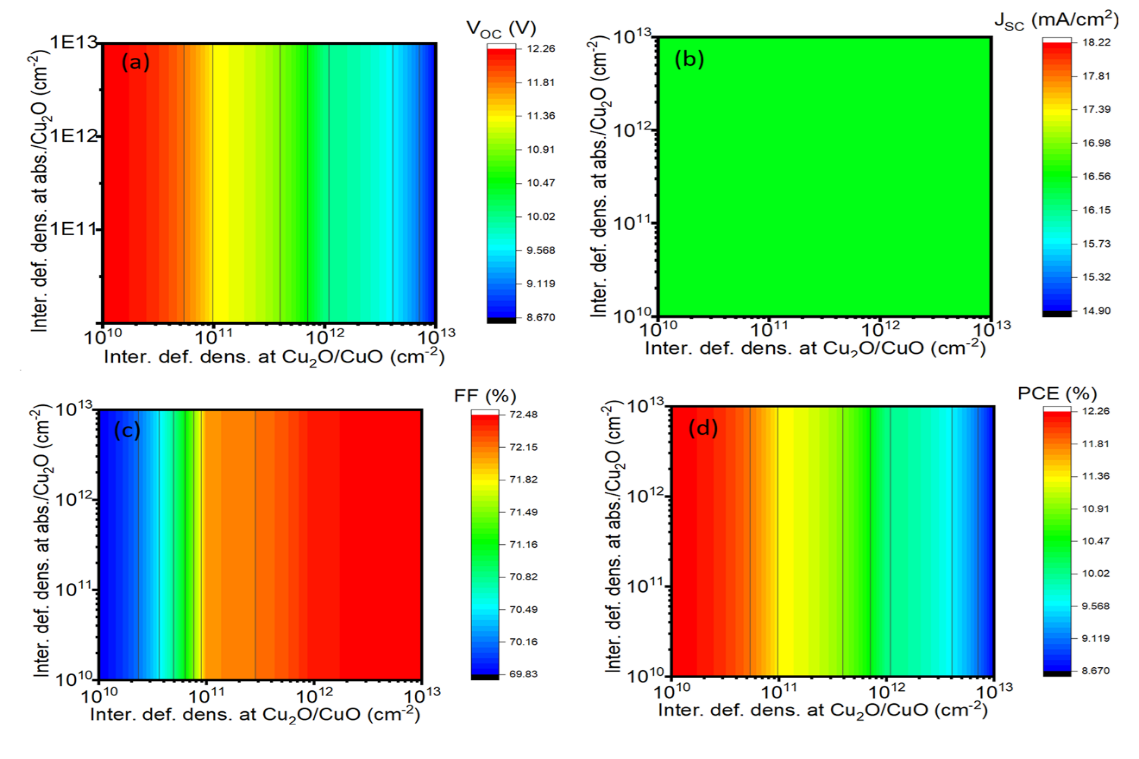
fig 10

Published

2026-07-20

How to Cite

Numerical optimization of photovoltaic performance of cesium titanium bromide perovskite solar cells using dual copper oxide hole transport layers. (2026). African Scientific Reports, 5(2), 488. https://doi.org/10.46481/asr.2026.5.2.488

Issue

Section

PHYSICS SECTION

How to Cite

Numerical optimization of photovoltaic performance of cesium titanium bromide perovskite solar cells using dual copper oxide hole transport layers. (2026). African Scientific Reports, 5(2), 488. https://doi.org/10.46481/asr.2026.5.2.488

Similar Articles

11-19 of 19

You may also start an advanced similarity search for this article.

Most read articles by the same author(s)