
Impact of level density models on the calculation of some theranostic radionuclides using EMPIRE code
Keywords:
EMPIRE 3.2.3, Medical radioisotopes, Level density models, Nuclear reaction cross sectionsAbstract
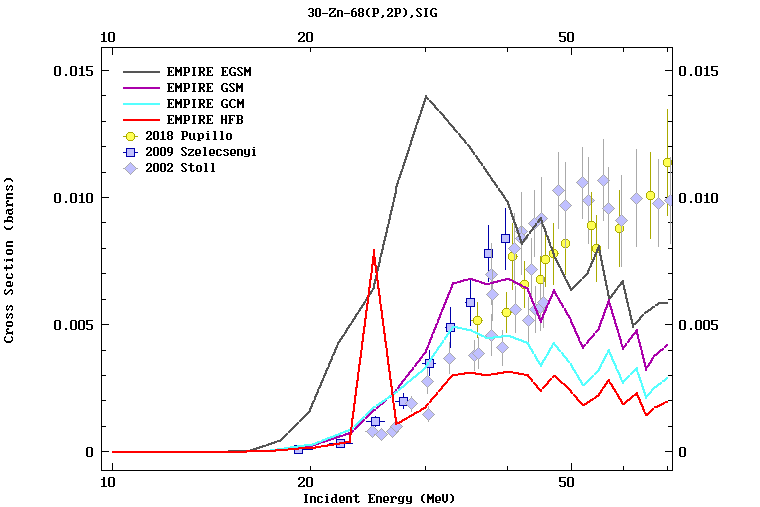
Radioisotopes such as 67Cu, 131I, and 99mTc are used in nuclear medicine for diagnostic and therapeutic (theranostic) applications. Cross-section data for the nuclear reactions that produce these radioisotopes are essential for efficient production; however, experimental cross-section data remain limited for these isotopes. The reaction cross sections of the radioisotopes 67Cu, 131I, and 99mTc were evaluated using the nuclear reaction model code EMPIRE 3.2.3. The influence of nuclear level density (NLD) models on energy-dependent cross-section calculations was investigated for the reactions 68Zn(p,2p)67Cu, 70Zn(p,alpha)67Cu, 130Te(d,n)131I, 100Mo(p,2n)99mTc, and 100Mo(n,2n)99Mo within an energy range from threshold to 70 MeV. Calculated energy-dependent cross-section functions were benchmarked against experimental data from the EXFOR database and evaluated nuclear data from International Atomic Energy Agency (IAEA) libraries. The results show clear sensitivity of the predicted cross sections to the selected NLD model. The cross-sections predicted by the nuclear level density models that showed the best agreement with the experimental data were 32 MeV (6.80 mb) for 68Zn(p,2p)67Cu, 17 MeV (17.79 mb) for 70Zn(p,alpha)67Cu, 12 MeV (99.94 mb) for 130Te(d,n)131I, and 18 MeV for both 100Mo(p,2n)99mTc (994.78 mb) and 100Mo(n,2n)99Mo (1500 mb). Radionuclidic purity indices ranged from 1.93% to 17.27%, depending on the reaction channel. These results demonstrate the reliability of EMPIRE 3.2.3 for predicting cross sections and provide useful nuclear data for radionuclide production.
References
[1] S. C. Vaz, F. Oliveira, K. Herrmann & P. Veit-Haibach, ``Nuclear medicine and molecular imaging advances in the 21st century'', British Journal of Radiology 93 (2020) 20200095. https://doi.org/10.1259/bjr.20200095.
[2] S. M. Qaim, ``Nuclear data relevant to the production and application of diagnostic radionuclide'', Radiochimica Acta 89 (2001) 223. https://doi.org/10.1524/ract.2001.89.4-5.223.
[3] W. D. Loveland, D. J. Morrissey & G. T. Seaborg, Modern nuclear chemistry, Wiley-Interscience, Hoboken, NJ, USA, 2006. https://doi.org/10.1002/0471768626.
[4] T. T. Böhlen, F. Cerutti, M. P. W. Chin, A. Fassò, A. Ferrari, P. G. Ortega, A. Mairani, P. R. Sala, G. Smirnov & V. Vlachoudis, ``The FLUKA code: developments and challenges for high energy and medical applications'', Nuclear Data Sheets 120 (2014) 211. https://doi.org/10.1016/j.nds.2014.07.049.
[5] A. B. Olorunsola, J. A. Bamikole, A. A. Bello & O. O. Ige, ``Theoretical prediction of neutron-induced radiative capture cross section of some isotopes of minor actinides'', Journal of Nuclear and Radiation Sciences 2 (2023) 1. http://dx.doi.org/10.5455/jnrs.2023.01.001.
[6] D. A. Brown, M. B. Chadwick, R. Capote, A. C. Kahler, A. Trkov, M. W. Herman, A. A. Sonzogni, Y. Danon, A. D. Carlson, M. Dunn, D. L. Smith, G. M. Hale, G. Arbanas, R. Arcilla, C. R. Bates, B. Beck, B. Becker, F. Brown, R. J. Casperson, J. Conlin, D. E. Cullen, M.-A. Descalle, R. Firestone, T. Gaines, K. H. Guber, A. I. Hawari, J. Holmes, T. D. Johnson, T. Kawano, B. C. Kiedrowski, A. J. Koning, S. Kopecky, L. Leal, J. P. Lestone, C. Lubitz, J. I. Márquez Damián, C. M. Mattoon, E. A. McCutchan, S. Mughabghab, P. Navratil, D. Neudecker, G. P. A. Nobre, G. Noguere, M. Paris, M. T. Pigni, A. J. Plompen, B. Pritychenko, V. G. Pronyaev, D. Roubtsov, D. Rochman, P. Romano, P. Schillebeeckx, S. Simakov, M. Sin, I. Sirakov, B. Sleaford, V. Sobes, E. S. Soukhovitskii, I. Stetcu, P. Talou, I. Thompson, S. van der Marck, L. Welser-Sherrill, D. Wiarda, M. White, J. L. Wormald, R. Q. Wright, M. Zerkle, G. Žerovnik & Y. Zhu, ``ENDF/B-VIII.0: The 8th major release of the nuclear reaction data library with CIELO-project cross sections, new standards and thermal scattering data'', Nuclear Data Sheets 148 (2018) 1. https://doi.org/10.1016/j.nds.2018.02.001.
[7] A. Koning, S. Hilaire & S. Goriely, ``TALYS: Modeling of nuclear reactions,'' The European Physical Journal A 59 (2023) 131. https://doi.org/10.1140/epja/s10050-023-01034-3.
[8] A. J. Koning & D. Rochman, ``Modern nuclear data evaluation with the TALYS code system'', Nuclear Data Sheets 113 (2012) 2841. https://doi.org/10.1016/j.nds.2012.11.002.
[9] W. Hauser & H. Feshbach, ``The inelastic scattering of neutrons'', Physical Review 87 (1952) 366. https://doi.org/10.1103/PhysRev.87.366.
[10] A. Gilbert & A. G. W. Cameron, ``A composite nuclear-level density formula with shell corrections,'' Canadian Journal of Physics 43 (1965) 1446. https://doi.org/10.1139/p65-139.
[11] A. V. Ignatyuk, G. N. Smirenkin & A. S. Tishin, ``Phenomenological description of the energy dependence of the level density parameter,'' Soviet Journal of Nuclear Physics 21 (1975) 255. https://doi.org/10.1007/BF01125206.
[12] S. Goriely, S. Hilaire & A. J. Koning, ``Improved microscopic nuclear level densities within the Hartree--Fock--Bogoliubov plus combinatorial method'', Physical Review C 78 (2008) 064307. https://doi.org/10.1103/PhysRevC.78.064307.
[13] H. A. Bethe, ``Nuclear Physics B. Nuclear Dynamics, Theoretical,'' Reviews of Modern Physics 9 (1937) 69. https://doi.org/10.1103/RevModPhys.9.69.
[14] S. Takács, Z. Szűcs, F. Tárkányi, A. Hermanne & M. Sonck, ``Evaluation of proton-induced reactions on $^{100}$Mo: new cross sections for production of $^{99mathrm{m}}$Tc and $^{99}$Mo'', Journal of Radioanalytical and Nuclear Chemistry 257 (2003) 195. https://doi.org/10.1023/A:1024790520036.
Published
How to Cite
Issue
Section
Copyright (c) 2026 Matthew Inalegwu Amanyi, Umaru Ibrahim, Kolo Matthew

This work is licensed under a Creative Commons Attribution 4.0 International License.