
Environmental exposure and health risk assessment of particulate-associated heavy metals from medical waste incineration

Authors

  • O. O. Oketayo
    Department of Physics, Federal University Oye-Ekiti, Oye-Ekiti, Nigeria
  • E. E. Osara
    Department of Physics, Federal University Oye-Ekiti, Oye-Ekiti, Nigeria
  • A. E. Odo
    Department of Physics, Federal University Oye-Ekiti, Oye-Ekiti, Nigeria
  • O. P. Idowu
    Department of Physics, Federal University Oye-Ekiti, Oye-Ekiti, Nigeria
  • O. J. Oluwadare
    Department of Physics, Federal University Oye-Ekiti, Oye-Ekiti, Nigeria
  • M. M. Orosun
    Institute of Environmental Radioactivity, Fukushima University, Fukushima, Japan

Keywords:

Particulate-associated heavy metals, Medical waste incineration, Environmental exposure, FAAS

Abstract

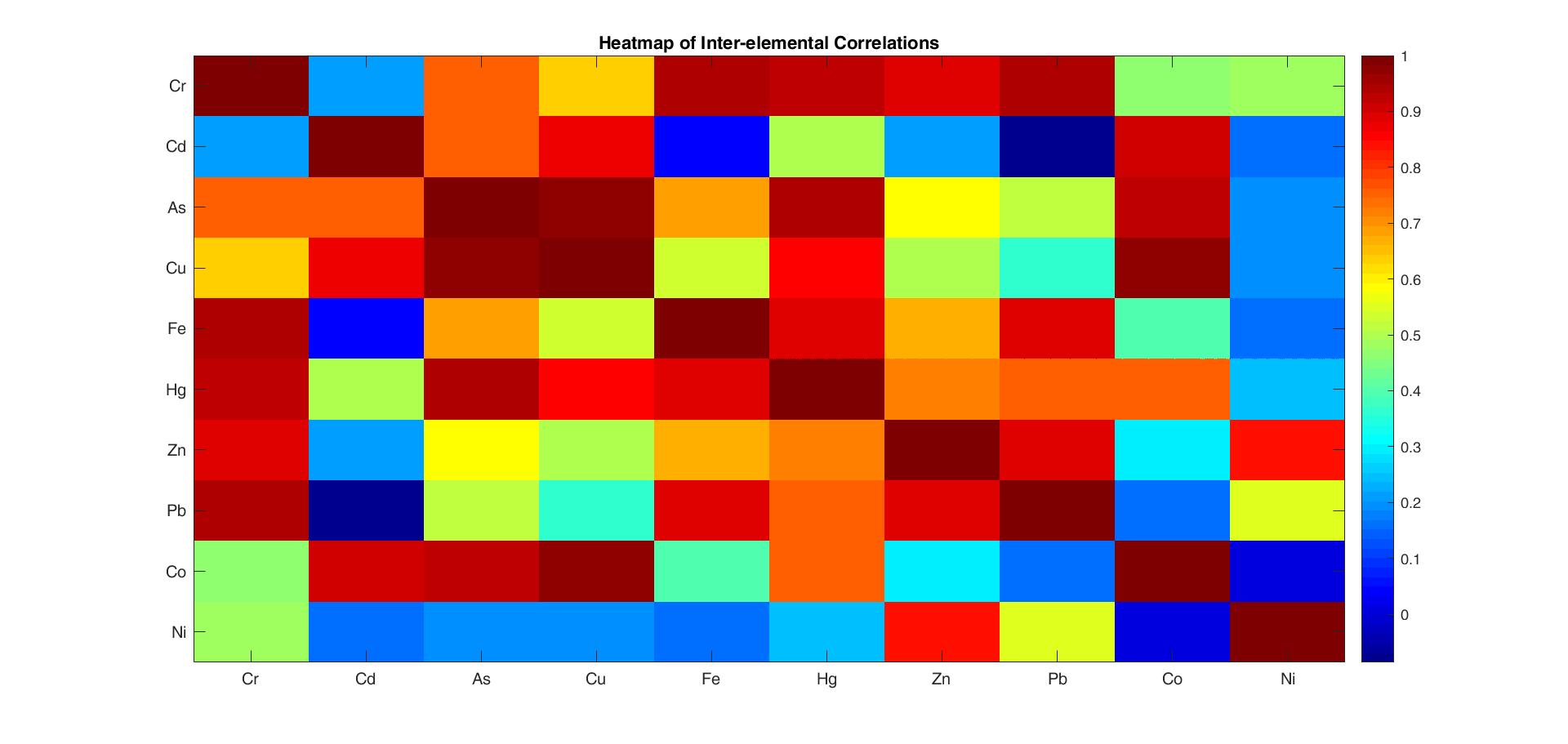
Incineration, a widely adopted waste-management strategy, poses significant health and environmental risks because of the continuous emission of heavy metals (HMs). In this study, the levels of ten HMs (Zn, Fe, Cu, Cr, Cd, As, Ni, Co, Pb, and Hg) were determined in particulate matter around a hospital incineration facility using flame atomic absorption spectrometry (FAAS). HM concentrations ranged from 0.059 to 0.330 mg kg-1 in the descending order Zn > Fe > Cu > Cr > Cd > As > Ni > Co > Pb > Hg. Statistical analysis confirmed significant differences between the exposed sites and the control baseline (p < 0.05). The mean levels of Ni, As, Cd, Hg, Pb, and Cr (0.120, 0.1216, 0.1440, 0.0592, 0.0704, and 0.2192 mg kg-1, respectively) exceeded World Health Organization limits, indicating potential ecological and public health risks. Strong positive correlations (p < 0.01) were obtained between specific metal pairs (As--Pb: r = 0.864; Hg--Cd: r = 0.517; Ni--Pb: r = 0.670; Pb--Cr: r = 0.983), suggesting common emission sources and synergistic environmental effects. Several other metals also exhibited strong positive correlations, including Cr--Co, Cr--Pb, Cd--Ni, As--Ni, Cu--Co, and Pb--Co (r > 0.70). These associations reiterate multiple common exposure pathways among workers occupationally exposed to the hospital incinerator. These findings highlight the need for enhanced regulatory frameworks and mitigation strategies to address pollution, safeguard public health, and promote sustainable waste management in this environment.
Dimensions

[1] L. Liang, Z. Wang & J. Li, ``The effect of urbanization on environmental pollution in rapidly developing urban agglomerations'', Journal of Cleaner Production 237 (2019) 117649. https://doi.org/10.1016/j.jclepro.2019.117649.

[2] P. Yu, Y. Wei, L. Ma, B. Wang, E. H. K. Yung & Y. Chen, ``Urbanization and the urban critical zone'', Earth Critical Zone 1 (2024) 100011. https://doi.org/10.1016/j.ecz.2024.100011.

[3] B. Parkes, A. L. Hansell, R. E. Ghosh, P. Douglas, D. Fecht, D. Wellesley, J. J. Kurinczuk, J. Rankin, K. de Hoogh, G. W. Fuller, P. Elliott & M. B. Toledano, ``Risk of congenital anomalies near municipal waste incinerators in England and Scotland: Retrospective population-based cohort study'', Environment International 134 (2020) 104845. https://doi.org/10.1016/j.envint.2019.05.039.

[4] M. El-Sharkawy, M. O. Alotaibi, J. Li, D. Du & E. Mahmoud, ``Heavy metal pollution in coastal environments: Ecological implications and management strategies: A review'', Sustainability 17 (2025) 701. https://doi.org/10.3390/su17020701.

[5] A. Alengebawy, S. T. Abdelkhalek, S. R. Qureshi & M. Q. Wang, ``Heavy metals and pesticides toxicity in agricultural soil and plants: Ecological risks and human health implications'', Toxics 9 (2021) 42. https://doi.org/10.3390/toxics9030042.

[6] J. M. Chisholm, R. Zamani, A. M. Negm, N. Said, M. M. Abdel daiem, M. Dibaj & M. Akrami, ``Sustainable waste management of medical waste in African developing countries: A narrative review'', Waste Management & Research 39 (2021) 1149. https://doi.org/10.1177/0734242X211029175.

[7] C. Wang, N. Shao, J. Xu, Z. Zhang & Z. Cai, ``Pollution emission characteristics, distribution of heavy metals, and particle morphologies in a hazardous waste incinerator processing phenolic waste'', Journal of Hazardous Materials 388 (2020) 121751. https://doi.org/10.1016/j.jhazmat.2019.121751.

[8] J. Awewomom, F. Dzeble, Y. D. Takyi, W. B. Ashie, E. N. Ettey, P. E. Afua, L. N. Sackey, F. Opoku & O. Akoto, ``Addressing global environmental pollution using environmental control techniques: A focus on environmental policy and preventive environmental management'', Discover Environment 2 (2024) 8. https://doi.org/10.1007/s44274-024-00033-5.

[9] T. H. Tulchinsky & E. A. Varavikova, ``Environmental and occupational health'', in The New Public Health, 3rd ed., Academic Press, 2014, p. 471. https://doi.org/10.1016/B978-0-12-415766-8.00009-4.

[10] H. Ali, E. Khan & I. Ilahi, ``Environmental chemistry and ecotoxicology of hazardous heavy metals: Environmental persistence, toxicity, and bioaccumulation'', Journal of Chemistry 2019 (2019) 6730305. https://doi.org/10.1155/2019/6730305.

[11] M. K. Elnabi, N. E. Elkaliny, M. M. Elyazied, S. H. Azab, S. A. Elkhalifa, S. Elmasry, M. S. Mouhamed, E. M. Shalamesh, N. A. Alhorieny, A. E. Abd Elaty, I. M. Elgendy, A. E. Etman, K. E. Saad, K. Tsigkou, S. S. Ali, M. Kornaros & Y. A.-G. Mahmoud, ``Toxicity of heavy metals and recent advances in their removal: A review'', Toxics 11 (2023) 580. https://doi.org/10.3390/toxics11070580.

[12] P. K. Gupta, ``Target organ toxicity'', in Problem Solving Questions in Toxicology, Springer, 2020, p. 83. https://doi.org/10.1007/978-3-030-50409-0_7.

[13] T. Sanders, Y. Liu, V. Buchner & P. B. Tchounwou, ``Neurotoxic effects and biomarkers of lead exposure: A review'', Reviews on Environmental Health 24 (2009) 15. https://doi.org/10.1515/REVEH.2009.24.1.15.

[14] G. Genchi, G. Lauria, A. Catalano, A. Carocci & M. S. Sinicropi, ``Arsenic: A review on a great health issue worldwide'', Applied Sciences 12 (2022) 6184. https://doi.org/10.3390/app12126184.

[15] F. Qu & W. Zheng, ``Cadmium exposure: Mechanisms and pathways of toxicity and implications for human health'', Toxics 12 (2024) 388. https://doi.org/10.3390/toxics12060388.

[16] P. Yu, Y. Han, M. Wang, Z. Zhu, Z. Tong, X. Shao, J. Peng, Y. Hamid, X. Yang, Y. Deng & Y. Huang, ``Heavy metal content and health risk assessment of atmospheric particles in China: A meta-analysis'', Science of the Total Environment 867 (2023) 161556. https://doi.org/10.1016/j.scitotenv.2023.161556.

[17] B. Hamidinasab & A. Nabavi-Pelesaraei, ``Systematic review on environmental impact assessment of incineration technologies'', Energy Conversion and Management: X 26 (2025) 101039. https://doi.org/10.1016/j.ecmx.2025.101039.

[18] J. N. Okorondu, V. A. Agidi, C. Nwaogu, B. E. Diagi, S. I . Ajiere & B. Alabi, ``Solid waste management practices in Sub-Saharan Africa and its impact on climate change and planetary health'', in Climate Change Management, Springer, 2024, p. 131. https://doi.org/10.1007/978-3-031-72740-5_7.

[19] E. A. Cohen Hubal, T. de Wet, L. Du Toit, M. P. Firestone, M. Ruchirawat, J. J. van Engelen & C. Vickers, ``Identifying important life stages for monitoring and assessing risks from exposures to environmental contaminants: Results of a World Health Organization review'', Regulatory Toxicology and Pharmacology 69 (2014) 113. https://doi.org/10.1016/j.yrtph.2013.09.008.

[20] O. J. Oyebode, C. C. Okpala, S. M. Ajibade, N. M. Ogarekpe, S. A. Afolalu, A. O. Coker, S. G. Udeagbara & A. T. Adeniyi, ``Comparative assessment of medical waste management in multi-system and selected teaching hospitals in Ekiti State, Nigeria'', Nature Environment and Pollution Technology 22 (2023) 653. https://doi.org/10.46488/NEPT.2023.v22i02.009.

[21] A. Al Mamun, I. Cheng, L. Zhang, E. Dabek-Zlotorzynska & J. P. Charland, ``Overview of size distribution, concentration, and dry deposition of airborne particulate elements measured worldwide'', Environmental Reviews 28 (2020) 77. https://doi.org/10.1139/er-2019-0035.

[22] J. O. Ogunbileje, V. M. Sadagoparamanujam, J. I. Anetor, E. O. Farombi, O. M. Akinosun & A. O. Okorodudu, ``Lead, mercury, cadmium, chromium, nickel, copper, zinc, calcium, iron, manganese and chromium(VI) levels in Nigeria and United States of America cement dust'', Chemosphere 90 (2013) 2743. https://doi.org/10.1016/j.chemosphere.2012.11.058.

[23] M. T. Sabiha-Javied & S. Khalid, ``Heavy metal pollution from medical waste incineration at Islamabad and Rawalpindi, Pakistan'', Microchemical Journal 90 (2008) 77. https://doi.org/10.1016/j.microc.2008.03.010.

[24] N. Wang, Q. Guan, Y. Sun, B. Wang, Y. Ma, W. Shao & H. Li, ``Predicting the spatial pollution of soil heavy metals by using the distance determination coefficient method'', Science of the Total Environment 799 (2021) 149452. https://doi.org/10.1016/j.scitotenv.2021.149452.

[25] S. C. Ibeneme, R. N. Ativie, G. C. Ibeneme, H. Myezwa, A. D. Ezuma, A. Nnamani, S. Ezeofor, M. J. Nwankwo, T. U. Ettu, A. O. Nwosu, I. J. Okoye & G. Fortwengel, ``Evidence of seasonal changes in airborne particulate matter concentration and occupation-specific variations in pulmonary function and haematological parameters among some workers in Enugu Southeast Nigeria: a randomized cross-sectional observational study'', Archives of Public Health 80 (2022) 213. https://doi.org/10.1186/s13690-022-00967-3.

[26] M. U. Uwem, ``Heavy metals pollution of soil around solid waste dumpsites in Abuja Metropolis'', Asian Journal of Applied Chemistry Research 16 (2025) 1. https://doi.org/10.9734/ajacr/2025/v16i2323.

[27] A. Honest, S. V. Manyele, J. A. Saria & J. Mbuna, ``Assessment of the heavy metal levels in the incinerators bottom-ash from different hospitals in Dar es Salaam'', African Journal of Environmental Science and Technology 14 (2020) 347. https://doi.org/10.5897/AJEST2020.2891.

[28] M. Adama, R. Esena, B. Fosu-Mensah & D. Yirenya-Tawiah, ``Heavy metal contamination of soils around a hospital waste incinerator bottom ash dumps site'', Journal of Environmental and Public Health 2016 (2016) 8926453. https://doi.org/10.1155/2016/8926453.

[29] Occupational Safety and Health Administration, Occupational safety and health standards: Cadmium, 29 CFR 1910.1027, U.S. Department of Labor, Washington, DC, USA, 2007. https://www.osha.gov/laws-regs/regulations/standardnumber/1910/1910.1027.

[30] National Institute for Occupational Safety and Health, NIOSH pocket guide to chemical hazards, U.S. Department of Health and Human Services, Centers for Disease Control and Prevention, Cincinnati, USA, 2007. https://doi.org/10.26616/NIOSHPUB2005149.

[31] World Health Organization, Air quality guidelines for Europe, 2nd ed., WHO Regional Publications, European Series, No. 91, WHO Regional Office for Europe, Copenhagen, Denmark, 2000. https://www.who.int/publications/i/item/9789289013581.

[32] Occupational Safety and Health Administration, Occupational safety and health standards: Toxic and hazardous substances, 29 CFR 1910.1000, U.S. Department of Labor, Washington, DC, USA, 2004. https://www.osha.gov/laws-regs/regulations/standardnumber/1910/1910.1000.

[33] Occupational Safety and Health Administration, Occupational safety and health standards: Air contaminants, 29 CFR 1910.1000, Table Z-1, U.S. Department of Labor, Washington, DC, USA, 1999. https://www.osha.gov/laws-regs/regulations/standardnumber/1910/1910.1000TABLEZ1.

[34] Occupational Safety and Health Administration, Occupational safety and health standards: Lead, 29 CFR 1910.1025, U.S. Department of Labor, Washington, DC, USA, 2019. https://www.osha.gov/laws-regs/regulations/standardnumber/1910/1910.1025.

[35] S. S. Sheriff, A. A. Yusuf, O. O. Akiyode, E. F. Hallie, S. Odoma, R. A. Yambasu, K. Thompson-William, C. Asumana, S. Z. Gono & M. A. Kamara, ``A comprehensive review on exposure to toxins and health risks from plastic waste: Challenges, mitigation measures, and policy interventions'', Waste Management Bulletin 3 (2025) 100204. https://doi.org/10.1016/j.wmb.2025.100204.

[36] O. O. Oketayo, S. D. Olaniyan, O. P. Idowu, O. Ojo & J. Oladepo, ``Assessment of some heavy metals in soil samples around identified metal workshops in Otun-Ekiti, Nigeria'', Water and Environment Sustainability 4 (2024) 28. Available online: https://www.journalwes.com/article_184769.html.

[37] M. M. Abd El-Salam, ``Hospital waste management in El-Beheira Governorate, Egypt'', Journal of Environmental Management 91 (2010) 618. https://doi.org/10.1016/j.jenvman.2009.08.012.

[38] M. R. Dsouza, K. M. Naji, M. K. Ramaiah & S. J. Patil, ``Revolutionizing biomedical waste management: Embracing innovative technologies for a healthier future'', in Solid Waste Management: A Roadmap for Sustainable Environmental Practices and Circular Economy, Springer, 2025, p. 173. https://doi.org/10.1007/978-3-031-78420-0_8.

[39] P. B. Tchounwou, C. G. Yedjou, A. K. Patlolla & D. J. Sutton, ``Heavy metals toxicity and the environment'', EXS 101 (2012) 133. https://doi.org/10.1007/978-3-7643-8340-4_6.

[40] J. Huff, R. M. Lunn, M. P. Waalkes, L. Tomatis & P. F. Infante, ``Cadmium-induced cancers in animals and in humans'', International Journal of Occupational and Environmental Health 13 (2007) 202. https://doi.org/10.1179/oeh.2007.13.2.202.

[41] R. A. Bernhoft, ``Mercury toxicity and treatment: A review of the literature'', Journal of Environmental and Public Health 2012 (2012) 460508. https://doi.org/10.1155/2012/460508.

[42] S. Singh & N. L. Devi, ``Heavy metal pollution in atmosphere from vehicular emission'', in Heavy Metal Toxicity: Environmental Concerns, Remediation Opportunities, Springer, 2023, p. 183. https://doi.org/10.1007/978-981-99-0397-9_9.

fig 1

Published

2026-06-10

How to Cite

Environmental exposure and health risk assessment of particulate-associated heavy metals from medical waste incineration. (2026). African Scientific Reports, 5(2), 439. https://doi.org/10.46481/asr.2026.5.2.439

Issue

Section

PHYSICS SECTION

How to Cite

Environmental exposure and health risk assessment of particulate-associated heavy metals from medical waste incineration. (2026). African Scientific Reports, 5(2), 439. https://doi.org/10.46481/asr.2026.5.2.439

Similar Articles

11-20 of 52

You may also start an advanced similarity search for this article.

Most read articles by the same author(s)