
Numerical evaluation of energy shifts due to dipole moments interaction in a hydrogen atom
Keywords:
Numerical methods, Energy shifts, Hydrogen atom, Wave function, Dipole-dipole interaction and Stark effectAbstract
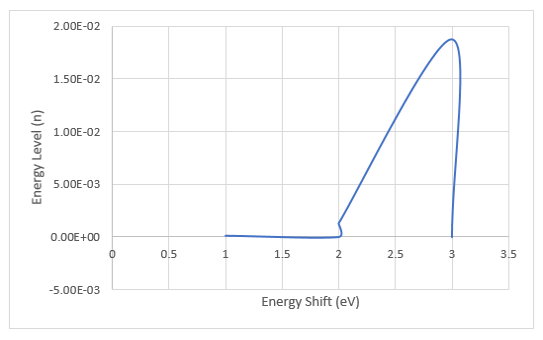
This study aimed to numerically investigate the impact of dipole-dipole interactions on the energy levels of a hydrogen atom, specifically the energy shift caused by the interaction of the atom's dipole moment with external electric fields. This research involved applying perturbation theory and numerical techniques to quantify the changes in energy levels due to dipole orientations and magnitudes, contributing to a deeper understanding of atomic behavior and its implications in various scientific disciplines. The results presented showed that the wavefunction of the hydrogen atom exhibits degeneracy, especially n=2, n=3 states. This implies that n=2, n=3, have different states but the same energy as a result of the subshells with angular momentum l, which contains 2l+1 distinct state corresponding to positive value of m (magnetic angular momentum quantum number) m=-l±1. The total degeneracy of the energy levels n is caused by n2. We find out that as the orientation of the electron charges (θ,ϕ) change the dipole moment also changes and thus has a perturbing effect on the energy levels of the hydrogen atom leading to a shift in its energy. This is confirmed, as the energy shift increases slightly from the ground state energy function Φ100 to the second exicted state Φ300, while the degeneracy state of Φ310 experiences infinitesimal energy shift above. This is because the probability of the electron been found in the lower energy level is greater than at higher energy level and so it is mostly affected there by energy shift. Also, the dipole moment could increase liberational energy of the atom and thus lead to more excitement even though its impact is quite negative. The outcome of this study could have implications in precision measurements, quantum computing, and the understanding of complex atomic systems.
Published
How to Cite
Issue
Section
Copyright (c) 2026 Otor Daniel Abi, Anene Gerald Makuachukwu, Daniel Ominyi Sunday, Peter Ikpe Adoga, Ortwer Felix Igbasue

This work is licensed under a Creative Commons Attribution 4.0 International License.
How to Cite
Similar Articles
- Matthew Inalegwu Amanyi, Umaru Ibrahim, Kolo Matthew, Impact of level density models on the calculation of some theranostic radionuclides using EMPIRE code , African Scientific Reports: Volume 5, Issue 2, August 2026
- E. Omugbe, O. E. Osafile, N. O. Nenuwe, E. A. Enaibe, Screening of Metal-Ion Intercalated Yttrium Carbide and Nitride MXenes for Energy Storage Applications via Density Functional Theory , African Scientific Reports: Volume 2, Issue 1, April 2023
- Abidah Amir, Awais Ahmad, Shah Zeb, Siti Ainor Mohd Yatim, Farah Aini Abdullah, A delay differential approach with sensitivity analysis for tuberculosis transmission and control , African Scientific Reports: Volume 5, Issue 2, August 2026
- Eli Danladi, Muhammad Y. Onimisi, Reuben M. Laah, Imosobomeh L. Ikhioya, High Performance Dye Sensitized Solar Cells by Plasmonic Enhancement of Silver Nanoparticles in ZnO Photoelectrode with Betanin Pigment , African Scientific Reports: Volume 1, Issue 1, April 2022
- P. R. Jubu, A. Nathan-Abutu, D. A. Otor, V. M. Igba, E. Danladi, T. T. Bem, O. J. Okoh, K. M. Chahrour, N. J. Mkav, Optimisation of Cooking Time for Two Varieties of Foodstuffs using Single- and Double-Cavity Cooking Pots , African Scientific Reports: Volume 2, Issue 2, August 2023
- Ebenezer O. Oladipe, Sunday E. Adewumi, Taiwo Kolajo, Joshua B. Agbogun, Crop recommendation in precision agriculture: a systematic literature review of methods, trends, and challenges , African Scientific Reports: Volume 5, Issue 3, December 2026 (In progress)
- Surajo Muhammed Gwio, Ibrahim Ayuba, Umar Faruk Aminua, Development of 3D flow diagnostic numerical simulator and rock property modelling for a homogeneous faulted reservoir , African Scientific Reports: Volume 3, Issue 1, April 2024
- I. D. Dorothy, I. M. Echi, A. N. Amah, Numerical simulation of a nonlinear diffusion type equation in a two phase media with linear porosity and permeability model , African Scientific Reports: Volume 3, Issue 1, April 2024
- Akpata Erhieyovwe, Ernest Ojegu, Aroghene Edison Enaibe, Application of modified analytical embedded atom method to the study of lattice vibration in bcc transitional metals , African Scientific Reports: Volume 4, Issue 3, December 2025
- Gafari Abiola Adepoju, Muniru Olajide Okelola, Muhammed Adekilekun Tijani, Hybrid Optimization Technique for Solving Economic Dispatch Problem: A Case Study of Nigerian Thermal Power System , African Scientific Reports: Volume 1, Issue 2, August 2022
You may also start an advanced similarity search for this article.