
Investigation of direct normal irradiance and total cloud cover connection over Nigeria using satellite data
Keywords:
Direct normal irradiance, Total cloud cover, Seasonal variability, Long-term trendAbstract
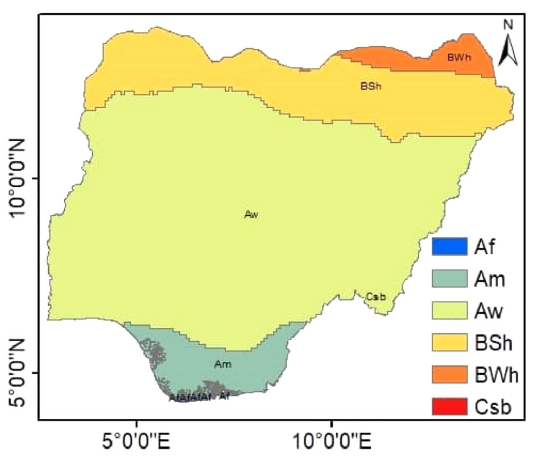
This study assessed the connection between Direct Normal Irradiance (DNI) and Total Cloud Cover (TCC) throughout Nigeria, a region with considerable yet underexploited solar energy potential. Daily DNI data from Modern-Era Retrospective Analysis for Research and Applications Version 2 (MERRA-2) and TCC data from the ERA5 reanalysis of the European Centre for Medium-Range Weather Forecasts (ECMWF) were aggregated into monthly means and analyzed across four climatological seasons. Seasonal variability was evaluated using standard deviation, while long-term trends were examined through simple linear regression, with statistical significance appraised at p < 0.05. Pearson’s correlation coefficient was used to estimate DNI–TCC relationship. Results show that TCC peaked during JJA in the Af and Am climates, whereas DNI peaked in DJF and SON, particularly in the BSh and BWh regions. Variability in both DNI and TCC was highest in DJF and lowest in JJA. DNI variability was highest in the Aw zone and lowest in Am, while TCC variability peaked in the Aw and BWh zones and was lowest in Af and Am. Regression analysis revealed a strong inverse relationship between DNI and TCC in the Csb and BWh zones, while Af and Am exhibited complex interactions. Correlation analysis showed strongest negative relationship during DJF and JJA (mean r = –0.73), and weakest during MAM (r = –0.33). Trend analysis indicated a modest increase in DNI across all climate zones, with TCC decreasing except in Af. DNI values exceeding 400 W/m² were most likely in northern zones during DJF and SON but low in the south.
References
[1] IRENA-AfDB report: Energy Transition Central to Africa’s Economic Future, 14 January 2022 Press Releases. https://primeprogressng.com/perspective/energy-transition-central-to-africas-economic-future-irena-afdb-report/.
[2] O. Ogunmodimu & A. Marquard, “CSP technology and its potential contribution to electricity supply in Northern Nigeria”, International Journal of Renewable Energy Research 3 (2013) 529. https://dergipark.org.tr/tr/download/article-file/148304.
[3] A. S. Sambo, “Matching electricity supply with demand in Nigeria”, International Association for Energy Economics 2008 (2008) 32. https://www.iaee.org/documents/newsletterarticles/408sambo.pdf.
[4] O. Ogunmodimu & E. C. Okoroigwe, “Solar thermal electricity in Nigeria: Prospects and challenges”, Energy Policy 128 (2019) 440. https://doi.org/10.1016/j.enpol.2019.01.013.
[5] N. Boerema, G. Morrison, R. Taylor & G. Rosengarten, “High temperature solar thermal central-receiver billboard design”, Solar Energy 97 (2013) 356. https://doi.org/10.1016/j.solener.2013.09.008.
[6] R. A. Taylor, P. E. Phelan, T. P. Otanicar, C. A. Walker, M. Nguyen & S. Trimble, “Applicability of nanofluids in high flux solar collectors”, Journal of Renewable and Sustainable Energy 3 (2011) 023104-1. https://doi.org/10.1063/1.3571565.
[7] D. Yang, P. Jirutitijaroen & W. M. Walsh, “Hourly solar irradiance time series forecasting using cloud cover index”, Solar Energy 86 (2012) 3531. https://doi.org/10.1016/j.solener.2012.07.029.
[8] K. M. Powell & T. F. Edgar, “Modeling and control of a solar thermal power plant with thermal energy storage”, Chemical Engineering Science 71 (2012) 138. https://doi.org/10.1016/j.ces.2011.12.009.
[9] K. Stefferud, J. Kleissl & J. Schoene, “Solar forecasting and variability analyses using sky camera cloud detection & motion vectors”, in 2012 IEEE Power and Energy Society General Meeting, San Diego, CA, USA, 2012, pp. 1–6. https://doi.org/10.1109/PESGM.2012.6345434.
[10] S. Lohmann, C. Schillings, B. Mayer & R. Meyer, “Long-term variability of solar direct and global radiation derived from ISCCP data and comparison with reanalysis data”, Solar Energy 80 (2006) 1390. https://doi.org/10.1016/j.solener.2006.03.004.
[11] F. R. Martins, E. B. Pereira, S. A. B. Silva, S. L. Abreu & S. Colle, “Solar energy scenarios in Brazil, part one: resource assessment”, Energy Policy 36 (2008) 2853. https://doi.org/10.1016/j.enpol.2008.02.014.
[12] S. R. West, D. Rowe, S. Sayeef & A. Berry, “Short-term irradiance forecasting using skycams: motivation and development”, Solar Energy 110 (2014) 188. https://doi.org/10.1016/j.solener.2014.08.038.
[13] A. A. Prasad, “Tropical thin cirrus from MISR: detection, validation and trends”, Ph.D. dissertation, Department of Physics, University of Auckland, New Zealand, 2012. https://hdl.handle.net/2292/20579.
[14] J. A. Crook, L. A. Jones, P. M. Forster & R. Crook, “Climate change impacts on future photovoltaic and concentrated solar power energy output”, Energy & Environmental Science 4 (2011) 3101. https://doi.org/10.1039/c1ee01495a.
[15] D. Akinyele, O. Babatunde, C. Monyei, L. Olatomiwa, A. Okediji, D. Ighravwe, O. Abiodun, M. Onasanya & K. Temikotan, “Possibility of solar thermal power generation technologies in Nigeria: Challenges and policy directions”, Renewable Energy Focus 29 (2019) 24. https://doi.org/10.1016/j.ref.2019.02.002.
[16] J. M. Olaniran, A. A. Muritala, O. O. Emmanuel & A. S. Lukman, “Impacts of cloudiness on near surface radiation and temperature in Nigeria, West Africa”, SN Applied Sciences 2 (2020) 2127. https://doi.org/10.1007/s42452-020-03961-y.
[17] I. Neher, S. Crewell, S. Meilinger, U. Pfeifroth & J. Trentmann, “Photovoltaic power potential in West Africa using long-term satellite data”, Atmospheric Chemistry and Physics 20 (2020) 12871. https://doi.org/10.5194/acp-20-12871-2020.
[18] A. A. Osinowo, E. C. Okogbue, S. B. Ogungbenro & O. Fashanu, “Analysis of global solar irradiance over climatic zones in Nigeria for solar energy applications”, Journal of Solar Energy 2015 (2015) 819307. https://doi.org/10.1155/2015/819307.
[19] E. O. Falayi & A. B. Rabiu, “Estimation of global solar radiation using cloud cover and surface temperature in some selected cities in Nigeria”, Archives of Physics Research 2 (2011) 99. http://scholarsresearchlibrary.com/archive.html.
[20] D. K. Danso, S. Anquetin, A. Diedhiou, C. Lavaysse, A. Kobea & N. D. E Touré, “Spatio-temporal variability of cloud cover types in West Africa with satellite-based and reanalysis data”, Quarterly Journal of the Royal Meteorological Society 145 (2019) 3715. https://doi.org/10.1002/qj.3651.
[21] B. Elliston, I. MacGill, A. Prasad & M. Kay, “Spatio-temporal characterization of extended low direct normal irradiance events over Australia using satellite derived solar radiation data”, Renewable Energy 74 (2015) 633. https://doi.org/10.1016/j.renene.2014.08.067.
[22] K. K. K. Cheung, S. Chooprateep & J. Ma, “Spatial and temporal patterns of solar absorption by clouds in Australia as revealed by exploratory factor analysis”, Solar Energy 111 (2015) 53. https://doi.org/10.1016/j.solener.2014.10.014.
[23] A. Troccoli & J. J. Morcrette, “Skill of direct solar radiation predicted by the ECMWF global atmospheric model over Australia”, Journal of Applied Meteorology and Climatology 53 (2014) 2571. https://doi.org/10.1175/JAMC-D-14-0074.1.
[24] S. Jerez, R. M. Trigo, S. M. Vicente-Serrano, D. Pozo-Vázquez, R. Lorente-Plazas, J. Lorenzo-Lacruz, F. Santos-Alamillos & J. P. Montávez, “The impact of the north atlantic oscillation on renewable energy resources in Southwestern Europe”, Journal of Applied Meteorology and Climatology 52 (2013) 2204. https://doi.org/10.1175/JAMC-D-12-0257.1.
[25] G. Colantuono, Y. Wang, E. Hanna & R. Erdélyi, “Signature of the north atlantic oscillation on British solar radiation availability and PV potential: the winter zonal seesaw”, Solar Energy 107 (2014) 210. https://doi.org/10.1016/j.solener.2014.05.045.
[26] L. T. Abiem, T. Igbawua & S. I. Aondoakaa, “Spatio-temporal assessment of climate in response to solar radiation changes over Nigeria using satellite data”, International Journal of Energy and Environmental Science 5 (2020) 40. https://doi.org/10.11648/j.ijees.20200502.12.
[27] T. Igbawua, A. A. Tyovenda, T. Sombo & I. M. Echi, “Spatio-temporal assessment of aerosol-induced atmospheric heating rates in Nigeria”, Journal of the Nigerian Society of Physical Sciences 7 (2025) 1918. https://doi.org/10.46481/jnsps.2025.1918.
[28] H. E. Beck, T. R. McVicar, N. Vergopolan, A. Berg, N. J. Lutsko, A. Dufour, Z. Zeng, X. Jiang, A. I. J. M van Dijk & D. G. Miralles, “High-resolution (1 km) Köppen-Geiger maps for 1901–2099 based on constrained CMIP6 projections”, Scientific Data 10 (2023) 724. https://doi.org/10.1038/s41597-023-02549-6.
[29] A. A. Prasad, R. A. Taylor & M. Kay, “Assessment of direct normal irradiance and cloud connections using satellite data over Australia”, Applied Energy 143 (2015) 301. http://dx.doi.org/10.1016/j.apenergy.2015.01.050.
[30] M. Journée, R. Müller & C. Bertrand, “Solar resource assessment in the Benelux by merging Meteosat-derived climate data and ground measurements”, Solar Energy 86 (2012) 3561. https://doi.org/10.1016/j.solener.2012.06.023.
[31] N. G. Loeb, S. Kato, W. Su, T. Wong, F. G. Rose & D. R. Doelling, “Advances in understanding top-of-atmosphere radiation variability from satellite observations”, Surveys in Geophysics 33 (2012) 359. https://doi.org/10.1007/s10712-012-9175-1.
[32] B. F. Murphy & B. Timbal, “A review of recent climate variability and climate change in southeastern Australia”, International Journal of Climatology 28 (2008) 859. https://doi.org/10.1002/joc.1627.
[33] A. A. Prasad & R. Davies, “Decadal changes in thin cirrus height measured by MISR”, AIP Conference Proceedings 1531 (2013) 400. https://doi.org/10.1063/1.4804791.
[34] S. T. Ogunjo, A. A. Obafaye & A. B. Rabiu, “Solar energy potentials in different climatic zones of Nigeria”, IOP Conference Series: Materials Science and Engineering 1032 (2021) 012040. https://doi.org/10.1088/1757-899X/1032/1/012040.
[35] O. S. Ohunakin, M. S. Adaramola, O. M. Oyewola, O. J. Matthew & R. O. Fagbenle, “The effect of climate change on solar radiation in Nigeria”, Solar Energy 116 (2015) 272. https://doi.org/10.1016/j.solener.2015.03.027.
[36] M. D. Dogara, M. K. O. Onwumere, S. Turang, P. Joshua & I. A. Joseph, “The trends in temperature and solar irradiance for Zaria, north western, Nigeria, between 1986 and 2015”, Science World Journal 12 (2017) 25. https://scienceworldjournal.org/article/view/17901.
[37] T. Sato, F. Kimura & A. S. Hasegawa, “Vegetation and topographic control of cloud activity over arid/semiarid Asia”, Journal of Geophysical Research: Atmospheres 112 (2007) 1. https://doi.org/10.1029/2006JD008129.
[38] D. O. Edokpa, P. N. Ede, J. Brown, A. J. Adeyemi & I. U. Pukiche, “The Nigeria climate zones: variability, trends and analysis from era-interim data (2010-2015)”, International Journal of Climate Research 8 (2024) 1. https://doi.org/10.18488/112.v8i1.3804.
[39] D. W. Medugu, S. B. Ibrahim & E. Yonanna, “The influence of some meteorological parameters on solar radiation in Yola, Adamawa State, Nigeria”, Adamawa State University Journal of Scientific Research 5 (2017) 153. https://www.adsujsr.com/.
[40] R. J. Davy & A. Troccoli, “Continental-scale spatial optimisation of a solar irradiance monitoring network”, Solar Energy 109 (2014) 36. https://doi.org/10.1016/j.solener.2014.08.026.
[41] E. J. Bala, J. O. Ojosu & I. H. Umar, “Government policies and programmes on the development of solar-PV sub-sector in Nigeria”, Nigerian Journal of Renewable Energy 8 (2000) 1. https://scholar.google.com/scholar?hl=en&assdt=0,5&cluster=13510257450420325907.
[42] IEA: International Energy Agency, World Energy Outlook 2010, IEA Paris, France, 2010. https://www.iea.org/reports/world-energy-outlook-2010.
[43] M. J. McPhaden, S. E. Zebiak & M. H. Glantz, “ENSO as an integrating concept in earth science”, Science 314 (2006) 1740. https://doi.org/10.1126/science.1132588.
Published
How to Cite
Issue
Section
Copyright (c) 2025 Louis Tersoo Abiem, Tertsea Igbawua, Jacob Tersugh Adawa

This work is licensed under a Creative Commons Attribution 4.0 International License.