Attenuation of indomethacin-induced gastric ulceration by methanolic extract of Cucumis Melo (L. indorous) seeds in male Wistar rats
Keywords:
Indomethacin, Ulceration, Catalase, TNF-A, Nitrite levelAbstract
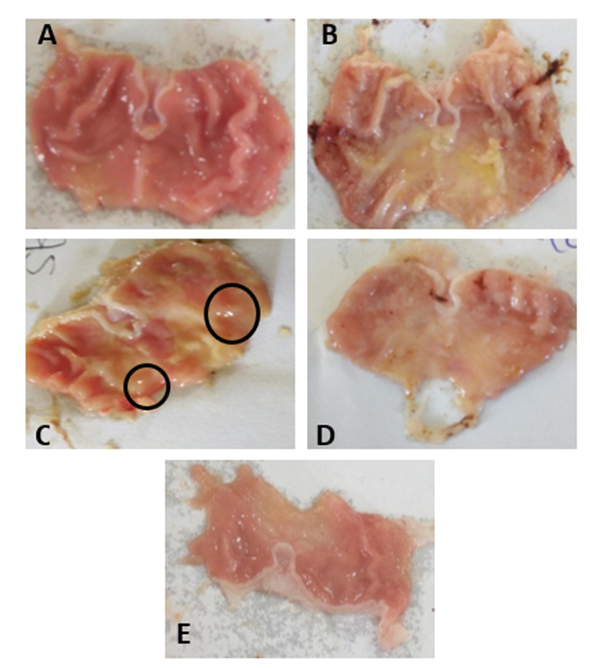
Inflammatory markers has been implicated during NSAID-induced gastric ulcer as it enhances leukocyte adhesion which also contribute to lipid peroxidation and decrease in antioxidants. Cucumis melo seeds (L. Indorous) is well known to contain some active component with strong anti-inflammatory potentials. Therefore, this study aimed to investigate the effects of Cucumis melo seed extract (MECmS) on indomethacin-induced stomach ulcers in male Wistar rats. Twenty-five male Wistar rats (n = 5, 130–150 mg) were randomly assigned to five groups: group 1 (water); group 2 (indomethacin; 40 mg/Kg); group 3 (50 mg/Kg methanolic extract of Cucumis melo seeds; MECmS + indomethacin); group 4 (100 mg/kg MECmS + indomethacin); and group 5 (200 mg/kg MECmS + indomethacin). MECmS was administered 14 days prior to induction of ulcers. Organs’ relative weights (RWO), total stomach acidity, ulcer score, and hematological parameters were assessed. MDA, catalase, protein level, nitrite, and TNF-alpha were also measured. Induction with indomethacin led to significant (p<0.05) increase in gastric acidity, ulcer score, relative stomach weight, MDA, TNF-alpha, and significant decrease in total protein, catalase, and nitrite level. Indomethacin also induced significant necrosis of the tunic mucosal. Treatment with Cucumis melo seed extract reversed tunic mucosal necrosis and significantly induced the proliferation of the gastric mucosal gland. Cucumis melo seed extract also significantly increased total protein, catalase, and nitrite level, while it significantly reduced ulcer score, gastric acidity, MDA and TNF-alpha levels. Cucumis melo possess antiulcer and anti-inflammatory properties; hence can be explored as a novel anti-ulcer drug.
References
D. Y. Graham, “History of helicobacter pylori, duodenal ulcer, gastric ulcer and gastric cancer”, World Journal of Gastroenterology 20 (2014) 5191. https://dx.doi.org/10.3748/wjg.v20.i18.5191.
L. X. Jin, Y. P. Fang, C. M. Xia, T. W. Cai, Q. Q. Li, Y. Y. Wang, H. F. Yan & X. Chen, “Helicobacter pylori infection alters gastric microbiota structure and biological functions in patients with gastric ulcer or duodenal ulcer”, World Journal of Gastroenterology 30 (2024) 3076. https://doi.org/10.3748/wjg.v30.i24.3076.
G. I. Adebayo-Gege, Z. S. Uthman, M. D. Adams, F. Tarfa, U. H. Danazumi, M. A. Ngabea, J. L. Hamidu, Q. Ozegbe, C. Onwuchekwa, A. Meraiyebu, K. Ojo, “Molecular docking and anti-ulcerative potential of Cucumis (L. Inodorous) on ibuprofen induced gastric ulceration in male wistar animals”, Biomedicine & Pharmacotherapy 161 (2023) 114531. https://doi.org/10.1016/j.biopha.2023.114531.
G. I. Adebayo-Gege, B. J. Okoli, P. O. Oluwayinka, A. F. Ajayi, F. Mtunzi, “Antiulcer and cluster of differentiation-31 properties of cucumis melo l. on indomethacin-induced gastric ulceration in male wistar rats”, in Chemistry for a Clean and Healthy Planet, P. Ramasami (eds.), Springer Nature, Switzerland, 2019, pp. 501–516. https://doi.org/10.1007/978-3-030-20283-5_29.
O. C. Rogoveanu, C. T. Streba, C. C. Vere, L. Petrescu & R. Traistaru, “Superior digestive tract side effects after prolonged treatment with NSAIDs in patients with osteoarthritis”, Journal of Medicine and Life 8 (2015) 458. https://www.ncbi.nlm.nih.gov/pmc/articles/PMC4656952/.
F. Y. Zaman, S. G. Orchard, A. VHaydon, J. R. Zalcberg “Non-aspirin non-steroidal anti-inflammatory drugs in colorectal cancer: a review of clinical studies”, British Journal of Cancer 127 (2022) 1735. https://doi.org/10.1038/s41416-022-01882-8.
G. Rashid, N. A. Khan, D. Elsori, A. Rehman, A. Tanzeelah, H. Ahmad, H. Maryam, A. Rais, M. S. Usmani, A. M. Babker & M. A. Kamal, “Non-steroidal anti-inflammatory drugs and biomarkers: A new paradigm in colorectal cancer”, Frontiers in Medicine 10 (2023) 1130710. https://doi.org/10.3389%2Ffmed.2023.1130710.
T. Hamoya, G. Fujii, S. Miyamoto, M. Takahashi, Y. Totsuka, K. Wakabayashi, J. Toshima & M. Mutoh, “Effects of NSAIDs on the risk factors of colorectal cancer: a mini review”, Genes and Environment 36 (2016) https://doi.org/10.1186/s41021-016-0033-0.
P. M. Rothwell, M. Wilson, C. E. Elwin, B. Norrving, A. Algra, C. P. Warlow, T. W. Meade, “Long-term effect of aspirin on colorectal cancer incidence and mortality: 20-year follow-up of five randomized trials”, Lancet 376 (2010) 1741. https://doi.org/10.1016/s0140-6736(10)61543-7.
L. Melcarne, P. Garc´ıa-Iglesias & X. Calvet, “Management of NSAID-associated peptic ulcer disease”, Expert Review of Gastroenterology and Hepatology 10 (2016) 723. https://doi.org/10.1586/17474124.2016.1142872.
O. M. Ighodaro & O. A. Akinloye, “First line defence antioxidants-superoxide dismutase (SOD), catalase (CAT) and glutathione peroxidase (GPX): Their fundamental role in the entire antioxidant defence grid”, Alexandria Journal of Medicine 54 (2018) 287. https://doi.org/10.1016/j.ajme.2017.09.001.
A. I. Elshamy, A. R. H. Farrag, I. M. Ayoub, K. A. Mahdy, R. F. Taher, A. E. Gendy, T. A. Mohamed, S. S. Al-Rejaie, Y. A. EI-Amier, A. M. Abd-EIGawad & A.F.Mohammed, “UPLC-qTOF-MS phytochemical profile and antiulcer potential of Cyperus conglomeratus Rottb. alcoholic extract”, Molecules 25 (2020) 4234. https://doi.org/10.3390/molecules25184234.
M. Shahnaz, P. Kaur & D. N. Prasad, “Gastroprotective NSAIDs”, Journal of Drug Delivery and therapeutics 8 (2018) 141. https://doi.org/10.22270/jddt.v8i5.1905.
J. L. Wallace & M. J. Miller,“Nitric oxide in mucosal defense: a little goes a long way”, Gastroenterology 119 (2000) 512. https://doi.org/10.1053/gast.2000.9304.
C. H. Cho,“Current roles of nitric oxide in gastrointestinal disorders”, Journal of Physiology 95 (2001) 253. https://doi.org/10.1016/s0928-4257(01)00034-1.
T. K. Motawi, H. M. Abd Elgawad & N. N.Shahin, “Modulation of indomethacin-induced gastric injury by spermine and taurine in rats”, Journal of Biochemical and Molecular Toxicology 21 (2007) 280. https://doi.org/10.1002/jbt.20194.
S. M. Andrabi, N. S. Sharma, A. Karan, S. M. Shatil Shahriar, B. Cordon, B. Ma & J. Xie, “Nitric oxide: physiological functions, delivery, and biomedical applications”, Advanced Science 10 (2023) 2303259. https://doi.org/10.1002/advs.202303259.
S. Okabe & K. Amagase, “An overview of acetic acid ulcer models–the history and state of the art of peptic ulcer research”, Biol Pharm Bull. 28 (2005) 1321. https://doi.org/10.1248/bpb.28.1321.
C. Hawkins & G. W. Hanks, “The gastroduodenal toxicity of nonsteroidal anti-inflammatory drugs: A review of the literature”, The Journal of Pain and Symptom Management 20 (2000) 140. https://doi.org/10.1016/s0885-3924(00)00175-5.
A. O. Ayoka, R. O. Akomolafe, O. S. Akinsomisoye & O. E. Ukponmwan, “Medicinal and economic value of Spondiasmombin”, African Journal of biomedical Research 11 (2008) 129. https://doi.org/10.4314/ajbr.v11i2.50714.
M. A. Silva, T. G. Albuquerque, R. C. Alves, M. B. P. Oliveira & H. S. Costa, “Melon (Cucumis melo L.) by-products: Potential food ingredients for novel functional foods?”, Trends in Food Science & Technology 98, 181. https://doi.org/10.1016/j.tifs.2018.07.005.
S. K. Prasad & M. K. Singh, “Horse gram- an underutilized nutraceutical pulse crop: a review”, J Food Sci Technol. 52 (2015) 2489. https://doi.org/10.1007/s13197-014-1312-z.
N. Jorge, A. C. da Silva & C. M. Veronezi, “Antioxidant and pharmacological activity of Cucumis melo var. cantaloupe”, Multiple Biological Activities of Unconventional Seed Oils, Abdalbasit Adam Mariod (Eds.), Academic Press, 2022, pp. 147–170. https://doi.org/10.1016/B978-0-12-824135-6.00001-5.
G. I. Adebayo- Gege, A. T. Salami, A. O. Odukanmi, I. O. Omotosho & S. B. Olaleye, “Pro-ulcerogenic activity of sodium arsenite in the gastric mucosa of male wistar rats”, Journal of African Association of Physiological Scences 6 (2018) 95. https://www.ajol.info/index.php/jaaps/article/view/181995.
M. B. Adinortey, C. Ansah, N. A. Galyuonm & Nyarko, “In vivo models used for evaluation of potential antigastroduodenal ulcer agents”, Hindawi Publishing Corporation Ulcers 2013 (2013) 12. http://dx.doi.org/10.1155/2013/796405.
R. Varshney & R. K. Kale, “Effect of calmodulin antagonist on radiation induced lipid peroxidation in microsomes”, International Journal of Radiation Biology 58 (1990) 733. https://doi.org/10.1080/09553009014552121.
A. C. Gornall, C. J. Bardawill & M. M. David, “Determination of serum protein by means of Biuret reaction”, Journal of Biological Chemistry 177 (1949) 751. https://doi.org/10.1016/S0021-9258(18)57021-6.
L. J. Ignarro, G. M. Buga, K. S.Wood, R. E. Byrns & G. Chaudhuri, “Endothelium-derived relaxing factor produced and released from artery and vein is nitric oxide”, Proc Natl Acad Sci U S A. 84 (1987) 9265. https://doi.org/10.1073/pnas.84.24.9265.
G. M. Pacifici, “Clinical pharmacology of indomethacin in preterm infants: implications in patent ductus arteriosus closure”, Pediatric Drugs 15 (2013) 363. https://doi.org/10.1007/s40272-013-0031-7.
M. A. Hull, S. H. Gardner & G. Hawcroft, “Activity of the non-steroidal anti-inflammatory drug indomethacin against colorectal cancer”, Cancer Treatment Reviews 29 (2003) 309. https://doi.org/10.1016/s0305-7372(03)00014-8.
T. M. Okda, S. K. Abd-Elghaffar, M. A. Katary & M. M Abd-Alhaseeb, “Chemopreventive and anticancer activities of indomethacin and vitamin D combination on colorectal cancer induced by 1,2 dimethylhydrazine”, Biomedical Reports 14 (2021) 27. https://doi.org/10.3892/br.2020.1403.
M. A. Morsy & M. A. El-Moselhy, “Mechanisms of the protective effects of curcumin against indomethacin-induced gastric ulcer in rats”, Pharmacology 91 (2013) 267. https://doi.org/10.1159/000350190.
M. A. El-Moselhy, N. M. Abdel-Hamid & S. Abdel-Raheim, “Gastro-protective effect of nicorandil in indomethacin and alcohol-induced acute ulcers”, Applied Biochemical and Biotechnology 152 (2009) 449. https://doi.org/10.1007/s12010-008-8384-z.
B. Danisman, B. Cicek, S. Yildirim, I Bolat, D. Kantar, K. S. Golokhvast, D. Nikitovic, A.Tsatsakis & A. Taghizadehghalehjoughi, “Carnosic acid ameliorates indomethacin-induced gastric ulceration in rats by alleviating oxidative stress and inflammation”, Biomedicines 11 (2023) 829. https://doi.org/10.3390/biomedicines11030829.
H. Yandrapu & J. Sarosiek, “Protective factors of the gastric and duodenal mucosa: an overview”, Current gastroenterology reports 17 (2015) 1. https://doi.org/10.1007/s11894-015-0452-2.
M. Magierowski, K. Magierowska, S. Kwiecien & T.Brzozowski, “Gaseous mediators nitric oxide and hydrogen sulfide in the mechanism of gastrointestinal integrity, protection and ulcerhealing”, Molecules 20 (2015) 9099. https://doi.org/10.3390/molecules20059099.
G. Adebayo-Gege, V. Alicha, T. O. Omayone, S. C. Nzekwe, C. A. Irozuoke, O. A. Ojo & A. F. Ajayi, “Anti-atherogenic and cardioprotective properties of Cucumis melo (Cucumis melo. L. Inodorus) seed extract on high fat diet induced obesity in male wistar rats”, BMC Complementary Medicine and Therapies 22 (2022) 334. https://doi.org/10.1186/s12906-022-03793-w.
G. I. Adebayo-Gege, D. A. Adetomiwa, T. P. Omayone, C. O. Akintayo, Q. B. Ozegbe, D. I. Yusuff & O. A. Ojo, “Anti-Ulcer potentials of aqueous extract of triticum aestivum on delayed healing of experimentally induced/gastric ulcer”, Nigerian Journal of Experimental and Clinical Biosciences 10 (2022) 90. http://dx.doi.org/10.4103/njecp.njecp_13_22.
K. Ajeigbe, K. Aibangbee, S. Saeed & O. Ajeigbe, A. Onifade, “Folic acid protects and heals gastric mucosa: role of acid output, inflammatory cytokines, angiogenic and growth factors”, The Journal of Basic and Applied Zoology 83 (2022) 15. https://doi.org/10.1186/s41936-022-00280-z.
S. Sabiu, T. Garuba, T. Sunmonu, E. Ajani, A. Sulyman, I.Nurain & A. Balogun, “Indomethacin-induced gastric ulceration in rats: protective roles of spondias mombin and ficus exasperate”, Toxicology Reports 2 (2015) 261. https://doi.org/10.1016/j.toxrep.2015.01.002.
I. O. Olubunmi, J. A. Bamidele & F. Omolara, “Phytochemical composition and in vitro antioxidant activity of golden melon (Cucumis melo L.) seeds for functional food application”, International Journal of Biochemistry Research & Review 25 (2019) 1. https://doi.org/10.9734/ijbcrr/2019/v25i230070.
A. M. Abbas & H. F. Sakr, “Effect of selenium and grape seed extract on indomethacin-induced gastric ulcers in rats”, Journal of Physiology and Biochemistry 69 (2013) 527. https://doi.org/10.1007/s13105-013-0241-z.
Published
How to Cite
Issue
Section
Copyright (c) 2024 Grace Adebayo-Gege, James Adiwu, Abednego Ovey Angbashim, Toyin Dorcas Alabi, Murtala Ngabea Audu , Frank Abimbola Ogundolie

This work is licensed under a Creative Commons Attribution 4.0 International License.