
Comparative evaluation of ARIMA and ETS models for short-term wind speed forecasting across twelve meteorological stations in Pakistan using the expanding-window method
Keywords:
Wind speed, ARIMA, ETS, Expanding-window validation, Forecast accuracyAbstract
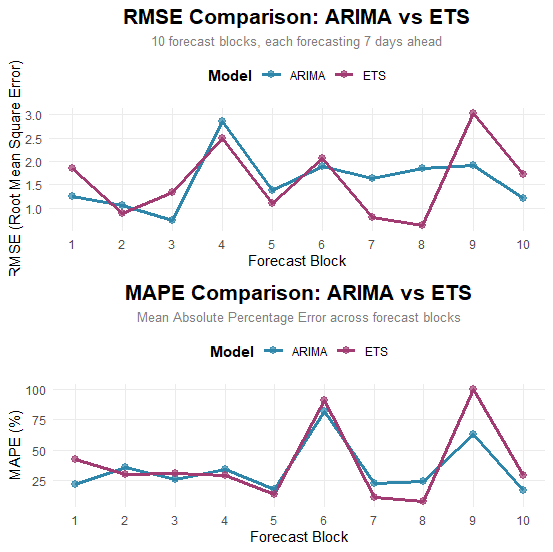
This article presents a statistical forecasting framework for wind speed using two well-known classical forecasting models, the autoregressive integrated moving average (ARIMA) and the exponential smoothing state space (ETS) models with the naïve model as a benchmark for comparison. Twelve meteorological stations across Pakistan were selected based on data availability and analyzed using a comprehensive and rigorous expanding-window data-splitting method. The expanding window method iteratively extends the training data over ten successive splits, with each split used to generate seven-day-ahead wind speed predictions. This approach allows the forecasting performance of the models to be evaluated over multiple forecast origins while progressively incorporating newly available observations into the training data. Root mean square error (RMSE) and mean absolute percentage error (MAPE) were used to examine the predictive behavior of all models and to evaluate their consistency and responsiveness over time. Model comparisons were further assessed by the Diebold-Mariano (DM) test on forecast errors for each model. The ARIMA model performed better (based on RMSE) for short-term wind speed forecasting at seven stations in Pakistan while the ETS model performed better at two stations and performed equally at three stations covered by this study. The DM test also supports the RMSE- and MAPE-based results in favor of the ARIMA model. The findings demonstrate the generally stronger performance of the ARIMA model.
References
[1] J. Zeng & W. Qiao, ``Short-term wind power prediction using a wavelet support vector machine'', IEEE Transactions on Sustainable Energy 3 (2012) 255. https://doi.org/10.1109/TSTE.2011.2180029.
[2] A. W. Bhutto, A. A. Bazmi & G. Zahedi, ``Greener energy: Issues and challenges for Pakistan—wind power prospective'', Renewable and Sustainable Energy Reviews 20 (2013) 519. https://doi.org/10.1016/j.rser.2012.12.010.
[3] G. E. P. Box, G. M. Jenkins, G. C. Reinsel & G. M. Ljung, Time series analysis: Forecasting and control, 5th ed., Wiley, 2015. Available online: https://www.wiley.com/en-us/time-series-analysis-forecasting-and-control-5th-edition-p-9781118675021.
[4] H. Liu, H. Q. Tian & Y. F. Li, ``Comparison of two new ARIMA-ANN and ARIMA-Kalman hybrid methods for wind speed prediction'', Applied Energy 98 (2012) 415. https://doi.org/10.1016/j.apenergy.2012.04.001.
[5] E. Erdem & J. Shi, ``ARMA based approaches for forecasting the tuple of wind speed and direction'', Applied Energy 88 (2011) 1405. https://doi.org/10.1016/j.apenergy.2010.10.031.
[6] E. Cadenas & W. Rivera, ``Wind speed forecasting in three different regions of Mexico, using a hybrid ARIMA–ANN model'', Renewable Energy 35 (2010) 2732. https://doi.org/10.1016/j.renene.2010.04.022.
[7] G. P. Zhang, ``Time series forecasting using a hybrid ARIMA and neural network model'', Neurocomputing 50 (2003) 159. https://doi.org/10.1016/S0925-2312(01)00702-0.
[8] R. J. Hyndman, A. B. Koehler, R. D. Snyder & S. Grose, ``A state space framework for automatic forecasting using exponential smoothing methods'', International Journal of Forecasting 18 (2002) 439. https://doi.org/10.1016/S0169-2070(01)00110-8.
[9] R. J. Hyndman & Y. Khandakar, ``Automatic time series forecasting: the forecast package for R'', Journal of Statistical Software 27 (2008) 1. https://doi.org/10.18637/jss.v027.i03.
[10] S. Makridakis & M. Hibon, ``The M3-Competition: Results, conclusions and implications'', International Journal of Forecasting 16 (2000) 451. https://doi.org/10.1016/S0169-2070(00)00057-1.
[11] J. Wang, S. Qin, Q. Zhou & H. Jiang, ``Medium-term wind speeds forecasting utilizing hybrid models for three different sites in Xinjiang, China'', Renewable Energy 76 (2015) 91. https://doi.org/10.1016/j.renene.2014.11.011.
[12] C. Bergmeir & J. M. Benítez, ``On the use of cross-validation for time series predictor evaluation'', Information Sciences 191 (2012) 192. https://doi.org/10.1016/j.ins.2011.12.028.
[13] L. J. Tashman, ``Out-of-sample tests of forecasting accuracy: An analysis and review'', International Journal of Forecasting 16 (2000) 437. https://doi.org/10.1016/S0169-2070(00)00065-0.
[14] J. González-Enrique, I. J. Turias, J. J. Ruiz-Aguilar, J. A. Moscoso-López & L. Franco, ``Spatial and meteorological relevance in NO$_2$ estimations: A case study in the Bay of Algeciras (Spain)'', Stochastic Environmental Research and Risk Assessment 33 (2019) 801. https://doi.org/10.1007/s00477-018-01644-0.
[15] M. A. Solis Teran, F. Leite Coelho da Silva, E. A. Torres Armas, N. Carbo-Bustinza & J. L. López-Gonzales, ``Modeling air pollution in Metropolitan Lima: A statistical and artificial neural network approach'', Environments 12 (2025) 196. https://doi.org/10.3390/environments12060196.
[16] F. García Crespi, E. Y. Funes & M. A. Simon, ``Rolling-origin validation reverses model rankings in multi-step PM10 forecasting: XGBoost, SARIMA, and persistence'', arXiv preprint arXiv:2603.20315 (2026). https://doi.org/10.48550/arXiv.2603.20315.
[17] J. Hu, J. Wang & G. Zeng, ``A hybrid forecasting approach applied to wind speed time series'', Renewable Energy 60 (2013) 185. https://doi.org/10.1016/j.renene.2013.05.012.
[18] T. J. Adejumo, A. I. Okegbade, J. I. Idowu, O. J. Oladapo & O. O. Oladejo, ``Time series analysis of Nigeria external (foreign) reserves'', African Scientific Reports 2 (2023) 54. https://doi.org/10.46481/asr.2023.2.1.54.
[19] I. M. Echi, E. V. Tikyaa, E. J. Eweh, A. A. Tyovenda & T. Igbawua, ``Investigation of the spatial distribution of deterministic chaos in some meteorological variables across Nigeria'', African Scientific Reports 4 (2025) 280. https://doi.org/10.46481/asr.2025.4.2.280.
[20] U. Moyi, K. Bello, O. J. Ibidoja & G. Muhammad, ``Modelling patients waiting and service time by ARIMA model: A case of Federal University Gusau clinic'', Recent Advances in Natural Sciences 1 (2023) 7. https://doi.org/10.61298/rans.2023.1.1.7.
[21] A. E. Afere, Y. B. Usman, E. Alih, E. V. Aguda & L. Enesi, ``Time series modelling of inflation and consumer price index trends in Nigeria'', Recent Advances in Natural Sciences 3 (2025) 225. https://doi.org/10.61298/rans.2025.3.2.225.
[22] A. Thorat, R. Metri & C. Bhattar, ``Reliable wind forecasting for grid stability using seasonal ARIMA'', Journal of Renewable Energies 29 (2026) 263. https://doi.org/10.54966/jreen.v29i1.1496.
Published
How to Cite
Issue
Section
Copyright (c) 2026 Muhammad Aslam, Naeem Ullah Khan, Atta Ullah

This work is licensed under a Creative Commons Attribution 4.0 International License.