
Nutritional composition of different rearing feedstocks influenceslarval survival of African palm weevil (Rhynchophorus phoenicis)
Keywords:
African palm weevil, Larval survival, Adult emergence, Feedstock, Proximate compositionAbstract
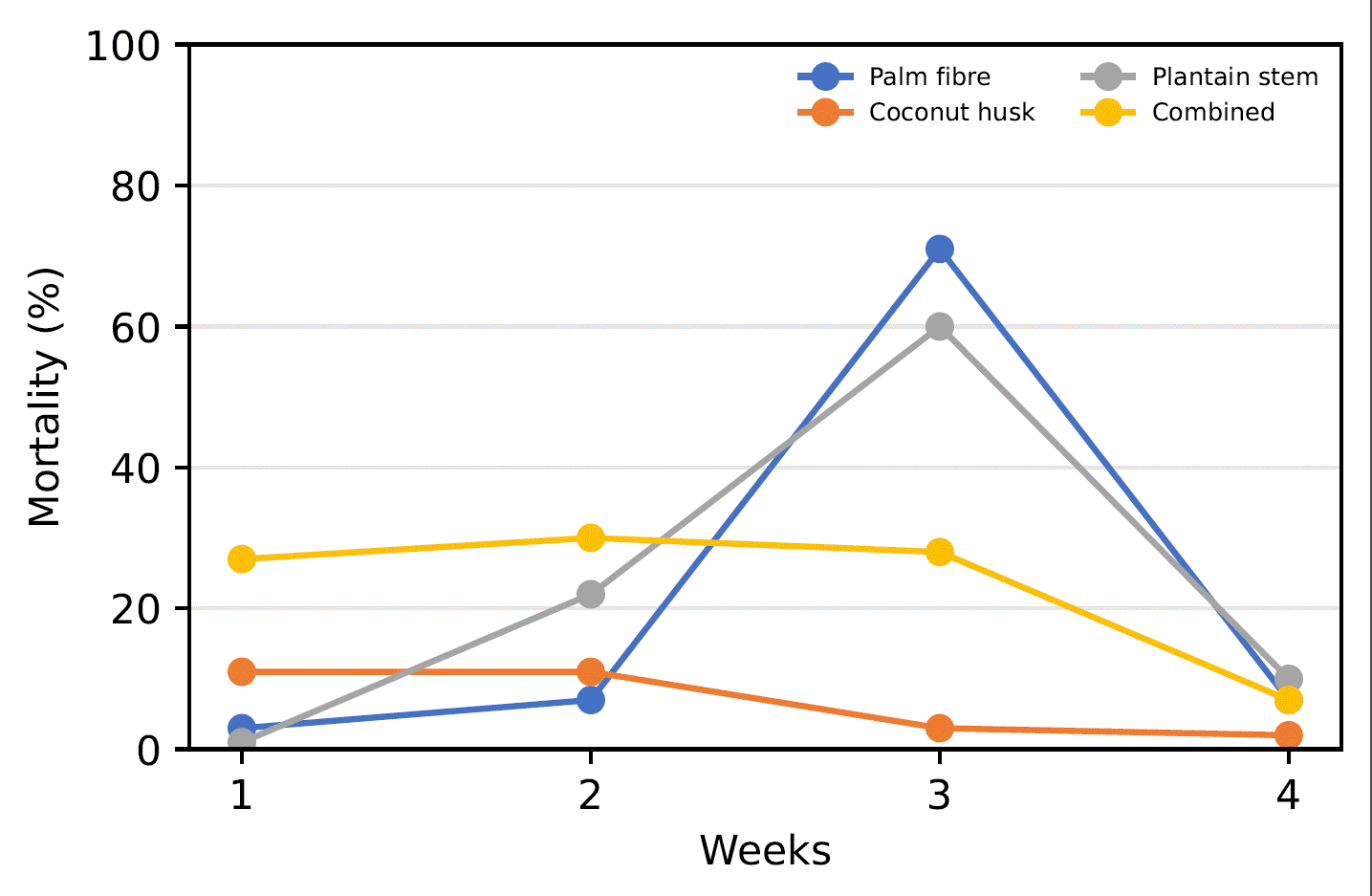
The African palm weevil (Rhynchophorus phoenicis) is a major pest of palm trees in the tropics and subtropics. This study examined the efficiency of rearing African palm weevil larvae on various substrates, used singly and in combination, with reference to their proximate compositions. Palm fibre, coconut husk, wet plantain stem and a mixture of the three substrates were used to rear palm weevil larvae. Twenty larvae were introduced per bowl into six bowls for each treatment, and four treatments were evaluated. Larval survival, pupation and adult emergence were recorded. High larval mortality was recorded in week 3 for wet plantain stem substrate (mean: 12.00) and palm trunk fibre (mean: 14.2). The combination of all substrates enhanced larval survival during the early rearing period. Mean pupation was highest with coconut husk in week 3, and mean adult emergence was highest with coconut husk in week 4. The differences were significant (p < 0.05). The proximate compositions of the substrates varied, but the differences were not statistically significant (p > 0.05). Moisture content was highest in plantain stem fibre. Ash content was highest in the combination of palm trunk fibre, coconut fruit husk and plantain stem fibre. Crude fibre, crude protein and ether extract were highest in the combination of pawpaw trunk fibre, palm trunk fibre, coconut fruit husk and sugarcane stem fibre. Carbohydrate content, measured as nitrogen-free extract (NFE), was highest in sugarcane stem fibre. Coconut husk was the most appropriate substrate for the mass rearing of African palm weevils.
References
[1] M. L. Colgrave, S. Dominik, A. B. Tobin, R. Stockmann, C. Simon, C. A. Howitt, D. P. Belobrajdic, C. Paull & T. Vanhercke, ``Perspectives on future protein production'', Journal of Agricultural and Food Chemistry 69 (2021) 15076. https://doi.org/10.1021/acs.jafc.1c05989.
[2] E. O. Adeparusi, O. M. Omosuyi & A. A. Dada, ``Dietary effects of processed African palm weevil (Rhynchophorus phoenicis) larvae with phyto-additives on growth performance and nutrient utilization of Clarias gariepinus juveniles'', Journal of Aquaculture Research and Development 14 (2023) 792. https://www.walshmedicalmedia.com/open-access/dietary-effects-of-processed-african-palm-weevil-irhynchophorus-phoenicisi-larvae-with-phytoadditives-on-growth-performance-and-nu-123246.html.
[3] A. R. Fogang Mba, G. Kansci, M. Viau, L. Ribourg, J. F. Muafor, N. Hafnaoui, P. Le Gall & C. Genot, ``Growing conditions and morphotypes of African palm weevil (Rhynchophorus phoenicis) larvae influence their lipophilic nutrient but not their amino acid compositions'', Journal of Food Composition and Analysis 69 (2018) 87. https://doi.org/10.1016/j.jfca.2018.02.012.
[4] I. C. Okoli, W. B. Olodi, I. P. Ogbuewu, N. O. Aladi & C. G. Okoli, ``Nutrient composition of African palm grub (Rhynchophorus phoenicis) larvae harvested from Raphia palm trunk in the Niger-Delta swamps of Nigeria'', Asian Journal of Biological Sciences 12 (2019) 284. https://doi.org/10.3923/ajbs.2019.284.290.
[5] T. K. Kim, H. I. Yong, Y. B. Kim, H. W. Kim & Y. S. Choi, ``Edible insects as a protein source: A review of public perception, processing technology, and research trends'', Food Science of Animal Resources 39 (2019) 521. https://doi.org/10.5851/kosfa.2019.e53.
[6] Z. T. Hlongwane, R. Slotow & T. C. Munyai, ``Nutritional composition of edible insects consumed in Africa: A systematic review'', Nutrients 12 (2020) 2786. https://doi.org/10.3390/nu12092786.
[7] C. C. Ojianwuna, V. N. Enwemiwe, E. Esiwo, G. O. Orji & A. J. Nkeze, ``Food and feed additive of insects: Economic and environmental impacts'', International Journal of Child Health and Nutrition 12 (2023) 107. https://doi.org/10.6000/1929-4247.2023.12.03.5.
[8] F. Adams, R. Aidoo, J.O. Mensah, A. Mensah, K. Amankwah, B.K. Kyei, J.E. Gbadago, K.A. Konadu, G. Boateng, A.B. Oduro, & C.K. Attobrah, ``Commercialisation of African palm weevil larvae for employment creation and nutritional security in rural Ghana: A financial feasibility approach'', Journal of Insects as Food and Feed 7 (2021) 1051. https://doi.org/10.3920/JIFF2020.0153.
[9] P. O. Edhebe, C. C. Ojianwuna, V. N. Enwemiwe, E. Esiwo, E. Aghahowa, S. Ifeta & T. E. Oborayiruvbe, ``Efficiency of rearing the African palm weevil (Rhynchophorus phoenicis) in different substrates as arsenal for addressing malnutrition in children'', International Journal of Child Health and Nutrition 14 (2025) 167. https://doi.org/10.6000/1929-4247.2025.14.02.09.
[10] A. A. U. Jongur, Y. Z. Dia & J. Onu, ``Livelihood diversification strategies as a means to poverty reduction among rural farming households in Adamawa State, Nigeria'', Green Reports 3 (2022) 39. https://doi.org/10.36686/Ariviyal.GR.2022.03.07.037.
[11] C. Fu, W. A. Cheema, M. Mobashar, A. A. Shah & M. M. Alqahtani, ``Insects as sustainable feed: Enhancing animal nutrition and reducing livestock environmental impression'', Journal of Animal Physiology and Animal Nutrition 109 (2025) 280. https://doi.org/10.1111/jpn.14055.
[12] S. A. Siddiqui, J. Osei-Owusu, B. M. Yunusa, T. Rahayu, I. Fernando, M. A. Shah & G. Centoducati, ``Prospects of edible insects as sustainable protein for food and feed -- a review'', Journal of Insects as Food and Feed 10 (2024) 191. https://doi.org/10.1163/23524588-20230042.
[13] F. Iannielli, A. Dolce, F. De Stefano, J. D. Fernandez-Bayo, C. Scieuzo & P. Falabella, ``Transformative potential of insect bioconversion and its role in circular economy'', Journal of Environmental Management 396 (2025) 128091. https://doi.org/10.1016/j.jenvman.2025.128091.
[14] F. Dickie, M. Miyamoto & C. M. T. Collins, The potential of insect farming to increase food security, in Edible Insects, IntechOpen, London, United Kingdom, 2019. https://doi.org/10.5772/intechopen.88106.
[15] P. G. Ehounou, N. M. E. N'Guessan, Y. A. E. Kouame, K. P. Yao & M. S. W. Ouali N'Goran, ``Rearing substrate influence on growth performance and nutritional composition of Rhynchophorus phoenicis larvae (Coleoptera: Curculionidae)'', World Journal of Advanced Research and Reviews 27 (2025) 2095. https://doi.org/10.30574/wjarr.2025.27.2.3091.
[16] A. Baris, ``Impact of feed quality on livestock productivity'', Journal of Livestock Policy 2 (2023) 1. https://doi.org/10.47604/jlp.v2i1.2112.
[17] B. Quaye, C. C. Atuahene, A. Donkoh, B. M. Adjei, O. Opoku & M. A. Amankrah, ``Alternative feed resource for growing African palm weevil (Rhynchophorus phoenicis) larvae in commercial production'', American Scientific Research Journal for Engineering, Technology, and Sciences 48 (2018) 490. Available online: https://asrjetsjournal.org/American_Scientific_Journal/article/view/4387.
[18] L. Qian, P. Deng, F. Chen, Y. Cao, H. Sun & H. Liao, ``The exploration and utilization of functional substances in edible insects: A review'', Food Production, Processing and Nutrition 4 (2022) 11. https://doi.org/10.1186/s43014-022-00090-4.
[19] D. G. A. B. Oonincx, S. Van Broekhoven, A. Van Huis & J. J. A. Van Loon, ``Feed conversion, survival and development, and composition of four insect species on diets composed of food by-products'', PLoS ONE 14 (2019) e0222043. https://doi.org/10.1371/journal.pone.0222043.
[20] S. K. Debrah, J. P. Anankware, G. M. Malinga & S. Asomah, ``Variation in substrate nutritional composition and its effects on the growth, development, and nutrient composition of Rhynchophorus phoenicis Fabricius (Coleoptera: Curculionidae)'', Journal of Insects as Food and Feed 10 (2024) 1023. https://doi.org/10.1163/23524588-20230059.
[21] C. Hancz, S. Sultana, Z. Nagy & J. Biro, ``The role of insects in sustainable animal feed production for environmentally friendly agriculture: A review'', Animals 14 (2024) 1009. https://doi.org/10.3390/ani14071009.
[22] Association of Official Analytical Chemists, Official Methods of Analysis of the Association of Official Analytical Chemists, 13th ed., Association of Official Analytical Chemists, Washington, DC, United States, 1980. https://openlibrary.org/books/OL22646346M/Official_methods_of_analysis_of_the_Association_of_Official_Analytical_Chemists.
[23] J. N. BeMiller, Carbohydrate analysis, in Food Analysis, S. S. Nielsen (Ed.), 5th ed., Springer International Publishing, Cham, Switzerland, 2017, pp. 333--360. https://doi.org/10.1007/978-3-319-45776-5_19.
[24] M. L. J. Claude, L. G. G. Jean, K. Kalenga & T. Hance, ``Influence of substrates on the rearing success of Rhynchophorus phoenicis (Fabricius)'', African Journal of Food Science and Technology 8 (2017) 7. https://doi.org/10.14303/ajfst.2015.065.
[25] B. G. Gebreyes & T. A. Teka, ``The environmental and ecological benefits of edible insects: A review'', Food Science and Nutrition 13 (2025) e70459. https://doi.org/10.1002/fsn3.70459.
[26] L. Selaledi, Z. Hassan, T. G. Manyelo & M. Mabelebele, ``Insects' production, consumption, policy, and sustainability: What have we learned from the indigenous knowledge systems?'', Insects 12 (2021) 432. https://doi.org/10.3390/insects12050432.
[27] A. Van Huis, J. Van Itterbeeck, H. Klunder, E. Mertens, A. Halloran, G. Muir & P. Vantomme, Edible Insects: Future Prospects for Food and Feed Security, FAO Forestry Paper 171, Food and Agriculture Organization of the United Nations, Rome, Italy, 2013. Available online: https://www.fao.org/3/i3253e/i3253e.pdf.
[28] C. Lalander, S. Diener, C. Zurbrugg & B. Vinneras, ``Effects of feedstock on larval development and process efficiency in waste treatment with black soldier fly (Hermetia illucens)'', Journal of Cleaner Production 208 (2019) 211. https://doi.org/10.1016/j.jclepro.2018.10.017.
[29] M. C. Ogwu, M. Osei-Kwarteng & F. E. Mukah, Insect farming: Methods and sustainability, in Edible Insects: Nutritional Benefits, Culinary Innovations and Sustainability, Springer Nature, Cham, Switzerland, 2025, pp. 69--95. https://doi.org/10.1007/978-3-031-90087-7_4.
[30] B. Dewangan, A. K. Panda, S. Kerketta, A. Kerketta, P. S. Bhatnagar, R. Mishra, S. DeMandal & S. S. Bisht , ``Reassuring insect farming ensures waste minimization and future food security'', Discover Sustainability 6 (2025) 451. https://doi.org/10.1007/s43621-025-01266-x.
Published
How to Cite
Issue
Section
Copyright (c) 2026 Victor Ngozi Enwemiwe, Sarah Ifeta, Eric Esiwo, Precious Edhebe, Ehimwenma Aghahowa, Vwegba Siakpere Rumekori, Chioma Cynthia Ojianwuna

This work is licensed under a Creative Commons Attribution 4.0 International License.