
Integrated geophysical, geochemical and remote sensing assessment of soil corrosion susceptibility in Sabon Gida, Katsina State, Northwestern Nigeria

Authors

  • Akpaneno A. Francis
    Department of Geophysics, Federal University Dutsin-Ma, P.M.B 5001. Dutsin-Ma, Katsina State, Nigeria
  • Ahmad Abdulhakim
    Department of Geophysics, Federal University Dutsin-Ma, P.M.B 5001. Dutsin-Ma, Katsina State, Nigeria;
    Department of Physics, School of General Studies, Federal University of Transportation Daura, P.M.B. 1050, Daura, Katsina State, Nigeria

Keywords:

Soil corrosivity, Electrical resistivity, Analytical hierarchy process, Corrosion susceptibility, Remote sensing

Abstract

One of the major factors affecting the longevity of buried metallic infrastructure, including pipelines, underground tanks, and foundation materials, is soil corrosivity. This study integrated geophysical, geochemical, and remote sensing data to assess soil corrosion susceptibility in Sabon Gida, Katsina State, Nigeria. The Schlumberger array configuration was used to acquire vertical electrical sounding (VES) data at 44 stations to evaluate subsurface resistivity and corrosion potential. Soil samples were collected at depths of 0--0.5, 0.5--1.0, 1.0--1.5, and 1.5--2.0 m from five representative VES locations corresponding to different resistivity classes and analyzed for pH. Sentinel-2 Level-2A imagery was processed to derive the normalized difference vegetation index (NDVI), normalized difference water index (NDWI), bare soil index (BSI), and salinity index (SI). The analytical hierarchy process (AHP) and weighted sum model (WSM) were integrated within a geographic information system (GIS) to generate a corrosion susceptibility index (CSI) map. The interpreted resistivity values ranged from 23.11 to 1779 Ω m, indicating significant spatial variation in subsurface conductivity. Soil pH values ranged from 6.3 to 7.1, reflecting slightly acidic to near-neutral conditions. The remote sensing indices revealed spatial variations in vegetation cover, moisture conditions, salinity, and bare soil exposure across the study area. The resulting CSI map indicates predominantly moderate corrosion susceptibility across the study area on 2 to 3 scale of corrosion susceptibility level suggesting relatively favorable conditions for buried infrastructure. However, site-specific engineering investigations and direct corrosion measurements are recommended before installation. The integrated approach provides a more comprehensive assessment than single-parameter methods and offers valuable information for infrastructure planning and corrosion management in the study area.
Dimensions

[1] M. G. Fontana, Corrosion engineering, 3rd ed., McGraw-Hill, New York, USA, 1986. Available online: https://www.google.com.ng/books/edition/Corrosion_Engineering/zcZRAAAAMAAJ?hl=en&gbpv=0&bsq=M.%20G.%20Fontana,%20Corrosion%20Engineering,%203rd%20ed.,%20McGraw-Hill,%20New%20York,%20USA,%201986.

[2] P. R. Roberge, Corrosion engineering: principles and practice, McGraw-Hill, New York, USA, 2008. Available online: https://www.accessengineeringlibrary.com/content/book/9780071482431.

[3] W. M. Telford, L. P. Geldart & R. E. Sheriff, Applied Geophysics, 2nd ed., Cambridge University Press, Cambridge, UK, 1990. https://doi.org/10.1017/CBO9781139167932.

[4] A. Samouëlian, I. Cousin, A. Tabbagh, A. Bruand & G. Richard, ``Electrical resistivity survey in soil science: A review'', Soil and Tillage Research 83 (2005) 173. https://doi.org/10.1016/j.still.2004.10.004.

[5] V. L. Mulder, S. de Bruin, M. E. Schaepman & T. R. Mayr, ``The use of remote sensing in soil and terrain mapping: a review'', Geoderma 162 (2011) 1. https://doi.org/10.1016/j.geoderma.2010.12.018.

[6] F. Castaldi, S. Chabrillat, A. Don & B. van Wesemael, ``Soil organic carbon mapping using lucas topsoil database and sentinel-2 data: an approach to reduce soil moisture and crop residue effects'', Remote Sensing 11 (2019) 2121. https://doi.org/10.3390/rs11182121.

[7] A. A. Adefolalu, Climate of Nigeria, in Nigeria in maps, K. M. Barbour, J. S. Oguntoyinbo, J. O. C. Onyemelukwe & J. C. Nwafor (Eds.), Hodder and Stoughton, London, UK, 1983.

[8] K. Abubakar, I. B. Abaje & R. Tukur, ``Rainfall and temperature dynamics in the context of climate change in the Sudan Savanna ecological zone of Katsina State, Nigeria'', FUDMA Journal of Earth and Environmental Sciences 1 (2024) 82. https://doi.org/10.33003/jees.2024.0102/08.

[9] P. McCurry, ``The geology of the Precambrian to Lower Palaeozoic rocks of northern Nigeria'', in Geology of Nigeria, C. A. Kogbe (Ed.), Elizabethan Publishing, Lagos, Nigeria, 1976, pp. 15--39. Available online: http://pascal-francis.inist.fr/vibad/index.php?action=getRecordDetail&idt=PASCALGEODEBRGM7720450807.

[10] M. A. Rahaman, ``Recent advances in the study of the basement complex of Nigeria'', in Precambrian Geology of Nigeria, Geological Survey of Nigeria, Kaduna, Nigeria, 1988, pp. 11--43. Available online: https://cir.nii.ac.jp/crid/1571135650759008768.

[11] A. I. Kankara & N. Shazalli, ``Geology and petrography of precambrian rocks of Katsina urban area, Northwestern Nigeria'', Zbornik Radova Departmana za Geografiju, Turizam i Hotelijerstvo 49 (2020) 113. https://doi.org/10.5937/zbdght2002113a.

[12] N. G. Obaje, ``The basement complex'', in Geology and mineral resources of Nigeria, Springer, Berlin, Germany, 2009. https://doi.org/10.1007/978-3-540-92685-6_2.

[13] M. H. Loke, Tutorial: 2-D and 3-D electrical imaging surveys, Geotomo Software, Malaysia, 2004. Available online: https://www.geotomosoft.com/downloads.php.

[14] A. A. Bobachev, IPI2Win v.3.0 and IPI2WinMT: Programs for resistivity and magnetotelluric data interpretation, Moscow State University and Geoscan-M Ltd., Moscow, Russia, 2003. https://x2ipi.voog.com/downloads?utm_source=chatgpt.com.

[15] ASTM G57-20, ``Standard test method for field measurement of soil resistivity using the Wenner four-electrode method'', ASTM International, West Conshohocken, PA, USA, 2020. https://doi.org/10.1520/G0057-20.

[16] NACE International, Control of external corrosion on underground or submerged metallic piping systems, NACE Standard RP0169, Houston, TX, USA, 2002. https://cir.nii.ac.jp/crid/1570009749298611840.

[17] ASTM International, ``ASTM G57-06: standard test method for field measurement of soil resistivity using the Wenner four-electrode method'', ASTM International, West Conshohocken, PA, USA, 2012. https://doi.org/10.1520/G0057-06R12.

[18] N. C. Brady & R. R. Weil, The nature and properties of soils, 15th ed., Pearson Education, London, UK, 2016. https://www.researchgate.net/publication/301200878_The_Nature_and_Properties_of_Soils_15th_edition.

[19] R. W. Revie & H. H. Uhlig, Corrosion and corrosion control: an introduction to corrosion science and engineering, 4th ed., John Wiley & Sons, Hoboken, NJ, USA, 2008. https://onlinelibrary.wiley.com/doi/book/10.1002/9780470277270.

[20] T. L. Saaty, The analytic hierarchy process, McGraw-Hill, New York, USA, 1980. Available online: https://d1wqtxts1xzle7.cloudfront.net/51627807/saaty-libre.pdf?1486172407=&response-content-disposition=inline%3B+filename%3DSaaty.pdf&Expires=1784803022&Signature=YAEubaJxZAfFbeyOhYhofPPt8EWmjTsd8dbdBtAabGUu5t~1f3JncBOj1MCOIn5sDPdcGIYC151Nh5pIwY6YDjW04zqJe6hYIkMP9gXxDTFo~~9BYLMyT5Rq~nhKuL2RH2vj68fcNF93Xa8utk2ZPKOptuU9JEAyViwGZIvMs9d72DLAK0I8X0sXs90QGHEp5ijhVRBR8kA7jIB8oCdgVEyG0T5dhPwVZcea~MIVCRXsRnh0DHTTTWstdVpABj-sdlAucRLstnH66~pMbsYvbd8GFlk8dVJJyuURZx0wRi2j9aZuwmgMLq31B0Rlfq6c-vv7IMjPjHkxn9o8RljbaA__&Key-Pair-Id=APKAJLOHF5GGSLRBV4ZA.

[21] J. R. Jensen, Introductory digital image processing: a remote sensing perspective, 4th ed., Pearson Education, New York, USA, 2015. Available online: https://www.pearson.com/en-us/subject-catalog/p/Jensen-Introductory-Digital-Image-Processing-A-Remote-Sensing-Perspective-4th-Edition/P200000006907?view=educator&srsltid=AfmBOoqmpMllRoXBXF8m9adLDCisKxvinfUkYdn_J2pvyDeJ1lPrKmb7.

[22] C. J. Tucker, ``Red and photographic infrared linear combinations for monitoring vegetation'', Remote Sensing of Environment 8 (1979) 127. https://doi.org/10.1016/0034-4257(79)90013-0.

[23] J. W. Rouse, R. H. Haas, J. A. Schell & D. W. Deering, ``Monitoring vegetation systems in the Great Plains with ERTS'', NASA SP-351 (1974) 309. https://ntrs.nasa.gov/api/citations/19740022614/downloads/19740022614.pdf.

[24] S. K. McFeeters, ``The use of normalized difference water index (NDWI) in the delineation of open water features'', International Journal of Remote Sensing 17 (1996) 1425. https://doi.org/10.1080/01431169608948714.

[25] A. Rikimaru, P. S. Roy & S. Miyatake, ``Tropical forest cover density mapping'', Tropical Ecology 43 (2002) 39. Available online: https://www.researchgate.net/publication/255718070_Tropical_forest_cover_density_mapping.

[26] Y. Zha, J. Gao & S. Ni, ``Use of normalized difference built-up index in automatically mapping urban areas from TM imagery'', International Journal of Remote Sensing 24 (2003) 583. https://doi.org/10.1080/01431160304987.

[27] A. A. Hammam & E. S. Mohamed, ``Mapping soil salinity in the East Nile Delta using several methodological approaches of salinity assessment'', Egyptian Journal of Remote Sensing and Space Sciences 23 (2020) 125. https://doi.org/10.1016/j.ejrs.2018.11.002.

[28] A. Arabameri, B. Pradhan, H. R. Pourghasemi, K. Rezaei & W. Kerle, ``A novel approach for assessing watershed susceptibility using weighted overlay and analytical hierarchy process (AHP) methodology'', Environmental Science and Pollution Research 26 (2019) 31981. https://doi.org/10.1007/s11356-019-06355-9.

[29] D. F. Watson & G. M. Philip, ``A refinement of inverse distance weighted interpolation'', Geoprocessing 2 (1985) 315. https://cir.nii.ac.jp/crid/1573387450062569472.

[30] I. A. Akinlabi & M. L. Olaiya, ``Geoelectrical and physicochemical evaluation of soil corrosivity on metallic pipelines: a case study'', Journal of Geography, Environment and Earth Science International 25 (2021) 46. https://doi.org/10.9734/jgeesi/2021/v25i530287.

[31] R. Sadiq, B. Rajani & Y. Kleiner, ``Fuzzy-based method to evaluate soil corrosivity for prediction of water main deterioration'', Journal of Infrastructure Systems 10 (2004) 149. https://doi.org/10.1061/(ASCE)1076-0342(2004)10:4(149).

[32] T. C. Irunkwor, C. O. Molua, C. Okobia, D. D. Nmorsi, N. Abanjo, M. Edobor & C. N. Eze, ``Geoelectric and geochemical assessment of sub-soil corrosivity and competence for civil infrastructures at Utue-Ogume, Delta State, Nigeria'', Discover Geoscience 3 (2025) 149. https://doi.org/10.1007/s44288-025-00256-w.

[33] U. B. Onyeanwuna, O. C. Akakuru, A. I. Opara, S. O. Onyekuru, S. I. Ibeneme, I. J. Ofoh, G. O. Aigbadon & H. Israel, ``Application of geological and geo-electric methods in the assessment of corrosivity, competence, and vulnerability of soils around Southeastern Nigeria'', International Journal of Physical Sciences 19 (2024) 58. https://doi.org/10.5897/IJPS2023.5057.

[34] A. M. George, ``Geophysical investigation of subsoil corrosivity within University of Cross River State, Calabar, Southern Nigeria'', Science World Journal 19 (2024) 466. Available online: https://scienceworldjournal.org/article/view/23966.

[35] I. A. Adeyemo, F. O. Korode, O. A. Olaniyan & O. E. Faleye, ``Subsurface corrosivity assessment using subsoil resistivity in a typical basement terrain: a case study of the Adebowale Area in Akure, Southwestern Nigeria'', Indonesian Journal of Earth Sciences 4 (2024) A998. https://doi.org/10.52562/injoes.2024.998.

[36] W. von Baeckmann, W. Schwenk & W. Prinz, Handbook of cathodic corrosion protection, 3rd ed., Gulf Professional Publishing, Houston, TX, USA, 1997. https://www.amazon.com/Handbook-Cathodic-Corrosion-Protection-Third/dp/0123996511.

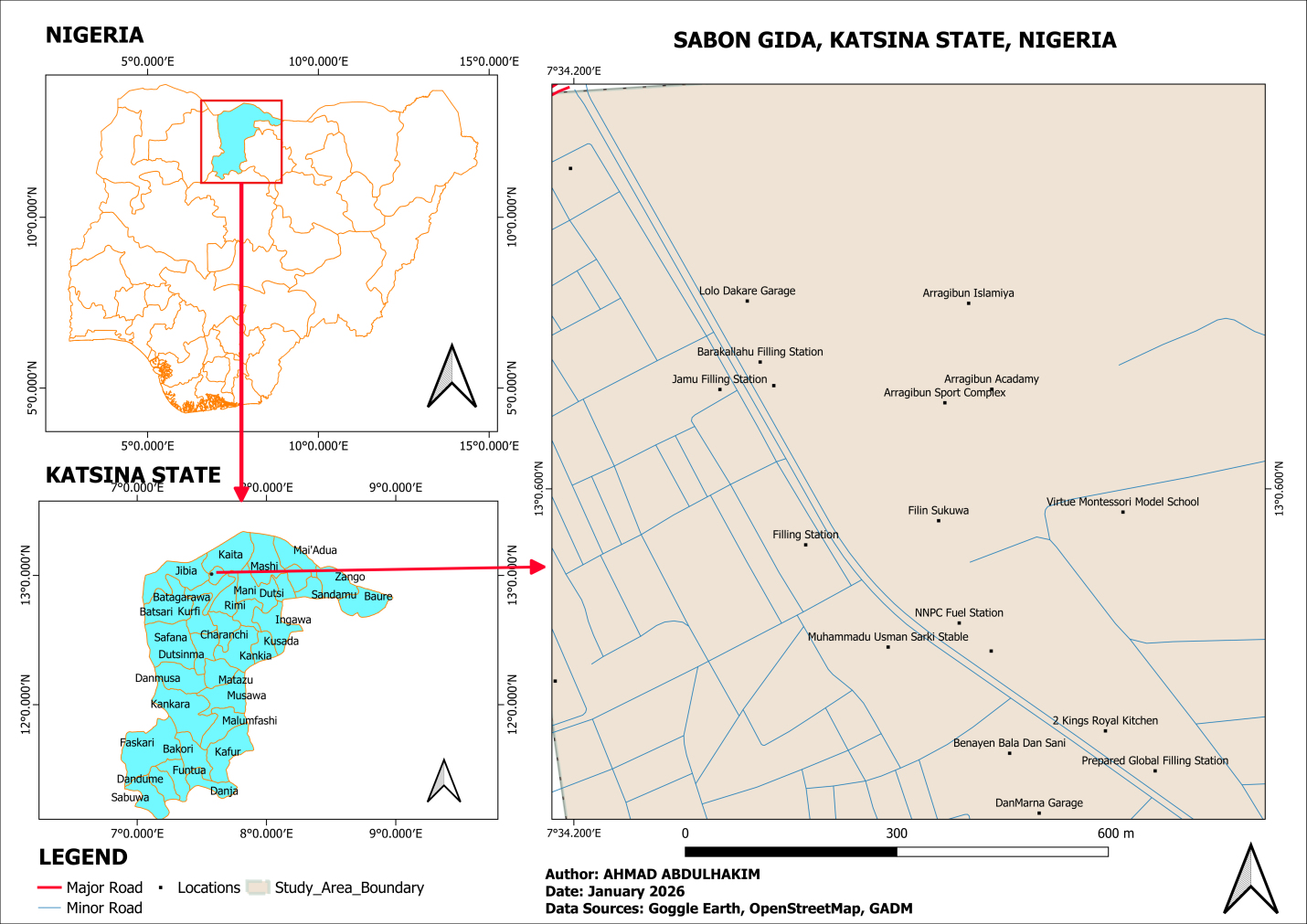
fig 1

Published

2026-07-30

How to Cite

Integrated geophysical, geochemical and remote sensing assessment of soil corrosion susceptibility in Sabon Gida, Katsina State, Northwestern Nigeria. (2026). African Scientific Reports, 5(2), 546. https://doi.org/10.46481/asr.2026.5.2.546

Issue

Section

GEOSCIENCES SECTION

How to Cite

Integrated geophysical, geochemical and remote sensing assessment of soil corrosion susceptibility in Sabon Gida, Katsina State, Northwestern Nigeria. (2026). African Scientific Reports, 5(2), 546. https://doi.org/10.46481/asr.2026.5.2.546

Similar Articles

11-20 of 50

You may also start an advanced similarity search for this article.