
Rain fade impairment analysis for Earth-to-space radio links using site diversity techniques in Delta State, Nigeria
Keywords:
Rain attenuation, Site diversity, Earth-to-space link, Ku-band, Satellite communicationAbstract
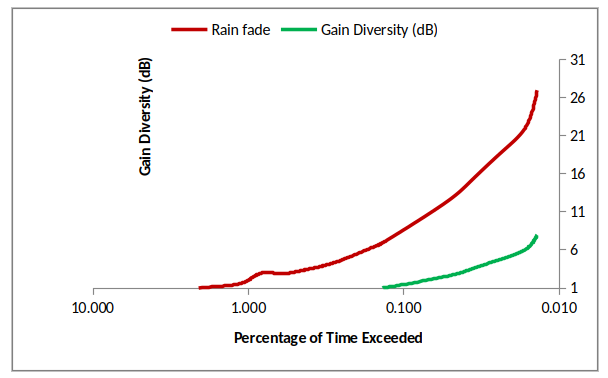
Site diversity is a fade mitigation technique that employs two or more spatially separated receiving stations to reduce the adverse effects of rain attenuation on satellite communication links. Its effectiveness is particularly important in tropical regions where intense convective rainfall frequently degrades Earth-to-space radio communications. This study investigates rain fade impairment and evaluates the effectiveness of site diversity for Ku-band Earth-to-space radio links in Warri, Delta State, Nigeria, a tropical coastal environment with high rainfall intensity. Rain rate and received signal level measurements collected during the peak rainy months of 2024 were analysed to generate cumulative distribution functions (CDFs) for rainfall occurrence and attenuation statistics. The study adopted the ITU-R P.618-11 and P.618-12 propagation models to estimate rain attenuation and diversity gain for both single-site and joint-site configurations. Results show that rain attenuation increases with rainfall intensity and becomes particularly severe for rainfall rates exceeding 70 mm/h. Maximum single-site attenuation values of 54.83 dB and 25.12 dB were observed during rainfall intensities of 200 mm/h in July and August, respectively. The application of site diversity reduced attenuation significantly, producing maximum diversity gains of 13.76 dB, 5.27 dB, 5.22 dB, and 4.10 dB for July, April, August, and October, respectively. Negative diversity gains observed at low rainfall intensities indicate periods of high spatial correlation between rain cells, during which diversity effectiveness is reduced. The findings validate the applicability of the ITU-R site diversity model under tropical convective rainfall conditions and provide localized propagation information for the design and optimization of reliable Ku-band satellite communication systems in the Niger Delta region of Nigeria.
References
[1] J. T. Zhimwang, E. P. Ogherohwo, A. A. Alonge, A. O. Ezekiel & S. O. Samuel, ``Effect of the variation of atmospheric refractive index on signal transmission for digital terrestrial television in Jos, Nigeria'', 2023 IEEE AFRICON, Nairobi, Kenya, 2023, pp. 1--4. https://www.researchgate.net/publication/375132092_Effect_of_the_Variation_of_Atmospheric_Refractive_Index_on_Signal_Transmission_for_Digital_Terrestrial_Television_in_Jos_Nigeria.
[2] Y. A. Abdulrahman, T. A. Rahman, S. K. A. Rahim & M. R. Islam, ``Rain attenuation predictions on terrestrial radio links: Differential equations approach'', Transactions on Emerging Telecommunications Technologies 23 (2012) 293. https://doi.org/10.1002/ett.1531.
[3] O. J. Igbekele, J. T. Zhimwang & E. P. Ogherohwo, ``Evaluation of propagation losses due to rain attenuated signal on terrestrial radio links over Jos, Plateau State, Nigeria'', Physical Science International Journal 23 (2019) 1. https://doi.org/10.9734/psij/2019/v23i130140.
[4] Y. Yahaya, J. T. Zhimwang, E. P. Ogherohwo, A. Ibrahim, O. S. Shaka & M. L. Frank, ``Evaluation of signal strength and quality of a Ku-band satellite downlink during raining season in Guinea Savanna Region of Nigeria'', International Journal of Advanced Network Applications 13 (2022) 5102. https://www.ijana.in/papers/V13I5-2.pdf.
[5] M. Sridhar, K. P. Raju & C. S. Rao, ``Estimation of rain attenuation based on ITU-R model in Guntur, India'', International Journal of Engineering Research and Applications 3 (2012) 6. https://www.bohrium.com/en/paper-details/estimation-of-rain-attenuation-based-on-itu-r-model-in-guntur-ap-india/1101188118280667175-2000000.
[6] J. T. Zhimwang & E. P. Ogherohwo, ``Nigeria digital terrestrial television broadcasting: An evaluation of the transmitted signal received under different environmental features in North-Central Region'', International Journal of Advanced Network Applications 14 (2023) 5722. https://doi.org/10.35444/IJANA.2023.14609.
[7] O. Ituabhor, J. Isabona, J. T. Zhimwang & I. Risi, ``Cascade forward neural networks-based adaptive model for real-time adaptive learning of stochastic signal power datasets'', International Journal of Computer Network and Information Security 14 (2022) 63. https://doi.org/10.5815/ijcnis.2022.03.05.
[8] O. Ituabhor, J. T. Zhimwang & R. Ikechi, ``Achievable throughput over mobile broadband network protocol layers: Practical measurements and performance analysis'', International Journal of Advanced Network Applications 13 (2022) 5037. https://www.researchgate.net/publication/359327444_Achievable_Throughput_over_Mobile_Broadband_Network_Protocol_Layers_Practical_Measurements_and_Performance_Analysis.
[9] J. T. Zhimwang, S. O. Samuel & L. Mercy, ``Analysis of frequency and polarization scaling on rain attenuated signal of a Ku-band link in Jos, Nigeria'', International Journal of Advanced Network Applications 14 (2022) 5310. https://www.ijana.in/papers/V14I1-11.pdf
[10] F. A. Semire, R. Mohd-Mokhtar, W. Ismail, N. Mohamad & J. S. Mandeep, ``Modeling of rain attenuation and site diversity predictions for tropical regions'', Annales Geophysicae 33 (2015) 321. https://doi.org/10.5194/angeo-33-321-2015.
[11] ITU-R, International Telecommunication Union Radiocommunication Bureau Recommendations, Geneva, Switzerland, 2016. https://www.itu.int/pub/r-reg-rr-2016.
[12] M. R. Islam, A. K. Lwas & M. H. Habaebi, ``Site diversity gain for Earth-to-satellite links using rain intensity measurement'', Indonesian Journal of Electrical Engineering and Informatics 5 (2017) 330. https://doi.org/10.11591/ijeei.v5i4.364.
[13] F. A. Fikih, E. S. Eko & G. H. Gamantyo, ``Computation of rain attenuation in tropical region with multiple scattering and multiple absorption effects using exponential drop size distribution'', IEEE Proceedings, 2011, pp. 1--4. https://doi.org/10.1109/URSIGASS.2011.6050802.
[14] A. De, A. Adhikari & A. Maitra, ``Diversity gain for rain attenuation over Earth-space path at a tropical location'', Advances in Space Research 57 (2016) 794. https://doi.org/10.1016/j.asr.2015.12.001.
[15] H. Wei, M. Wen, Z. Ruan, H. Li, X. Shi & Z. Huang, ``Investigation of the meteorological conditions, dynamical, and microphysical characteristics of convective precipitation over the rainfall center of South China in the pre-summer rainy season'', Atmospheric Research 314 (2025) 107823. https://doi.org/10.1016/j.atmosres.2024.107823.
[16] R. A. Houze Jr., K. L. Rasmussen, M. D. Zuluaga & S. R. Brodzik, ``The variable nature of convection in the tropics and subtropics: A legacy of 16 years of the Tropical Rainfall Measuring Mission satellite'', Reviews of Geophysics 53 (2015) 994. https://doi.org/10.1002/2015RG000488.
[17] S. K. Kotamraju & C. S. K. Korada, ``Precipitation and other propagation impairments effects at microwave and millimeter wave bands: A mini survey'', Acta Geophysica 67 (2019) 703. https://doi.org/10.1007/s11600-018-0238-7
[18] C. H. Arslan, Detection and estimation of rainfall through data analysis of geostationary Ku-band satellite signals, Ph.D. dissertation, 2017. https://etda.libraries.psu.edu/catalog/13892cha5024.
Published
How to Cite
Issue
Section
Copyright (c) 2026 Jangfa Timothy Zhimwang

This work is licensed under a Creative Commons Attribution 4.0 International License.