
Comparative effects of resistance training and aerobic exercise on ovulation and female reproductive physiology
Keywords:
Resistance training, Aerobic exercise, Ovulation, Reproductive health, Exercise physiologyAbstract
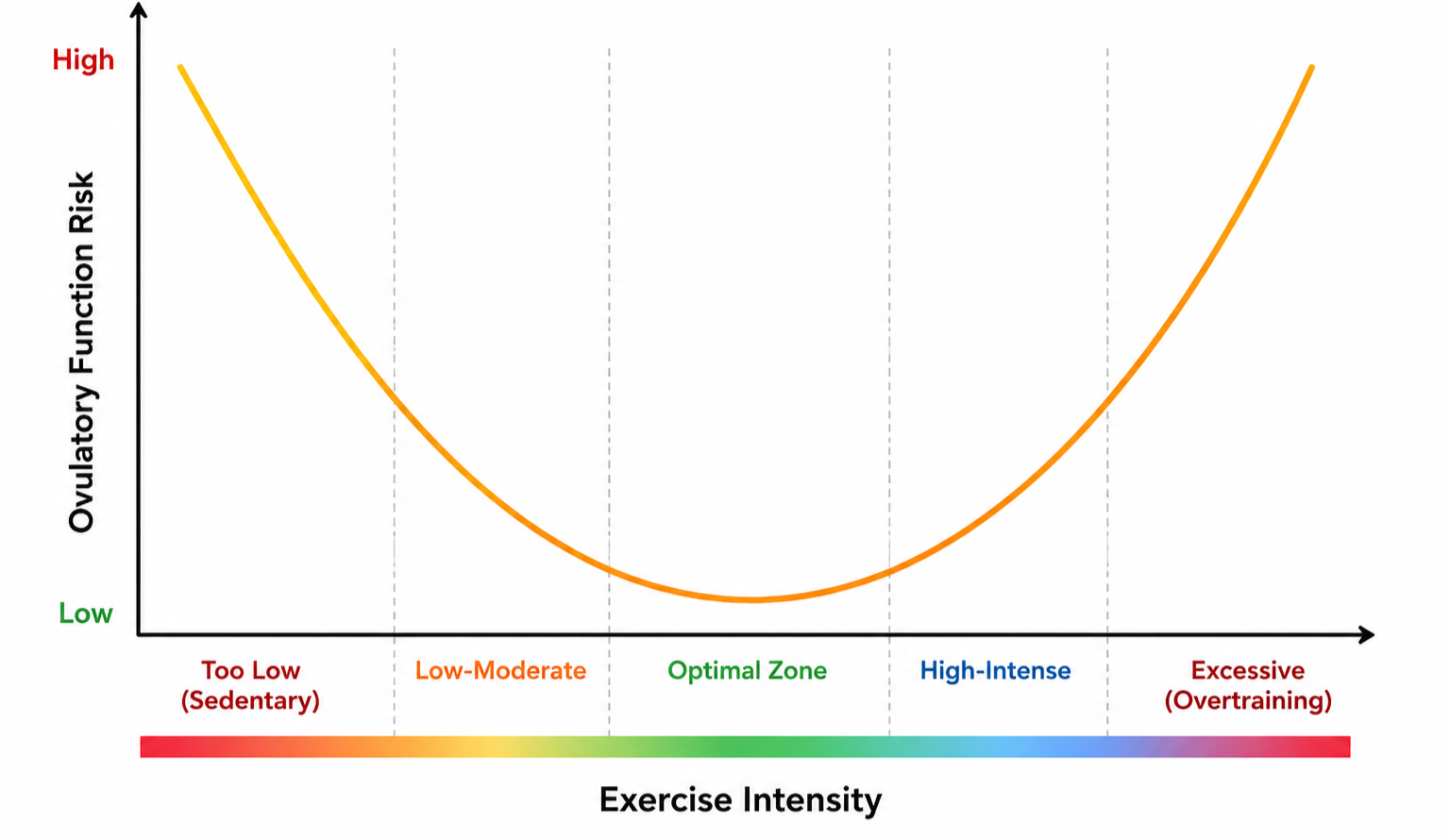
Physical exercise plays an important role in reproductive health, particularly through its influence on the hypothalamic--pituitary--ovarian (HPO) axis and ovulation. Although both resistance training (RT) and aerobic exercise (AE) benefit women's health, their comparative effects on ovulatory function remain unclear. This narrative review evaluates the differential effects of RT and AE on ovulatory function from a sports physiology perspective, with emphasis on training type, intensity, and frequency. Literature was identified through major scientific databases, including PubMed, Scopus, Web of Science, and Google Scholar, with a focus on exercise and female reproductive health. The evidence suggests that RT and AE may have beneficial but distinct effects on ovulatory function mediated by metabolic and hormonal mechanisms. Moderate- to high-intensity AE has been reported to improve body mass index (BMI), insulin sensitivity, and menstrual regularity, whereas RT may support muscle development, androgen regulation, and metabolic health. However, excessive exercise or insufficient energy intake can disrupt gonadotropin-releasing hormone (GnRH) pulsatility and suppress gonadotropins, which may lead to menstrual dysfunction. Overall, AE has more consistent evidence for improvements in BMI and menstrual-cycle regularity, while RT shows promising but still emerging benefits for androgen regulation and metabolic health. These findings may guide women, healthcare providers, and policymakers in tailoring exercise choices to protect women's ovulatory and reproductive health. Future studies should prioritise comparative exercise trials, diverse populations, and the incorporation of nutritional factors.
Published
How to Cite
Issue
Section
Copyright (c) 2026 Olajumoke Oyedoyin

This work is licensed under a Creative Commons Attribution 4.0 International License.
How to Cite
Similar Articles
- Peace P. Desben, Emmanuel N. Dashe, Joel N. Ndam, Transmission dynamics of community-and hospital-acquired infections: insights from mathematical modelling , African Scientific Reports: Volume 5, Issue 2, August 2026
- C. Andrew, S. W. Ngbo, L. O. Edmund, P. S. Moses, P. Y. Olekwu, A. I. Onen, Spectrophotometric and voltammetric assessment of totalflavonoid and phenolic content of Cucurbita species and theirantioxidant activity , African Scientific Reports: Volume 5, Issue 2, August 2026
- A. P. Onatunji, O. M. Ajao, K. T. Amzat, L. A. Oladimeji, O. A. Olalude, Bayesian analysis of the effects of some identified risk factors of systolic pressure among pregnant women in Ogbomoso, Oyo State , African Scientific Reports: Volume 3, Issue 2, August 2024
- Gabriel James, Anietie Ekong, Etimbuk Abraham, Enobong Oduobuk, Nseobong Michael, Victor Ufford, Oscar Ebong, An enhanced control solutions for efficient urban waste management using deep learning algorithms , African Scientific Reports: Volume 3, Issue 3, December 2024
- Adebayo Abdulganiyu Keji, Oluwafemi Fakeye, Nneka N. Onochie, Olumide Sangotoki, Predicting long-term deposit customers using convolutional neural network and data conversion technique , African Scientific Reports: Volume 3, Issue 3, December 2024
- Tertsea Igbawua, Aondongu Alexander Tyovenda, Terver Sombo, Idugba Mathias Echi, Fanan Ujoh, Investigating factors influencing PM2.5 threshold exceedance in Nigeria using multivariate logistic regression analysis , African Scientific Reports: Volume 3, Issue 3, December 2024
- J. Lawal, A. A. Tyovenda, H. Lawal, M. U. Sarki, J. A. Lawal, D. A. Ismaila, D. S. Igba, Measurement and characterization of ambient air pollutants in selected industrial areas of Kaduna, Nigeria , African Scientific Reports: Volume 5, Issue 2, August 2026
- Sunday Sani Daku, Victor Bulus Diyelmak, Ernest Anayo Okafor, Assessment of potentially harmful elements in mine spoils of Jos and environs, central Nigeria , African Scientific Reports: Volume 4, Issue 3, December 2025
- D. S. Adepehin, L. C. Anu, A. B. Babinisi, A. I. Odudu, T. A. Olajide, D. D. Awosika, A. Ikusika, Effect of viscosity on reservoir deliverability of greenfield, Niger-Delta, Nigeria , African Scientific Reports: Volume 3, Issue 2, August 2024
- Ahmad M. Shuaibu, Kizito O. Musa, Ijioma M. Okiyi, Groundwater recharge modelling using SWAT analysis for groundwater reserve quantification of Ka watershed catchment area part of Sokoto-Rima Basin, North West Nigeria , African Scientific Reports: Volume 4, Issue 1, April 2025
You may also start an advanced similarity search for this article.