
Towards strengthening edge computing security through stack protection mechanisms
Keywords:
Agricultural Internet of Things, Stack protection, ARM Cortex-M4, Attack preventionAbstract
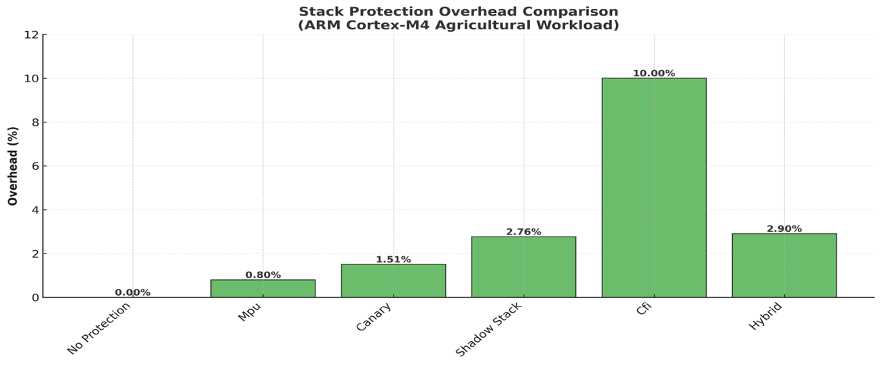
Stack-based attacks pose a major security risk to lightweight edge computing devices used in smart agriculture. This study investigated a secure stack-protection model for Advanced RISC Machines (ARM) Cortex-M4 microcontrollers commonly used in agricultural Internet of Things (IoT) workloads in Nigeria. Six configurations were simulated: Memory Protection Unit (MPU), Stack Canary, Shadow Stack under Mask (SuM), Control-Flow Integrity (CFI), a Hybrid MPU--SuM mechanism, and an unprotected control. The Python-based simulation modelled 500 sensor readings and 100 simulated attack attempts for each mechanism. The Hybrid mechanism prevented all simulated attacks within the defined threat model while incurring only 2.90% performance overhead and a 2.83% reduction in estimated battery life. It maintained an operational lifetime above 5.8 months on a 2000 mAh battery. Although CFI also achieved complete prevention in the simulation, its 10.00% overhead reduced its suitability for latency-sensitive and duty-cycled sensor workloads. The results indicate that hardware-assisted protection, particularly MPU enforcement and the Hybrid MPU--SuM approach, can provide practical stack-level security for resource-constrained agricultural IoT nodes without requiring additional hardware.
Published
How to Cite
Issue
Section
Copyright (c) 2026 Justine Utsu Undiandeye, Moses Adah Agana

This work is licensed under a Creative Commons Attribution 4.0 International License.
How to Cite
Similar Articles
- E. A. Yerima, A. U. Itodo, R. Sha’Atob, R. A. Wuana, G. O. Egah, S. P. Ma’ajia, Phytoremediation and Bioconcentration of Mineral and Heavy metals in Zea mays Inter-planted with Striga hermonthica in Soils from Mechanic Village Wukari , African Scientific Reports: Volume 1, Issue 2, August 2022
- O. E. Ojo, O. A. Oyinloye, A. O. Adejimi, T. Adejumo, Evaluation of an Adaptive Multimedia Streaming in Mobile Cloud Computing for Slow-Speed Networks , African Scientific Reports: Volume 2, Issue 2, August 2023
- M. M. Orosun, Q. T. Lawal , E. O. Ehinlafa, G. B. Egbeyale, G. O. Okwajebi, A. D. Adewuyi, Assessment of Radionuclide Concentrations in Catfish and Tilapia fish from Asa-Dam Ilorin, North-central Nigeria , African Scientific Reports: Volume 2, Issue 1, April 2023
- Emmanuel Joseph, Gonto Kamal, Oluwasesan M. Bello, Natural radionuclide distribution and analysis of associated radiological concerns in rock samples from a rocky town (Dutsin-Ma) in the North-Western region of Nigeria , African Scientific Reports: Volume 2, Issue 3, December 2023
- Rwat Solomon Isa, Tsok Samuel Hwere, Usman Garba, Shehu Sidi Abubakar, Sabastine Emmanuel, Mathematical modelling of terrorists re-cycle induced with backward bifurcation , African Scientific Reports: Volume 2, Issue 3, December 2023
- E. Agboeze, N. P. Ani, E. O. Omeje, Extraction and Characterization of Pharmaceutical Grade Microcrystalline Cellulose From Bambara Nut (Voandzeia Subterranean (L) Thousars) Husk , African Scientific Reports: Volume 1, Issue 2, August 2022
- R. Hamood, Samia Jamal, Zina A. Al Shadid, Mechanical Characterization of Armchair and Zigzag Single-walled Carbon Nanotube , African Scientific Reports: Volume 1, Issue 1, April 2022
- Sunday Sani Daku, Victor Bulus Diyelmak, Ernest Anayo Okafor, Assessment of potentially harmful elements in mine spoils of Jos and environs, central Nigeria , African Scientific Reports: Volume 4, Issue 3, December 2025
You may also start an advanced similarity search for this article.