
The impact of cognitive and emotional factors on user experience in HCI
Keywords:
Human–Computer Interaction (HCI), User Experience (UX), Cognitive Factors, Emotional Design, Affective ComputingAbstract
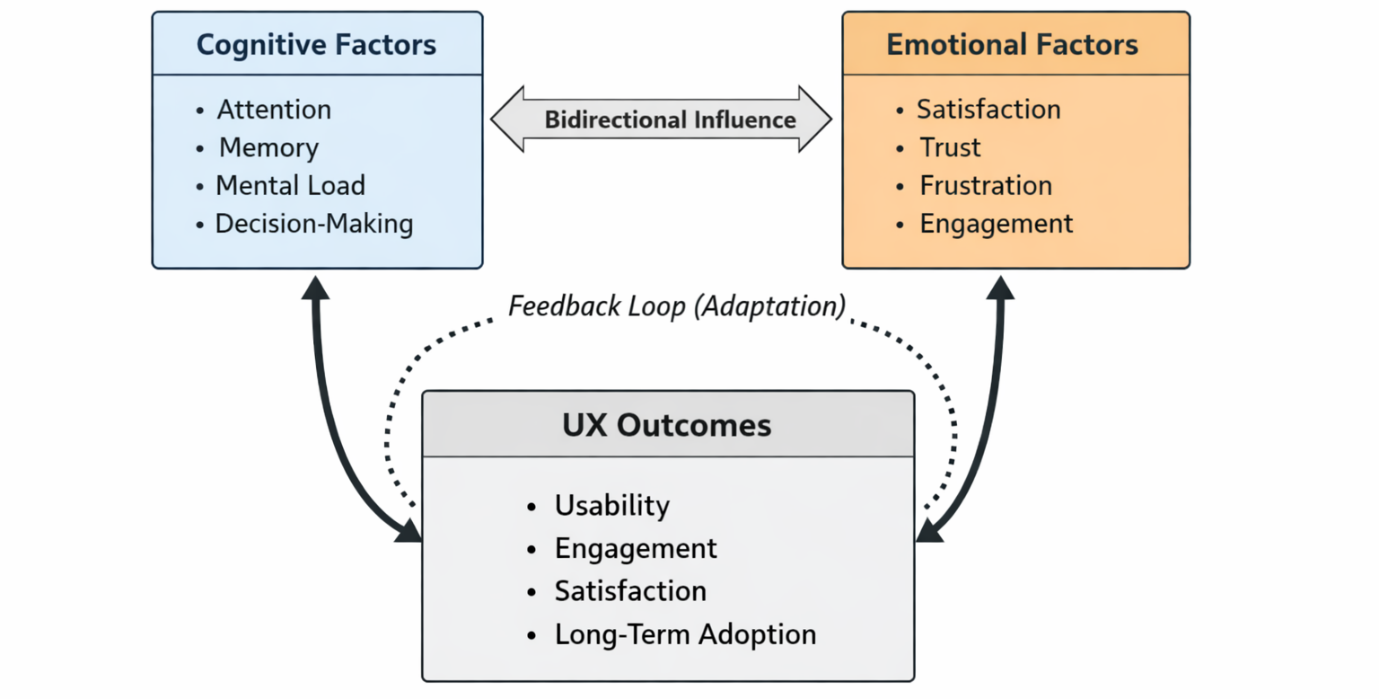
This paper discusses how cognitive and emotional factors affect user experience (UX) in human-computer interaction (HCI). It examines how users' cognitive processes, including perception, attention, memory and decision-making, interact with emotional reactions, including satisfaction, trust and engagement, to shape the quality of interaction. Drawing on principles from cognitive psychology and affective computing, the study shows that effective HCI design extends beyond functionality and efficiency to include emotional appeal and user satisfaction. The paper emphasises that reducing cognitive load, maintaining interface consistency and using intuitive visual cues improve understanding and task performance. At the same time, integrating affective design principles, including aesthetic appeal, empathy and personalisation, contributes to greater emotional satisfaction and user motivation. It also assesses approaches for measuring UX, including usability testing, heuristic evaluation, affective feedback and physiological emotion monitoring, to capture the cognitive and emotional dimensions of interaction. The findings indicate that combining cognitive ergonomics and emotional intelligence in interface design can produce more adaptive, engaging and human-centred systems. By balancing mental efficiency with positive emotional experience, designers can create technologies that promote trust, empathy and long-term user engagement. Overall, this study supports the value of balancing rational and affective design to develop interactive systems that are useful, efficient, meaningful and emotionally satisfying.
References
[1] L. Balcombe & D. De Leo, ``Human-Computer Interaction in digital mental health'', Informatics 9 (2022) 14. https://doi.org/10.3390/informatics9010014.
[2] J. A. Bargas-Avila & K. Hornbæk, ``Old wine in new bottles or novel challenges: A critical analysis of empirical studies of user experience'', in Proc. SIGCHI Conf. Human Factors in Computing Systems, 2011, pp. 2689--2698. https://doi.org/10.1145/1978942.1979336.
[3] R. Beale & C. Peter, ``The role of affect and emotion in HCI'', in Affect and Emotion in Human-Computer Interaction, R. Beale and C. Peter, Eds. Berlin, Germany: Springer, 2008, pp. 1--11. https://doi.org/10.1007/978-3-540-85099-1_1.
[4] R. Yuvaraj, R. Mittal, A. A. Prince & J. S. Huang, ``Affective computing for learning in education: a systematic review and bibliometric analysis'', Education Sciences 15 (2025) 65. https://doi.org/10.3390/educsci15010065.
[5] A. Dorner, M. Bures, M. Simon & G. Pirkl, ``Making cognitive ergonomics in the human–computer interaction of manufacturing execution systems assessable: experimental and validation approaches to closing research gaps'', Machines 12 (2024) 195. https://doi.org/10.3390/machines12030195.
[6] J. M. Carroll & J. R. Olson, ``Mental models in human-computer interaction'' in Handbook of Human-Computer Interaction, North-Holland, 1988, pp. 45-65. https://doi.org/10.1016/B978-0-444-70536-5.50007-5.
[7] T. Farooq, C. M. Nadeem Faisal, J. De Andres, Z. Saeed, S. Anwer & T. Mahmood, ``Improving perception of usability through user interface design patterns to optimize information architecture for cognitive benefits and user satisfaction in massive open online courses'', IEEE Access 13 (2025) 176259. https://doi.org/10.1109/ACCESS.2025.3619384.
[8] J. O. Toje, ``The importance of usability and user-centered design in web applications: a critical review of literature'', 2023. https://doi.org/10.13140/RG.2.2.19014.04160.
[9] D. Cyr, M. Head & A. Ivanov, ``Design aesthetics leading to m-loyalty in mobile commerce'', Inf. Manage. 43 (2006) 950. https://doi.org/10.1016/j.im.2006.08.009.
[10] S. D'Mello & J. Kory, ``A review and meta-analysis of multimodal affect detection systems'', ACM Comput. Surv. 47 (2015) 1. https://doi.org/10.1145/3381466.
[11] P. Desmet & P. Hekkert, ``Framework of product experience'', Int. J. Des. 1 (2007) 57. http://www.ijdesign.org/index.php/IJDesign/article/view/66/15.
[12] A. Dix, ``Human-computer interaction: Principles and practice'', Interact. Comput. 34 (2022) 1. https://doi.org/10.1051/e3sconf/202339904037.
[13] K. Doherty & G. Doherty, ``Engagement in HCI: Conception, theory and measurement'', ACM Comput. Surv. 51 (2018) 1. https://doi.org/10.1145/3234149.
[14] A. T. Duchowski, Eye Tracking Methodology: Theory and Practice, 4th ed. Cham, Switzerland: Springer, 2020. https://doi.org/10.1007/978-1-4471-3750-4.
[15] M. R. Endsley, ``Situation awareness in human-computer interaction: A cognitive perspective'', Hum.-Comput. Interact. 36 (2021) 201. https://doi.org/10.1016/B978-0-443-41660-6.00008-9.
[16] Z. Gao & J. Huang, ``Human-computer interaction emotional design and innovative cultural and creative product design'', Frontiers in Psychology 13 (2022) 982303. https://doi.org/10.3389/fpsyg.2022.982303.
[17] B. L. Fredrickson & C. Branigan, ``Positive emotions broaden the scope of attention and thought-action repertoires'', Cognition and Emotion 19 (2005) 313. https://doi.org/10.1080/02699930441000238.
[18] S. Sun, Y. Sun & J. Li, ``Research on emotional design for VR games in digital cultural heritage: a case of Tianjin Marco Polo Square's virtual--real integrated digital scene'', Heritage 9 (2026) 185. https://doi.org/10.3390/heritage9050185.
[19] M. Hassenzahl, ``Reflections on experience design'', in Experience Design. Synthesis Lectures on Human-Centered Informatics, Springer, Cham, Switzerland, 2010. https://doi.org/10.1007/978-3-031-02191-6_5.
[20] M. Hassenzahl, ``The thing and I: understanding the relationship between user and product'', in Funology, M. A. Blythe, K. Overbeeke, A. F. Monk & P. C. Wright, Eds., Human-computer interaction series, vol. 3, Springer, Dordrecht, 2003. https://doi.org/10.1007/1-4020-2967-5_4.
[21] M. Hassenzahl, ``The interplay of beauty, goodness, and usability in interactive products'', Human--Computer Interaction 19 (2004) 319. https://doi.org/10.1207/s15327051hci1904_2.
[22] M. Hassenzahl & N. Tractinsky, ``User experience - A research agenda'', Behav. Inf. Technol. 25 (2006) 91. https://doi.org/10.1080/01449290500330331.
[23] L. Rui & M. Firzan, ``Emotional design of interior spaces: exploring challenges and opportunities'', Buildings 15 (2025) 153. https://doi.org/10.3390/buildings15020153.
[24] L. Hirsch, S. Paananen, D. Lengyel, J. Häkkilä, G. Toubekis, R. Talhouk & L. Hespanhol, ``Human--computer interaction (HCI) advances to re-contextualize cultural heritage toward multiperspectivity, inclusion, and sensemaking'', Applied Sciences 14 (2024) 7652. https://doi.org/10.3390/app14177652.
[25] A. Dirin & T. H. Laine, ``The influence of virtual character design on emotional engagement in immersive virtual reality: the case of feelings of being'', Electronics 12 (2023) 2321. https://doi.org/10.3390/electronics12102321.
[26] A. Johnson & R. W. Proctor, ``Perceptual processes in user interface design'', Int. J. Hum.-Comput. Interact. 36 (2020) 901. https://doi.org/10.1080/0144929X.2016.1186735.
[27] P. W. Jordan, Designing Pleasurable Products: An Introduction to the New Human Factors, 1st ed. CRC Press, London, U.K. 2000. https://doi.org/10.1201/9780203305683.
[28] S. Kalyuga, ``Cognitive load theory: How many types of load?'', Educ. Psychol. Rev. 23 (2011) 1. https://doi.org/10.1007/s10648-010-9150-7.
[29] D. R. Kaufman, T. G. Kannampallil & V. L. Patel, ``Cognition and human-computer interaction in healthcare'', in Human-Computer Interaction in Healthcare, D. R. Kaufman, T. G. Kannampallil & V. L. Patel (Eds.) Springer, Cham, Switzerland, 2024, pp. 11--36. https://doi.org/10.1007/978-3-031-69947-4_2.
[30] F. Xie, Y. He, S. Zheng, L. Ling & Z. Fan, ``Human--computer interaction analysis and prediction for task operating system based on GOMS model'', in Man-Machine-Environment System Engineering (MMESE 2020), S. Long & B. S. Dhillon (Eds.) Lecture Notes in Electrical Engineering, vol. 645, Springer, Singapore, 2020. https://doi.org/10.1007/978-981-15-6978-4_83.
[31] Q. Keqiu, M. S. B. Muhammad & N. B. Mohd Norowi, ``Emotional design elements in mobile apps: a TTED-based systematic review'', IEEE Access 14 (2026) 12316. https://doi.org/10.1109/ACCESS.2026.3656285.
[32] M. Kurosu, Ed., Human-Computer Interaction. Design and User Experience. Cham, Switzerland: Springer, 2020. https://doi.org/10.1007/978-3-030-49059-1.
[33] L. S. Machado, J. B. dos Santos França, S. Delabrida & R. dos Santos Oliveira, ``Hci research methods in focus: perspectives and strategies,” in human-computer interaction – INTERACT 2025, C. Ardito et al., Eds., Lecture Notes in Computer Science, vol. 16111. Cham: Springer, 2026. https://doi.org/10.1007/978-3-032-05008-3_69.
[34] A. Vizcarra, G. Quiroz & J. Cornejo, ``The impact of user interface and experience (UI/UX) design on visual ergonomics: a technical approach for reducing human error in industrial settings'', Designs 10 (2026) 8. https://doi.org/10.3390/designs10010008.
[35] N. Makkan, J. Brosens & R. Kruger, ``Designing for positive emotional responses in users of interactive digital technologies: a systematic literature review'', in Responsible Design, Implementation and Use of Information and Communication Technology, vol. 12067, pp. 441--451, 2020. https://doi.org/10.1007/978-3-030-45002-1_38.
[36] T. McCall, M. Threats, M. Pillai, A. Lakdawala & C. S. Bolton III, ``Recommendations for design of a mobile application to support management of anxiety and depression among Black American women'', Frontiers in Digital Health 4 (2022) 1028408. https://doi.org/10.3389/fdgth.2022.1028408.
[37] Y. Lin, Y. Liu, W. Li, L. Zhou, Y. Ge, J. Chai & X. Sun, ``Using physiological measures to evaluate user experience of mobile applications'', in Engineering Psychology and Cognitive Ergonomics (EPCE 2014), D. Harris (Ed.) Lecture Notes in Computer Science, vol. 8532, Springer, Cham, Switzerland, 2014. https://doi.org/10.1007/978-3-319-07515-0_31.
[38] R. AlShaikh, N. Al-Malki & M. Almasre, ``The implementation of the cognitive theory of multimedia learning in the design and evaluation of an AI educational video assistant utilizing large language models'', Heliyon 10 (2024) e25361. https://doi.org/10.1016/j.heliyon.2024.e25361.
[39] S. Richmond, Design for a better world: meaningful, sustainable, humanity centered, Donald Norman, Explorations in Media Ecology 24 (2025) 255. https://doi.org/10.1386/eme_00249_5.
[40] V. Pammer-Schindler, E. Harpstead, B. Xie, B. DiSalvo, A. Kharrufa, P. Slovak, A. Ogan, J. J. Williams & M. J. Lee, ``Learning and education in HCI: a reflection on the SIG at CHI 2019'', interactions 27 (2020) 6. https://doi.org/10.1145/3411290.
[41] S. Kaur & N. Kulkarni, ``Recent trends and challenges in human computer interaction using automatic emotion recognition: a review'', International Journal of Biometrics 16 (2023) 16. https://doi.org/10.1504/IJBM.2024.135160.
[42] H. Pashler & S. Sutherland, ``Attention and interface design: Cognitive constraints and opportunities'', Cogn. Tech. Work 24 (2022) 245. https://doi.org/10.1007/s10111-021-00689-3.
[43] P. S. Saikrishna, ``Affective edge computing: challenges and opportunities in decoding emotional states'', in Bridging the Gap between Mind and Machine, R. Vinjamuri (Ed.) Springer, Cham, Switzerland, 2026. https://doi.org/10.1007/978-3-032-06713-5_3.
[44] I. Burkitt, ``The emotions in cultural-historical activity theory: personality, emotion and motivation in social relations and activity'', Integrative Psychological and Behavioral Science 55 (2021) 797. https://doi.org/10.1007/s12124-021-09615-x.
[45] F. E. Ritter, G. D. Baxter & E. F. Churchill, Foundations for Designing User-Centered Systems: What System Designers Need to Know about People, Springer, London, UK, 2014. https://doi.org/10.1007/978-1-4471-5134-0.
[46] J. Wu, K. D. Hesseldahl, S. Johnson, S. Clark, D. Quinlan & D. Harrow, ``Designing for driver's emotional transitions and rituals'', in 13th International Conference on Automotive User Interfaces and Interactive Vehicular Applications (AutomotiveUI '21), Association for Computing Machinery, New York, NY, USA, 2021, pp. 126--136. https://doi.org/10.1145/3409118.3475143.
[47] E. Dell'Aquila, M. Ponticorvo & P. Limone, ``Psychological foundations for effective human--computer interaction in education'', Applied Sciences 15 (2025) 3194. https://doi.org/10.3390/app15063194.
[48] P. Slovak & S. A. Munson, ``HCI contributions in mental health: a modular framework to guide psychosocial intervention design'', in Proceedings of the 2024 CHI Conference on Human Factors in Computing Systems (CHI '24), Association for Computing Machinery, New York, NY, USA, 2024, Article 692, pp. 1--21. https://doi.org/10.1145/3613904.3642624.
[49] A. Sonderegger & J. Sauer, ``The influence of aesthetics on perceived usability in HCI'', Ergonomics 63 (2020) 983. https://doi.org/10.1016/j.apergo.2009.09.002.
[50] J. Sweller, J. J. G. van Merriënboer & F. Paas, ``Cognitive architecture and instructional design: 20 years later'', Educ. Psychol. Rev. 31 (2019) 261. https://doi.org/10.1007/s10648-019-09465-5.
[51] F. Shahnabati, A. Sabourifard, S. H. Amiri, A. Bosaghzadeh & R. Ebrahimpour, ``Cognitive load and visual attention assessment using physiological eye tracking measures in multimedia learning'', PLOS ONE 20 (2025) e0337195. https://doi.org/10.1371/journal.pone.0337195.
[52] M. Thüring & S. Mahlke, ``Usability, aesthetics and emotions in human--technology interaction'', International Journal of Psychology 42 (2007) 253. https://doi.org/10.1080/00207590701396674.
[53] Y. Liu, K. Wang, L. Wei, J. Chen, Y. Zhan, D. Tao & Z. Chen, ``Affective computing for healthcare: recent trends, applications, challenges, and beyond'', arXiv preprint arXiv:2402.13589 [cs.HC], 2024. https://arxiv.org/abs/2402.13589.
Published
How to Cite
Issue
Section
Copyright (c) 2026 Ike Joseph Mgbeafulike, Ogochukwu C. Okeke, Osita Miracle Nwakeze, Anthony T. Umerah, Uju Cynthia Nwabudike, Chikaodili Chidi-Onuigbo

This work is licensed under a Creative Commons Attribution 4.0 International License.