
Measurement and simulation of indoor radon concentration distribution in students’ residential hostels around Ladoke Akintola University of Technology, Ogbomoso, Nigeria
Keywords:
Indoor radon, Air change rate, Annual absorbed dose, Annual effective dose, Radon monitoringAbstract
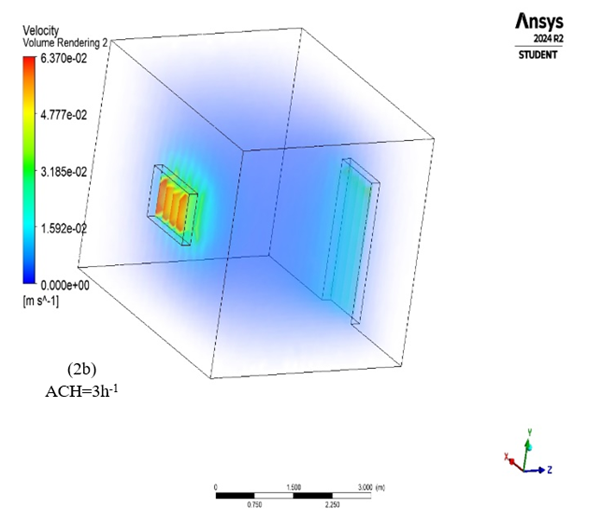
Radon is a harmful gas and class I carcinogen posing global challenge to human health. Being an inert gas, it is impossible to perceive its presence by any of the sense organs, thus the application of Computational Fluid Dynamics (CFD) simulation in radon study is enhancing human understanding of the behavior and distribution of radon in indoor air. Hence, this work measured the indoor radon concentration (Ri) in student’s residential hostels and evaluate radon gas distribution in indoor air. In-situ measurement of the Ri in 10 student’s residential hostels was carried for a period of one month using RAD7. The CFD code ANSYS Fluent 2024R2, based on the finite volume method was employed in modeling the geometry of the student’s room, calculate, predict and visualize the concentration and distribution of radon inside the room. The average measured Ri was 45.89 Bq/m3 with a corresponding annual effective dose of 1.042 mSv/yr. The simulation revealed an average value of 45.51 Bq/m3 and the annual effective dose from the inhalation of radon when ACH is 2, 3 and 4 h-1 respectively was calculated to be 1.03 mSv/yr, which is lower than the recommended value by ICRP. The simulation revealed that radon gas is more concentrated at the building window compare to other parts of the building. It is therefore recommended that the indoor radon induced air be diffused with external or fresh air by ensuring adequate ventilation and maintaining healthy air circulation.
References
[1] M. A. Ashraf & M. M. Hanafiah, “Sustaining life on earth system through clean air, pure water and fertile soil”, Environmental science and pollution research 26 (2019) 13679. https://doi.org/10.1007/s11356-018-3528-3.
[2] E. W. Pinchbeck, N. Szumilo, S. Roth & E. Vanino “The price of indoor air pollution: evidence from radon maps and the housing market”, Journal of the Association of Environmental and Resource Economists 10 (2023) 1439. https://www.journals.uchicago.edu/doi/abs/10.1086/725028.
[3] E. A. Oni, O. O. Oladapo, M. K. Lawal, A. A. Aremu, P. S. Ayanlola, O. O. Oloyede & O. M. Oni “An overview of radon concentration in southwestern Nigeria”, Physical Science and Biophysics Journal 6 (2022) 000220. https://doi.org/10.23880/psbj-16000220.
[4] K. Aladeniyi “Health risk evaluation of radon progeny exposure in Nigeria traditional mud houses”, Journal of the Nigerian Society of Physical Sciences 6 (2024) 2128. https://doi.org/10.46481/jnsps.2024.2128.
[5] A. A. Aremu, M. O. Oni, O. O. Oladapo, E. A. Oni, P. S. Ayanlola, A. O. Adewoye, K. Amodu, M. K. Lawal & A. E. Oladipo. “Radiological risk assessment of radon inhalation in offices of selected institutions in southwestern Nigeria”, LAUTECH Journal of Civil and Environmental Studies 11 (2023) 107. https://doi.org/10.36108/laujoces/3202.11.0101.
[6] M. Fuente, S. Long, D. Fenton, L. C. Hung, J. Goggins & M. Foleya “Review of recent radon research in Ireland, OPTI-SDS project and its impact on the National Radon Control Strategy”, Applied radiation ad isotopes 163 (2020) 109210. https://doi.org/10.1016/j.apradiso.2020.109210.
[7] R. Rabi & L. Oufni “Study of radon dispersion in typical dwelling using CFD modeling combined with passive-active measurements”, Radiation Physics and Chemistry 139 (2017) 40. http://dx.doi.org/10.1016/j.radphyschem.2017.04.012.
[8] S. Snehal & K. Priya “Review paper on air pollution monitoring system”, International Journal of Advanced Research in Computer and Communication Engineering 4 (2015) 218. http://dx.doi.org/10.17148/IJARCCE.2015.4147.
[9] E. A. Oni, P. S. Ayanlola, A. A. Aremu, O. O. Oladapo & M. K. Lawal “Effect of chronic exposure to low-level radon gas from tertiary institutions workplaces in western Nigeria”, Journal of Applied Science and Environmental Management 29 (2025) 831. https://dx.doi.org/10.4314/jasem.v29i3.19.
[10] A. Keramatollah, M. Jafar & M. Ghanbari “Simulation of ventilation effects on indoor radon”. Management of Environmental Quality 24 (2013) 394. http://dx.doi.org/10.1108/14777831311322686.
[11] F. A. Lima, R. P. Palomino-Merino, V. M. Castano & G. Espinosa “Analysis of indoor radon distribution within a room by means of computational fluid dynamics (CFD) simulation”, Journal of Nuclear Physics, Material Science Radiation and Applications 7 (2020) 89. http://dx.doi.org/10.15415/jnp.2020.72010.
[12] W. Y. A. Elola, T. L. Bambara, A. Doumounia, N. Kohio, S. Ouédraogo & F. Zougmore “Assessment of radon concentrations inside residential buildings and estimation of the dose in the city of Kaya, Burkina Faso”, Open Journal of Applied Sciences 13 (2023) 1066. https://doi.org/10.4236/ojapps.2023.137085.
[13] M. R. Usikalu, V. Olatinwo, M. Akpochafor, M. A. Aweda, G. Giannini & V. Massimo “Measurement of radon concentration in selected houses in Ibadan, Nigeria,” Journal of Physics: Conference Series 852 (2017) 012028. https://doi.org/10.1088/1742-6596/852/1/012028.
[14] United Nations Scientific Committee on the Effects of Atomic Radiation (UNSCEAR 2000). Sources and effects of ionizing radiation. Report to the General Assembly, with scientific annexes, Vol 1. [Online]. https://www.google.com/url?sa=t&source=web&rct=j&opi=89978449&url=https://www.unscear.org/unscear/uploads/documents/unscear-reports/UNSCEAR_2000_Report_Vol.I.pdf.
[15] R. Rabi, L. Oufni & H. Badry “Measurements and CFD modeling of outdoor radon dispersion”, in 7th International Conference on Optimization and Applications, Wolfenbüttel, 1-7. 2021. https://doi.org/10.1109/icoa51614.2021.9442664.
[16] T. Wah-Yen, Y. Asako, N. A. Che sidik & G. Rui-Zher “Governing equations in CFD: derivation and a recent review”, Journal of Progress in Energy and Environment 1 (2017) 1. ISSN: 2600-7762. [Online]. https://www.researchgate.net/publication/322031540_Governing_Equations_in_Computational_Fluid_Dynamics_Derivations_and_A_Recent_Review.
[17] A. Narkhede & N. Gnanasekaran “3D numerical modelling of turbulent flow in a channel partially filled with different blockage ratios of metal foam”, Journal of Applied Fluid Mechanics 17 (2024) 548. https://doi.org/10.47176/jafm.17.3.2189.
[18] B. E. Anyaegbuna, A. O. Onokwai, N. T. Anyaegbuna, S. Iweriolor, I. D. Anyaegbuna, I. K. Adegun, O. S. Fayomi, D. E. Igbravwe & M. K. Onifade “Numerical analysis on mechanical ventilation impact on indoor air quality in a basement”, Scientific Africa 25 (2024) 2468. https://doi.org/10.1016/j.sciaf.2024.e02310.
[19] E. C. Jung, G. H. Lee, E. B. Shim, H. Ha “Assessing the impact of turbulent kinetic energy boundary conditions on turbulent flow simulations using computational fluid dynamics”, Scientific Reports 13 (2023) 14638. https://doi.org/10.1038/s41598-023-41324-w.
[20] M. Adelikhah, M. Imani & T. Kovacs “Measurements and computational fluid dynamics investigation of the indoor radon distribution in a typically natural ventilated room”, Scientific reports 13 (2023) 2064. https://doi.org/10.1038/s41598-022-23642-7.
[21] International Commission on Radiation Protection (ICRP). Summary of ICRP recommendations on radon. ICRP ref. 4836-9756-8598. 2018. [Online]. https://www.icrpaedia.org/images/f/fd/ICRPRadonSummary.pdf.
[22] World health organization (WHO). Handbook on indoor radon: A public health perspective. WHO press, Switzerland. ISBN 978-92-4-156558-5. 2009. [Online]. https://iris.who.int/bitstream/handle/10665/44149/9789241547673 eng.pdf.
[23] US Environmental Protection Agency (EPA) EPA protocol for conducting radon and radon decay product measurements in multifamily buildings; Environmental Protection Agency: Washington. DC, 2017. [Online]. https://www.google.com/url?sa=t&source=web&rct=j&opi=89978449&url=https://nepis.epa.gov/Exe/ZyPURL.cgi%3FDockey%3D0000059B.TXT.
[24] S. A. Amin, S. D. Alalgawi & H. M. Hashim “Indoor radon concentrations and effective dose estimation in Al-Karkh side of Baghdad dwellings”, Iranian Journal of Science & Technology 39 (2015) 491. https://doi.org/10.22099/ijsts.2015.3400.
[25] M. Fahiminia, F. R. Fouladi, R. Ardani, K. Naddafi, M. S. Hassanvand & B. A. Mohammad “Indoor radon measurements in residential dwellings in Qom, Iran”, International Journal of Radiation Research 14 (2016) 331. http://dx.doi.org/10.18869/acadpub.ijrr.14.4.331.
[26] W. A. Alhamdi & K. M. S. Abdullah “Estimation of indoor radon concentration and dose evaluation of radon and its progeny in selected dwellings in Duhok city, Kurdistan Region, Iraq”, International Journal of Radiation Research 20 (2022) 461. http://dx.doi.org/10.52547/ijrr.
[27] M. Tirmarche, J. D. Harrison, D. Laurier, F. Paquet, E. Blanchardon & J. W. Marsh, “International Commission on Radiological Protection. ICRP Publication 115. Lung cancer risk from radon and progeny and statement on radon”, Annals of the ICRP 40 (2010) 1. https://doi.org/10.1016/j.icrp.2011.08.011.
[28] U.S. Environmental Protection Agency. (2009). A citizen’s guide to radon: the guide to protecting yourself and your family from radon. Washington, DC: U.S. EPA. https://www.epa.gov/radon.
Published
How to Cite
Issue
Section
Copyright (c) 2025 E. A. Oni, C. O. Ajiboye, P. S. Ayanlola, O. O. Oloyede, A. A. Aremu, T. A. Olajide, O. O. Oladapo, O. P. Oyero, A. E. Oladipo, M. K. Lawal

This work is licensed under a Creative Commons Attribution 4.0 International License.