Acute toxicity of Oreochromis niloticus fingerlings exposed to effluent from Delta State University, Abraka Nigeria boys hostel
Keywords:
Aquatic pollution, Behavioural responses, Effluent, Toxicity, Oreochromis niloticusAbstract
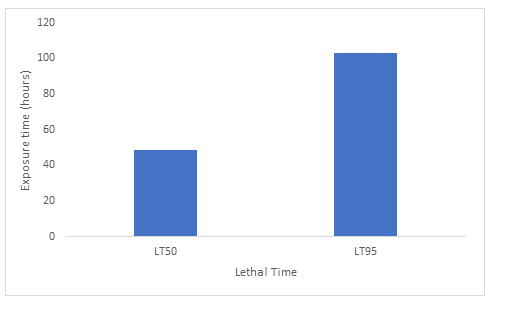
Studies on aquatic pollution are crucial for maintaining environmental health. This study assessed the toxicity of effluents from the male hostel site II at Delta State University (DELSU) on Oreochromis niloticus fingerlings. Behavioral responses and mortality rates were observed as toxicity indicators. The physicochemical characteristics of the raw effluent were evaluated and compared with standard methods. In a 96-hour static bioassay, 20 fingerlings were exposed to varying effluent concentrations: 0%, 20%, 40%, 60%, 80%, and 100%, with the experiment triplicated. Analysis showed pH (5.6), temperature (26.1°C), TDS (304 mg/L), dissolved oxygen (5.7 mg/L), chlorine (5.55 mg/L), ammonia (0.21 mg/L), and hardness (0.79 mg/L). Water analysis over 12-96 hours ranged for pH (5.45-5.62), temperature (22.50-26.30°C), TDS (61.50-237.50 mg/L), DO (4.45-6.00 mg/L), chlorine (0.84-3.98 mg/L), ammonia (0.14-0.37 mg/L), and hardness (6.52-31.93 mg/L), with no statistically significant differences (p>0.05). Behavioral responses included air gulping, irregular swimming, and lack of reflex. Mortality depended on effluent concentration, with no deaths at 0%-80% but 80% mortality at 100%. Lethal times for 50% and 95% mortality at 100% concentration were 48.6 and 102.8 hours, respectively. Diluting or treating wastewater before release is necessary to prevent fish mortality in the wild.
References
R. Verma & S. Kumar, “Research on the impact of river pollution on water quality”, Social Science Journal for Advanced Research 3 (2023) 4. https://doi.org/10.54741/ssjar.3.4.3.
A. Anju, S. Ravi & S. Bechan, “Water pollution with special reference to pesticide contamination in India”, Journal of Water Resource and Protection 2 (2010) 432. https://doi.org/DOI:10.4236/jwarp.2010.25050.
M. Porretti, F. Arrigo, G. Di Bella & C. Faggio, “Impact of pharmaceutical products on zebrafish: An effective tool to assess aquatic pollution”, Comparative Biochemistry and Physiology Part C: Toxicology & Pharmacology 261 (2022) 109439. https://doi.org/10.1016/j.cbpc.2022.109439.
A. Gajewicz-Skretna, E. Wyrzykowska & M. Gromelski, “Quantitative multi-species toxicity modeling: Does a multi-species, machine learning model provide better performance than a single-species model for the evaluation of acute aquatic toxicity by organic pollutants?”, Science of The Total Environment 861 (2023) 160590. https://doi.org/10.1016/j.scitotenv.2022.160590.
B. F. Bakare & G. C. Adeyinka, “Evaluating the potential health risks of selected heavy metals across four wastewater treatment water works in Durban, South Africa”, Toxics 10 (2022) 340. https://doi.org/10.3390/toxics10060340
B. A. Seay, K. Dasu, I. C. MacGregor, M. P. Austin, R. T. Krile, A. J. Frank & S. Buehler, “Per- and polyfluoroalkyl substances fate and transport at a wastewater treatment plant with a collocated sewage sludge incinerator”, Science of The Total Environment 874 (2023) 162357. https://doi.org/10.1016/j.scitotenv.2023.162357.
G. Grziniˇ c, A. Piotrowicz-Cie´ slak, A. Klimkowicz-Pawlas, R. L. G´ orny, A. Ławniczek-Wałczyk, L. Piechowicz & L. Wolska, “Intensive´ poultry farming: A review of the impact on the environment and human health”, Science of The Total Environment 858 (2023) 160014. https://doi.org/10.1016/j.scitotenv.2022.160014.
W. S. H. W. Sulaiman, R. Othman, N. H. Abd Latiff, R. Ramya & F. A. M. Hatta, “Physicochemical Properties for Toyyib Environmental Assessment on Lake Water Quality”, A Mini Review Halalpshere 3 (2023) 1. https://doi.org/10.31436/hs.v3i1.67.
C. E. Lach, C. S. Pauli, A. S. Coan, E. L. Simionatto & L. A. D. Koslowski, “Investigating the process of electrocoagulation in the removal of azo dye from synthetic textile effluents and the effects of acute toxicity on Daphnia magna test organisms”, Journal of Water Process Engineering 45 (2022) 102485. https://doi.org/10.1016/j.jwpe.2021.102485.
M. Kindie, M. Andargie, W. Hilluf & M. Amare, “Assessment on level of selected heavy metals in Nile tilapia and Barbus fish species and water samples from the southern parts of Lake Tana, Ethiopia”, Scientific African 9 (2020) e00519. https://doi.org/10.1016/j.sciaf.2020.e00519.
S. E. Abalaka, F. O. Oyelowo, M. G. Akande, O. Z. Tenuche, N. A. Sani, B. T. Adeyemo & S. A. Ejeh, “Toxicopathological effects of acute cadmium chloride exposure of African Catfish, Clarias gariepinus”, Toxicology and Environmental Health Sciences 14 (2022) 25. https://doi.org/10.1007/s13530-021-00113-6.
Y. Kawashima, Y. Onishi, N. Tatarazako, H. Yamamoto, M. Koshio, T. Oka, Y. Horie, H. Watanabe, T. Nakamoto, J. Yamamoto, H. Ishikawa, T. Sato, K. Yamazaki, & T. Iguchi, “Summary of 17 chemicals evaluated by OECD TG229 using Japanese Medaka, Oryzias latipes in EXTEND 2016”, Journal of Applied Toxicology 42 (2022) 750. https://doi.org/10.1002/jat.4255.
A. Faith & D. Okoro, “Assessment of physicochemical properties of the ovwian section of the Warri River”, International Journal of Scientific Research and Management (IJSRM) 11 (2023). https://doi.org/10.18535/ijsrm/v11i10.c02.
M. Miebaka, E. Nwabueze & E. Ikem “Toxicology digest acute toxic effects of petroleum refinery effluents on fingerlings of tilapia oreochromis niloticus and clarias gariepinus catfish”, Toxicology Digest 1 (2017) 148. https://www.researchgate.net/publication/331642505-Toxicology-Digest-Acute-Toxic-Effects-of-Petroleum-Refinery-Effluents-on-Fingerlings-of-Tilapia-Oreochromis-niloticus-and-Clarias-gariepinus-Catfish.
R. S. Lokhande, P. U. Singare & D. S. Pimple, “Study on Physico-Chemical Parameters of Waste Water Effluents from Taloja Industrial Area of Mumbai, India”, International Journal of Ecosystem 1 (2012) 1. http://dx.doi.org/10.5923/j.ije.20110101.01.
K. C. Ogbu, C. I. Ebenebe & M. C. Abajue, “Physico-chemical characteristics of ama brewery effluent and its receiving Ajali River in Udi, Enugu State, Nigeria”, Animal Research International 13 (2016) 2. https://www.researchgate.net/publication/320015155-Physico-chemical-characteristics-of-ama-brewery-effluent-and-its-receiving-Ajali-River-in-Udi
M. K. Ladipo, V. F. Doherty, and S. A. Oyebadejo “Acute toxicity, behavioural changes and histopathological effect of paraquat dichloride on tissues of catfish (Clarias gariepinus)”, International Journal of Biology 3 (2011) 2. https://doi.org/10.5539/ijb.v3n2p67.
Published
How to Cite
Issue
Section
Copyright (c) 2024 Ebenezer O. Ayoola, Victor N. Enwemiwe, Hilda O. Erhenhi, Clement C. Obi, Agboola A. Adebowale, Eric Esiwo, Joyce A. Onokpasa, Robert B. Ikomi

This work is licensed under a Creative Commons Attribution 4.0 International License.