
Evaluation of daily tropospheric radio refractivity, refractivity gradient and geoclimatic factor over Otukpo, Benue State, Nigeria
Keywords:
Geoclimatic factor, Meteorological data, Radio waves, Radio refractivity gradientAbstract
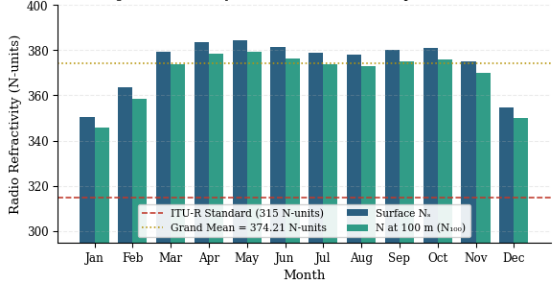
Radio refractivity is a key parameter for reliable terrestrial microwave-link design because the tropospheric propagation of radio waves is strongly affected by atmospheric refractive properties. Daily meteorological data spanning 23 years (2000--2022) were analysed to characterise surface radio refractivity (Ns), estimate refractivity at 100 m altitude (N100), determine the radio refractivity gradient (RRG), and compute the geoclimatic factor (K-factor) over Otukpo, Benue State, Nigeria (7.22oN, 8.15oE; 91 m altitude). Surface refractivity was calculated using the International Telecommunication Union--Radiocommunication Sector (ITU-R) P.453-14 three-term equation with temperature, relative humidity, and surface pressure data from the National Aeronautics and Space Administration Prediction of Worldwide Energy Resources (NASA POWER) reanalysis database. N100 was estimated with the ITU-R exponential refractivity profile, and the RRG and K-factor were computed using ITU-R P.530-18. Seasonal and interannual variability were assessed from monthly and annual averages. The grand mean surface refractivity was 374.21 N-units, about 61 N-units higher than the height-adjusted ITU-R reference value (approx 313 N-units). Refractivity showed a distinct bimodal seasonal pattern, with the highest value in May (384.32 N-units) and the lowest value in January (350.44 N-units) during the Harmattan season. The mean RRG and mean K-factor were estimated as -50.57 N-units km-1 and 1.4757, respectively, corresponding to an effective Earth radius of about 9,402 km. These values were derived from observed surface refractivity climatology using the ITU-R model and are not direct measurements of vertical atmospheric structure. The results show that refractivity over Otukpo is generally higher than standard ITU-R conditions, indicating that locally derived propagation parameters are more representative for terrestrial microwave-link planning. These estimates should be confirmed in future studies using upper-air or high-resolution atmospheric profile data.
Published
How to Cite
Issue
Section
Copyright (c) 2026 Emmanuel Daniel Onoja, Andrew Ichoja, Anthony Odeh Ejila, Majesty Oche Omikpa, Emmanuel Vezua Tikyaa, Elijah E. Onwoke, Jack Zuhumnan Kevin

This work is licensed under a Creative Commons Attribution 4.0 International License.
How to Cite
Similar Articles
- M. M. Tanko, M. S. Liman, W. L. Lumbi, U. S. Aliyu, Spatial and Seasonal Estimation of Tropospheric Radio Refractivity in Nigeria , African Scientific Reports: Volume 1, Issue 1, April 2022
- Mohammed Sidi, Abubakar Aminu Abubakar, Anas Ya'u, Umar Mansur, Aliyu Abdullahi Hassan, Usman Tijjani, Shielding Adequacy of Conventional X-ray Facilities in Kano Metropolis, Nigeria using RadShield Software , African Scientific Reports: Volume 1, Issue 3, December 2022
- J. E. Moyegbone, P. Onyema, O. C. Madubuattah, E. O. Emurotu, E. E. Oronsaye, P. T. Osunu, J. A. Ebeigbe, E. U. Nwose, Prevalence and driving-related factors influencing prediabetes and diabetes among commercial drivers in Benin City metropolis, Edo State, Nigeria , African Scientific Reports: Volume 5, Issue 1, April 2026
- Emmanuel Ike, Adetola Sunday Oniku, Sabastine Chinedu Ezike, Maxwell Obia Kanu, Rodney Ewusi-Wilson, Geothermal resource potentials estimation from the interpretation of aeromagnetic data over parts of Southwestern Nigeria , African Scientific Reports: Volume 3, Issue 1, April 2024
- Oladimeji Lukman Abiola, Oke Samuel Abayomi, Akinade Oludayo Olugbenga, Oguntola Toyin Omoyeni, Adebayo Azeez Ademola, Daily rainfall prediction in Lagos using logistic regression, random forest, and support vector machine with web development , African Scientific Reports: Volume 5, Issue 3, December 2026 (In progress)
- Grace Adagba, Emmanuel Vezua Tikyaa, Tertsea Igbawua, Moses Owoicho Audu, Investigating chaos in solar activity over six solar cycles , African Scientific Reports: Volume 5, Issue 2, August 2026
- Shamsuddeen Sani Alhassan, Mahmud Abdulsalam, Abdullahi Tanimu, Ibrahim Muhammad Bagudo, Role of Van der Waals correction on the catalytic performance of 1T-TiS₂ electrocatalyst , African Scientific Reports: Volume 4, Issue 3, December 2025
- Ebenezer O. Oladipe, Sunday E. Adewumi, Taiwo Kolajo, Joshua B. Agbogun, Crop recommendation in precision agriculture: a systematic literature review of methods, trends, and challenges , African Scientific Reports: Volume 5, Issue 3, December 2026 (In progress)
- A. O. Daramola, T. J. Ajayi, O. S. Olusi, T. V. Olugbade, E. O. Aina, A. J. Folorunso, B. M. Rotimi, K. S. Okonji, Epidemiology of ABO and Rhesus blood group frequencies in a Nigerian tertiary hospital: public health and transfusion-relevant patterns , African Scientific Reports: Volume 5, Issue 3, December 2026 (In progress)
- Denis U. Ashishie, Endurance O. Obi, Osowomuabe Njama-Abang, Ahena I. Bassey, Transformative approach in Lassa fever diagnostics: an innovative integrative strategy for early detection and outcome prediction , African Scientific Reports: Volume 4, Issue 3, December 2025
You may also start an advanced similarity search for this article.
Most read articles by the same author(s)
- I. M. Echi, E. V. Tikyaa, E. J. Eweh, A. A. Tyovenda, T. Igbawua, Investigation of the spatial distribution of deterministic chaos in some meteorological variables across Nigeria , African Scientific Reports: Volume 4, Issue 2, August 2025
- Grace Adagba, Emmanuel Vezua Tikyaa, Tertsea Igbawua, Moses Owoicho Audu, Investigating chaos in solar activity over six solar cycles , African Scientific Reports: Volume 5, Issue 2, August 2026