
Investigating chaos in solar activity over six solar cycles

Authors

  • Grace Adagba
    Department of Physics, Moses Orshio Adasu University, Makurdi, Benue State, Nigeria
  • Emmanuel Vezua Tikyaa
    Department of Physics, Joseph Sarwuan Tarka University, Makurdi, Benue State, Nigeria
  • Tertsea Igbawua
    Department of Physics, Joseph Sarwuan Tarka University, Makurdi, Benue State, Nigeria
  • Moses Owoicho Audu
    Department of Physics, Joseph Sarwuan Tarka University, Makurdi, Benue State, Nigeria

Keywords:

Solar cycle, Sunspot number, Equivalent planetary amplitude, Solar radio flux, Chaos

Abstract

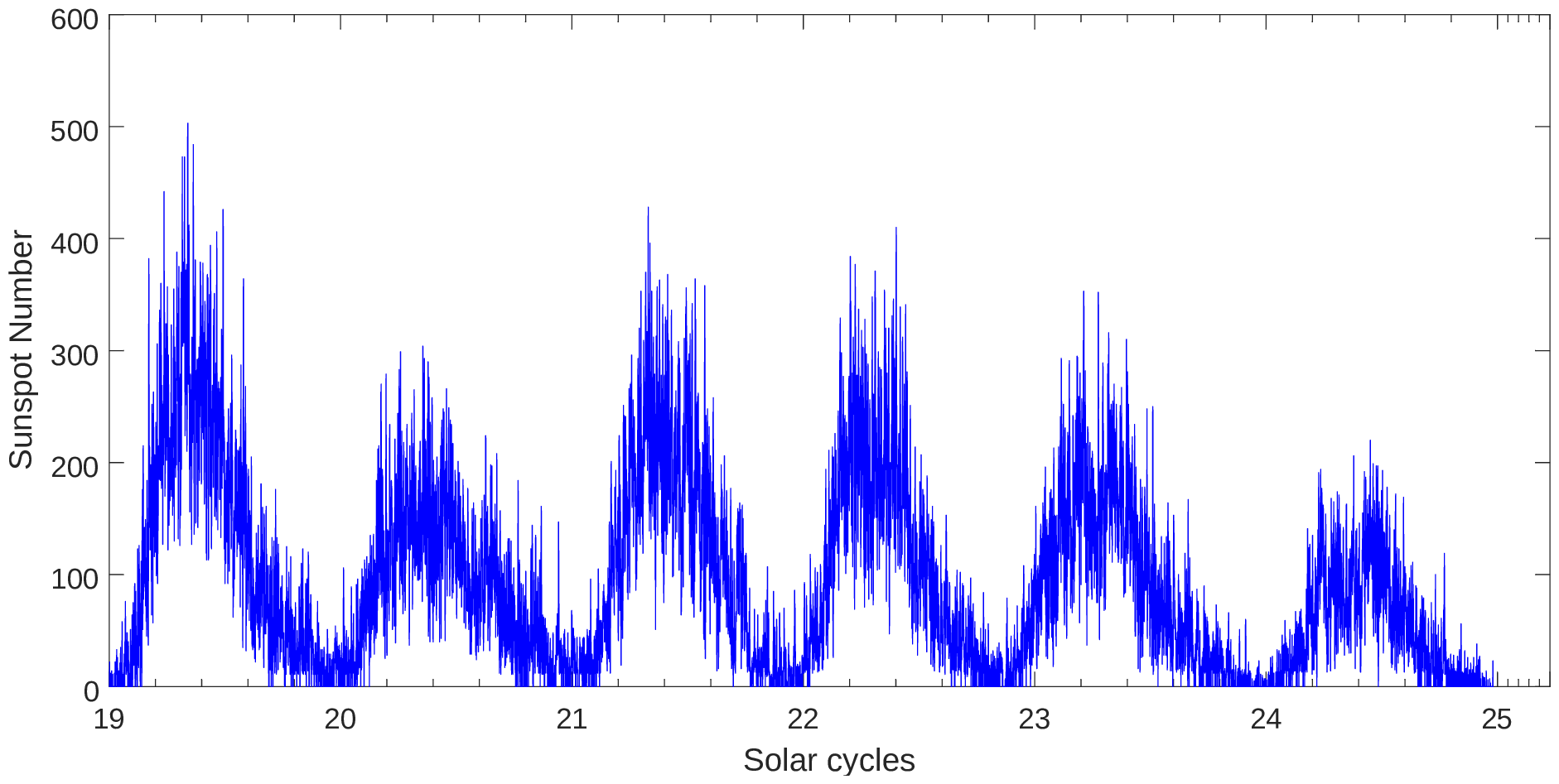
In this work, nonlinear dynamical characterization of selected geospace variables was undertaken by analyzing temporal chaotic trends in daily sunspot number (SSN), equivalent planetary amplitude (Ap), and solar radio flux (F10.7obs) data over six solar cycles (19--24). The nonlinear analysis tools used were correlation dimension, Lyapunov exponents, approximate entropy, and the Gottwald--Melbourne 0--1 test. The results show that the Lyapunov exponents, correlation dimension, and 0--1 test values indicate the presence of low-dimensional deterministic chaos in SSN, Ap, and F10.7obs. The Lyapunov exponent values were positive, the correlation dimension values fell within the range 2.1 < D2 < 2.3, the surrogate significance test returned positive values for all three parameters, and the 0--1 test results were very close to one (all >0.99). The Hurst values were between 0.8 and 1, indicating persistence and long-term autocorrelation. Based on the correlation dimension and Lyapunov exponent values, the chaoticity was affirmed as Ap < SSN < F10.7obs. Chaotic trends across the solar cycles showed that the degree of chaos in all three solar-cycle parameters increased from cycle 19 to cycle 24. This increase is attributed to small perturbations in interior plasma flow, shear in the axis of rotation, and variation in the strength and orientation of the Sun's geomagnetism, which are amplified over time, as evident in the decrease in the mean SSN (129--49) and increase in the signal-to-noise ratio (0.84--0.96). These processes lead to increased fluctuations in the amplitude and periodicity of solar activity from one solar cycle to another.
Dimensions

[1] S. Yamakawa, M. Inoue & R. Suppiah, ``Relationships between solar activity and variations in SST and atmospheric circulation in the stratosphere and troposphere'', Quaternary International 397 (2016) 289. https://doi.org/10.1016/j.quaint.2015.11.018

[2] B. Adhikari, S. Dahal, R. K. Mishra & N. Sapkota, ``Analysis of solar, interplanetary, and geomagnetic parameters during solar cycles 22, 23 and 24'', Russian Journal of Earth Sciences 19 (2019). https://doi.org/10.2205/2018ES000645.

[3] R. Sharma, O. P. Tripathi, A. Dwivedi & S. Kumar, ``Association of sunspot number, solar radio flux and geomagnetic storms during the period of 2009--2019'', International Journal of Recent Scientific Research 14 (2023) 6. https://www.researchgate.net/publication/372159241_ASSOCIATION_OF_SUNSPOT_NUMBER_SOLAR_RADIO_FLUX_AND_GEOMAGNETIC_STORMS_DURING_THE_PERIOD_OF_2009-2019

[4] D. H. Hathaway, ``The solar cycle'', Living Reviews in Solar Physics 7 (2010) 25. https://doi.org/10.1007/s41116-023-00037-y.

[5] R. G. Cionco, S. M. Kudryavtsev & W. W.-H. Soon, ``Tidal forcing on the Sun and the 11-year solar-activity cycle'', Solar Physics 298 (2023) 70. https://doi.org/10.1007/s11207-023-02167-w.

[6] S. K. Solanki, ``Sunspots: An overview'', Astronomy and Astrophysics Review 11 (2003) 153--286. https://doi.org/10.1007/s00159-003-0018-4.

[7] J. Matzka, C. Stolle, Y. Yamazaki, O. Bronkalla & A. Morschhauser, ``The geomagnetic Kp index and derived indices of geomagnetic activity'', Space Weather 19 (2021). https://doi.org/10.1029/2020SW002641.

[8] C. G. Njumogu & T. N. Obiekezie, ``Selection of ten geomagnetially quietest days using Kp index'', IOSR Journal of Applied Geology and Geophysics (IOSR-JAGG) 8(2) (2020) 54. https://doi.org/10.9790/0990-0802015457.

[9] K. F. Tapping, ``The 10.7 cm solar radio flux (F10.7)'', Space Weather 11 (2013) 394. https://doi.org/10.1002/swe.20064.

[10] G. S. Lakhina, ``Solar wind-magnetosphere-ionosphere coupling and chaotic dynamic'', Surveys in Geophysics 15 (1994) 703. https://doi.org/10.1007/BF00666091.

[11] A. Veronig, M. Messerotti & A. Hanslmeier, Nonlinear analysis of solar radio events: A preliminary approach, Institut fur Astronomie, University of Graz, Austria, A-8010 (1991). https://www.google.com/url?q=https://austriaca.at/0xc1aa5572%200x0015cd5b.pdf&sa=U&ved=2ahUKEwiGhrHO8ayVAxXjl1YBHV-_ImoQFnoECAoQAg&usg=AOvVaw1934YAx7P5dYSWYIAx6EWa.

[12] M. D. Mundt, W. B. Maguire II & R. P. Chase, ``Chaos in the sunspot cycles: Analysis and prediction'', Journal of Geophysical Research 96(A2) (1991) 1705. https://doi.org/10.1029/90JA02150

[13] R. A. Greenkorn, ``Analysis of sunspot activity cycles'', Solar Physics 255 (2009) 301. https://doi.org/10.1007/s11207-009-9331-z.

[14] Q.-X. Li & K.-J. Li, ``Low dimensional chaos from the group sunspot numbers'', Chinese Journal of Astronomy and Astrophysics 7(3) (2007) 435. Available online: https://doi.org/10.1088/1009-9271/7/3/14.

[15] S. T. Selvi & R. S. Selvaraj, ``Investigation of chaotic nature of sunspot data by nonlinear analysis techniques'', American-Eurasian Journal of Scientific Research 10(5) (2015) 272. https://doi.org/10.5829/idosi.aejsr.2015.10.5.1150.

[16] Q.-T. Xiao, S.-B. Wang, Z. Zhang & J.-X. Xu, Analysis of sunspot time series (1749--2014) by means of 0--1 test for chaos detection, 11th International Conference on Computational Intelligence and Security (2015). https://doi.org/10.1109/CIS.2015.60.

[17] S. T. Ogunjo, A. B. Rabiu, I. A. Fuwape & A. A. Obafaye, ``Evolution of dynamical complexities in geospace as captured by Dst over four solar cycles 1964--2008'', Journal of Geophysical Research: Space Physics 126 (2021) e2020JA027873. https://doi.org/10.1029/2020JA027873.

[18] C. P. Gonc{c}alves, ``Topological machine learning and chaotic attractors decomposition: An application to sunspot chaos'', International Journal of Swarm Intelligence and Evolutionary Computation 13 (2024) 387. https://doi.org/10.35248/2090-4908.24.13.387.

[19] F. Takens, ``Detecting strange attractors in turbulence'', Lecture Notes in Mathematics 898 (1981) 366. https://doi.org/10.1007/BFb0091924.

[20] N. Packard, J. Crutchfield, J. Farmer & R. Shaw, ``Geometry from a time series'', Physical Review Letters 45 (1980) 712. https://doi.org/10.1103/PhysRevLett.45.712.

[21] A. M. Fraser & H. L. Swinney, ``Independent coordinates for strange attractors from mutual information'', Physical Review A 33(2) (1986) 1134. https://doi.org/10.1103/PhysRevA.33.1134.

[22] M. B. Kennel, R. Brown & H. D. I. Abarbanel, ``Determining embedding dimension for phase-space reconstruction using a geometrical construction'', Physical Review A 45(6) (1992) 3403. https://doi.org/10.1103/PhysRevA.45.3403.

[23] I. M. Echi, E. V. Tikyaa & B. C. Isikwue, ``Dynamics of rainfall and temperature in Makurdi, International'', Journal of Science and Research 4(7) (2015) 493. https://dx.doi.org/10.21275/SUB156176.

[24] P. Grassberger & I. Procaccia, ``Characterization of strange attractors'', Physical Review Letters 50 (1983) 346. https://doi.org/10.1103/PhysRevLett.50.346.

[25] M. Y. Boon, B. I. Henry, C. M. Suttle & S. J. Dain, ``The correlation dimension: A useful objective measure of the transient visual evoked potential?'', Journal of Vision 8(1) (2008) 6. https://doi.org/10.1167/8.1.6.

[26] F. Mitschke & M. Dammig, ``Chaos versus noise in experimental data'', International Journal of Bifurcation and Chaos 3(3) (1993) 693. https://doi.org/10.1142/S021812749300060X.

[27] D. Prichard & J. Theiler, ``Generating surrogate data for time series with several simultaneously measured variables'', Physical Review Letters 73(7) (1994) 951. https://doi.org/10.1103/PhysRevLett.73.951.

[28] I. M. Echi, E. V. Tikyaa, E. J. Eweh, A. A. Tyovenda & T. Igbawua, ``Investigation of the spatial distribution of deterministic chaos in some meteorological variables across Nigeria'', African Scientific Reports 4 (2025) 280. https://doi.org/10.46481/asr.2025.4.2.280.

[29] M. Rosenstein, J. J. Collins & C. De Luca, ``A practical method for calculating largest Lyapunov exponents from small data sets'', Physica D 65 (1993) 117. https://doi.org/10.1016/0167-2789(93)90009-P.

[30] S. M. Pincus, Approximate entropy as a measure of system complexity, Proceedings of the National Academy of Sciences 88(6) (1991) 2297. https://doi.org/10.1073/pnas.88.6.2297.

[31] H. E. Hurst, ``Long-term storage capacity of reservoirs'', Transactions of the American Society of Civil Engineers 116(1) (1951) 770. https://doi.org/10.1061/TACEAT.0006518

[32] J. O. Akinsusi, I. A. Fuwape, A. O. Adelakun & S. T. Ogunjo, ``Complexity of air temperature along different altitudes of the troposphere over Nigeria'', Arabian Journal of Geosciences 16 (2023) 512. https://doi.org/10.1007/s12517-023-11632-6.

[33] R. Kriz, ``Finding chaos in Finnish GDP'', International Journal of Automation and Computing 11(3) (2014) 231. https://doi.org/10.1007/s11633-014-0785-6.

[34] G. A. Gottwald & I. Melbourne, ``A new test for chaos in deterministic systems'', Proceedings of the Royal Society of London A 460 (2004) 603. https://doi.org/10.1098/rspa.2003.1183.

[35] J. Hu, W. W. Tung, J. B. Gao & Y. H. Cao, ``Reliability of the 0--1 test for chaos'', Physical Review E 72 (2005) 056207. https://doi.org/10.1103/PhysRevE.72.056207.

[36] GFZ Data services, ``Geomagnetic and solar indices (Kp, ap, Ap, SN, F10.7)'', GFZ Helmholtz Centre for Geosciences, (2025). Available online: https://kp.gfz.de/fileadmin/files_for_gfz_cms/Kp_ap_Ap_SN_F107_since_1932.txt.

[37] G. Adagba, T. Igbawua & E. V. Tikyaa, ``Relative roles of cloud, radiative, and solar--geomagnetic processes in modulating convective available potential energy across Nigerian climate zones'', ABUAD International Journal of Natural and Applied Sciences (AIJNAS) 5(2) (2025) 175. https://Doi.Org/10.53982/Aijnas.2025.0502.12-J.

[38] B. W. Joshua, O. M. Oladipo, J. L. Adamu, S. J. Adebiyi & S. O. Ikubanni, ``Correlation between sunspot number and geomagnetic storm'', Equity Journal of Science and Technology 5(1) (2018) 157. https://equipost.com/?mno=302644056

[39] M. O. Audu, F. Okeke, E. Tikyaa, T. Jam, P. Onoja & I. Thankgod, ``Assessment of seasonal distribution and characterization of geomagnetic storm occurrence during solar cycles 21--24'', Indonesian Journal of Earth Sciences 4(1) (2024) A1035. https://doi.org/10.52562/injoes.2024.1035.

[40] W. Caesarendra, P. Kosasih, K. Tieu & C. Moodie, An application of nonlinear feature extraction: A case study for low speed slewing bearing condition monitoring and prognosis, IEEE/ASME International Conference on Advanced Intelligent Mechatronics: Mechatronics for Human Wellbeing, AIM (2013) 1713. https://doi.org/10.1109/AIM.2013.6584344.

[41] M. Dikpati, ``The importance of the solar tachocline'', Advances in Space Research 38(5) (2006) 839. https://doi.org/10.1016/j.asr.2005.07.016.

[42] M. Watzke, ``3D simulations reveal why the sun flips its magnetic field every 11 years'', Smithsonian Story, (2017). Available online: https://www.si.edu/stories/3d-simulations-reveals-why-sun-flips-its-magnetic-field-every-11-years.

[43] C. J. McMahon, J. P. Toomey & D. M. Kane, ``Insights on correlation dimension from dynamics mapping of three experimental nonlinear laser systems'', PLOS ONE 12(8) (2017) e0181559. https://doi.org/10.1371/journal.pone.0181559.

[44] S. Motamedi-Fakhr, M. Moshrefi-Torbati, M. Hill, C. M. Hill & P. R. White, ``Signal processing techniques applied to human sleep EEG signals: A review'', Biomedical Signal Processing and Control 10 (2014) 21. https://doi.org/10.1016/j.bspc.2013.12.003.

[45] V. A. Makarov, R. Mu~noz-Arnaiz, O. Herreras & J. Makarova, ``Correlation dimension of high-dimensional and high-definition experimental time series Special Collection: Data-Driven Models and Analysis of Complex Systems'', Chaos 33 (2023) 1. https://doi.org/10.1063/5.0168400.

fig 1

Published

2026-07-02

How to Cite

Investigating chaos in solar activity over six solar cycles. (2026). African Scientific Reports, 5(2), 517. https://doi.org/10.46481/asr.2026.5.2.517

Issue

Section

PHYSICS SECTION

How to Cite

Investigating chaos in solar activity over six solar cycles. (2026). African Scientific Reports, 5(2), 517. https://doi.org/10.46481/asr.2026.5.2.517

Similar Articles

31-33 of 33

You may also start an advanced similarity search for this article.

Most read articles by the same author(s)