TDO-MSF: A turn-deviation optimized multi-stage framework for smooth three-dimensional UAV trajectories
Keywords:
Unmanned aerial vehicle (UAV), Trajectory planning, Three-dimensional UAV, Turn-deviation optimized multi-stage framework (TDO-MSF)Abstract
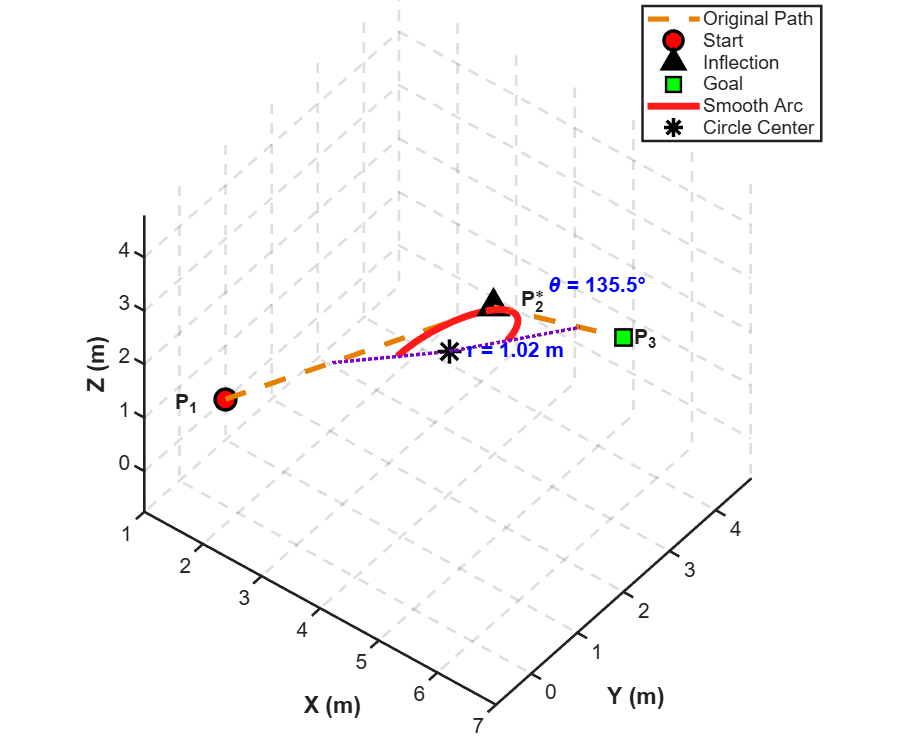
Path planning remains a major challenge for the autonomous navigation of Unmanned Aerial Vehicles (UAVs). Despite significant advances in graph-based, sampling-based, metaheuristic, and learning-based path-planning approaches, many existing methods still produce excessive turning points, large path deviations, and trajectories that are misaligned with UAV maneuverability constraints. To address these limitations, this paper presents a Turn-Deviation Optimized Multi-Stage Framework (TDO-MSF) for UAV path planning. The proposed framework integrates a bidirectional A* search algorithm, a turn-deviation reduction strategy, and a direction-constrained neighborhood expansion mechanism to reduce unnecessary directional changes during path generation. A multiscale inflection correction method is employed to eliminate redundant turning points, while a curvature-constrained adaptive-radius smoothing technique is applied to improve trajectory continuity and maneuverability. In addition, a trajectory-guided Enhanced Artificial Potential Field (E-APF) algorithm is incorporated for obstacle avoidance, along with constraints on velocity, acceleration, jerk, and turning radius. The proposed framework is evaluated in various 3D benchmark environments with different obstacle densities and configurations. Its performance is compared with those of the original A*, Improved A*, Improved RRT, Improved PSO, ICSSA, and the baseline MSF-MTPO algorithms using both conventional path-planning and trajectory-quality metrics. Experimental results indicate that the proposed TDO-MSF achieves an average path-length reduction of approximately 2.08% and a 29.25% reduction in the number of turns compared with the benchmark methods. Furthermore, it improves trajectory smoothness and obstacle-avoidance performance while maintaining curvature-constrained and trajectory-guided obstacle-avoidance capabilities.
References
[1] L. Xu, M. Xi, R. Gao, Z. Ye & H. He, ``Dynamic path planning of UAV with least inflection point based on the adaptive neighborhood A* algorithm and multi-strategy fusion'', Scientific Reports 15 (2025) 8563. https://doi.org/10.1038/s41598-025-92406-w.
[2] W. Meng, X. Zhang, L. Zhou, H. Guo & X. Hu, ``Advances in UAV path planning: A comprehensive review of methods, challenges, and future directions'', Drones 9 (2025) 376. https://doi.org/10.3390/drones9050376.
[3] Q. Wu, Y. Su, W. Tan, R. Zhan, J. Liu & L. Jiang, ``UAV path planning trends from 2000 to 2024: A bibliometric analysis and visualization'', Drones 9 (2025) 128. https://doi.org/10.3390/drones9020128.
[4] R. Zhou, H. Li, H. Liu, L. Yu, P. Wang & S. Liang, ``Research and implementation of multi-UAV navigation path planning algorithm for search and rescue missions'', presented at the 5th International Conference on Artificial Intelligence, Robotics, and Communication (ICAIRC), Xiamen, China, 7--9 November 2025, pp. 557-565. https://doi.org/10.1109/ICAIRC68035.2025.11385267.
[5] Y. Alqudsi & M. Makaraci, ``UAV swarms: Research, challenges, and future directions'', Journal of Engineering and Applied Science 72 (2025) 12. https://doi.org/10.1186/s44147-025-00582-3.
[6] M. S. Adam, N. F. Abdullah, A. Abu-Samah, O. A. Amodu & R. Nordin, ``Neural-guided adaptive clustering for UAV-based user grouping in 5G/6G post-disaster networks'', Drones 9 (2025) 731. https://doi.org/10.3390/drones9110731.
[7] Y. Wang, Q. Yan, Z. Ren, G. Zhao & X. Wu, ``Two-stage multi-UAV path planning based on MAPPO'', presented at the 4th Conference on Fully Actuated System Theory and Applications (FASTA), Nanjing, Jiangsu, China, 4--6 July 2025 pp. 1551-1556. https://doi.org/10.1109/FASTA65681.2025.11139026.
[8] A. M. Bacha, R. B. Zamoum & F. Lachekhab, ``Machine learning paradigms for UAV path planning: Review and challenges'', Journal of Robotics and Control 6 (2025) 215. https://doi.org/10.18196/jrc.v6i1.24097.
[9] W. Xu, C. Cui, Y. Ji, X. Li & S. Li, ``A UAV path planning algorithm for bridge construction safety inspection in complex terrain'', Scientific Reports 15 (2025) 13564. https://doi.org/10.1038/s41598-025-97108-x.
[10] Q. Cheng, Z. Zhang, Y. Du & X. Zhao, ``Hybrid metaheuristic-driven 3D path planning for UAVs in complex urban environments: A multi-objective fusion framework'', Geocarto International 40 (2025) 2538099. https://doi.org/10.1080/10106049.2025.2538099.
[11] L. I. Igbinosun & N. R. Udoenoh, ``Optimal distribution of vehicular traffic flow with Dijkstra's algorithm and Markov chains'', African Scientific Reports 4 (2025) 292. https://doi.org/10.46481/asr.2025.4.2.292.
[12] Y. Li, X. Dong, Q. Ding, Y. Xiong, H. Liao & T. Wang, ``Improved A-STAR algorithm for power line inspection UAV path planning'', Energies 17 (2024) 5364. https://doi.org/10.3390/en17215364.
[13] X. Liu, W. Yi, P. Chen & Y. Tan, ``Flight path planning of UAV-driven refinement inspection for construction sites based on 3D reconstruction'', Automation in Construction 177 (2025) 106360. https://doi.org/10.1016/j.autcon.2025.106360.
[14] N. Li & S. I. Han, ``Adaptive bi-directional RRT algorithm for three-dimensional path planning of unmanned aerial vehicles in complex environments'', IEEE Access 13 (2025) 23748. https://doi.org/10.1109/ACCESS.2025.3537697.
[15] M. N. Jenabi, H. Asharioun & M. Pourgholi, ``3D UAV path planning based on an improved TD3 deep reinforcement learning for data collection in an urban environment'', Journal of Network and Computer Applications 244 (2025) 104336. https://doi.org/10.1016/j.jnca.2025.104336.
[16] Z. Wang, T. Wei, G. Sun, X. Liu, H. Yu & D. Niyato, ``Multi-UAV enabled MEC networks: Optimizing delay through intelligent 3-D trajectory planning and resource allocation'', IEEE Transactions on Intelligent Transportation Systems 26 (2025) 20897. https://doi.org/10.1109/TITS.2025.3586874.
[17] L. Mu, W. Liu, H. Wang & Y. Zhang, ``Research on UAV 3D path planning based on an improved dwarf mongoose algorithm with multiple strategies'', Scientific Reports 15 (2025) 26979. https://doi.org/10.1038/s41598-025-11492-y.
[18] G. M. Nayeem, M. Fan & G. M. Daiyan, ``Adaptive Q-learning grey wolf optimizer for UAV path planning'', Drones 9 (2025) 246. https://doi.org/10.3390/drones9040246.
[19] J. Fan, X. Zhang, K. Zheng, Y. Zou & N. Zhou, ``Hierarchical path planner combining probabilistic roadmap and deep deterministic policy gradient for unmanned ground vehicles with non-holonomic constraints'', Journal of the Franklin Institute 361 (2024) 106821. https://doi.org/10.1016/j.jfranklin.2024.106821.
[20] A. Majeed & S. O. Hwang, ``A multi-objective coverage path planning algorithm for UAVs to cover spatially distributed regions in urban environments'', Aerospace 8 (2021) 343. https://doi.org/10.3390/aerospace8110343.
[21] M. A. Gutierrez-Martinez, E. G. Rojo-Rodriguez, L. E. Cabriales-Ramirez, K. Estabridis & O. Garcia-Salazar, ``Genetic algorithm-based path planning of quadrotor UAVs on a 3D environment'', The Aeronautical Journal 129 (2025) 902. https://doi.org/10.1017/aer.2024.132.
[22] S. Zhang, C. Liu & N. Haala, ``Guided by model quality: UAV path planning for complete and precise 3D reconstruction of complex buildings'', International Journal of Applied Earth Observation and Geoinformation 127 (2024) 103667. https://doi.org/10.1016/j.jag.2024.103667.
[23] M. Qi, L. Dou & B. Xin, ``3D smooth trajectory planning for UAVs under navigation relayed by multiple stations using Bezier curves'', Electronics 12 (2023) 2358. https://doi.org/10.3390/electronics12112358.
[24] Z. Zheng, Z. Zhang, Z. Li, Q. Yu & Y. Jiang, ``Adaptive aberrance repressed correlation filters with cooperative optimization in high-dimensional unmanned aerial vehicle task allocation and trajectory planning'', Electronics 13 (2024) 3071. https://doi.org/10.3390/electronics13153071.
[25] H. Bayerlein, M. Theile, M. Caccamo & D. Gesbert, ``Multi-UAV path planning for wireless data harvesting with deep reinforcement learning'', IEEE Open Journal of the Communications Society 2 (2021) 1171. https://doi.org/10.1109/ojcoms.2021.3081996.
[26] Z. Lv, L. Ni, H. Peng, K. Zhou, D. Zhao, G. Qu, W. Yuan, Y. Gao & Q. Zhang, ``Research on global off-road path planning based on improved A* algorithm'', ISPRS International Journal of Geo-Information 13 (2024) 362. https://doi.org/10.3390/ijgi13100362.
[27] C. Zammit & E. J. van Kampen, ``Real-time 3D UAV path planning in dynamic environments with uncertainty'', Unmanned Systems 11 (2023) 203. https://doi.org/10.1142/S2301385023500073.
[28] H. S. Yahia & A. S. Mohammed, ``Path planning optimization in unmanned aerial vehicles using meta-heuristic algorithms: A systematic review'', Environmental Monitoring and Assessment 195 (2023) 30. https://doi.org/10.1007/s10661-022-10590-y.
[29] Q. Meng, K. Chen & Q. Qu, ``PPSwarm: Multi-UAV path planning based on hybrid PSO in complex scenarios'', Drones 8 (2024) 192. https://doi.org/10.3390/drones8050192.
[30] L. Lyu, H. Jiang & F. Yang, ``Improved dung beetle optimizer algorithm with multi-strategy for global optimization and UAV 3D path planning'', IEEE Access 12 (2024) 69240. https://doi.org/10.1109/ACCESS.2024.3401129.
[31] Z. Ye, H. Li & W. Wei, ``Improved particle swarm optimization based on multi-strategy fusion for UAV path planning'', International Journal of Intelligent Computing and Cybernetics 17 (2024) 213. https://doi.org/10.1108/IJICC-06-2023-0140.
[32] Y. Jiang, X. X. Xu, M. Y. Zheng & Z. H. Zhan, ``Evolutionary computation for unmanned aerial vehicle path planning: A survey'', Artificial Intelligence Review 57 (2024) 267. https://doi.org/10.1007/s10462-024-10913-0.
[33] Y. He & M. Wang, ``An improved chaos sparrow search algorithm for UAV path planning'', Scientific Reports 14 (2024) 366. https://doi.org/10.1038/s41598-023-50484-8.
[34] A. Haidar Ahmad, O. Zahwe, A. Nasser & B. Clement, ``Path planning for unmanned aerial vehicles in dynamic environments: A novel approach using improved A* and Grey Wolf Optimizer'', World Electric Vehicle Journal 15 (2024) 531. https://doi.org/10.3390/wevj15110531.
[35] J. Luo, Z. Wang, M. Xia, L. Wu, Y. Tian & Y. Chen, ``Path planning for UAV communication networks: Related technologies, solutions, and opportunities'', ACM Computing Surveys 55 (2023) Article 1. https://doi.org/10.1145/3560261.
[36] Y. He, T. Hou & M. Wang, ``A new method for unmanned aerial vehicle path planning in complex environments'', Scientific Reports 14 (2024) 9257. https://doi.org/10.1038/s41598-024-60051-4.
[37] Q. Meng, Q. Qu, K. Chen & T. Yi, ``Multi-UAV path planning based on cooperative co-evolutionary algorithms with adaptive decision variable selection'', Drones 8 (2024) 435. https://doi.org/10.3390/drones8090435.
[38] X. Wang, Y. Feng, J. Tang, Z. Dai & W. Zhao, ``A UAV path planning method based on the framework of multi-objective jellyfish search algorithm'', Scientific Reports 14 (2024) 28058. https://doi.org/10.1038/s41598-024-79323-0.
[39] J. Luo, Y. Tian & Z. Wang, ``Research on unmanned aerial vehicle path planning'', Drones 8 (2024) 51. https://doi.org/10.3390/drones8020051.
[40] X. Zhenyang & Y. Wei, ``Mobile robot path planning based on fusion of improved A* algorithm and adaptive DWA algorithm'', Journal of Physics: Conference Series 2330 (2022) 012003. https://doi.org/10.1088/1742-6596/2330/1/012003.
[41] A. Gautam, Y. He & X. Lin, ``An overview of motion-planning algorithms for autonomous ground vehicles with various applications'', SAE International Journal of Vehicle Dynamics, Stability and NVH 8 (2024) 179. https://doi.org/10.4271/10-08-02-0011.
[42] M. Wu, G. Li, J. Liao, H. Wang, W. Liu, X. Yan, Y. Wang, Y. Liu & S. Li, ``Multi-strategy hybrid adaptive dung beetle optimization for UAV photogrammetric 3D path planning under complex constraints'', Scientific Reports 15 (2025) 15088. https://doi.org/10.1038/s41598-025-98563-2.
[43] W. Zheng, T. Li, Q. Jing, S. Qi & Y. Li, ``Real-time quantitative risk analysis and routing optimization of gaseous hydrogen tube trailer transport: A Bayesian network and Dijkstra algorithm combining approach'', Process Safety and Environmental Protection 192 (2024) 1205. https://doi.org/10.1016/j.psep.2024.10.110.
[44] G. Gugan & A. Haque, ``Path planning for autonomous drones: Challenges and future directions'', Drones 7 (2023) 169. https://doi.org/10.3390/drones7030169.
[45] G. Hao, Q. Lv, Z. Huang, H. Zhao & W. Chen, ``UAV path planning based on improved artificial potential field method'', Aerospace 10 (2023) 562. https://doi.org/10.3390/aerospace10060562.
[46] S. Ganesan, B. Ramalingam & R. E. Mohan, ``A hybrid sampling-based RRT* path planning algorithm for autonomous mobile robot navigation'', Expert Systems with Applications 258 (2024) 125206. https://doi.org/10.1016/j.eswa.2024.125206.
Published
How to Cite
Issue
Section
Copyright (c) 2026 T. Sivanraj, K. Suthendran

This work is licensed under a Creative Commons Attribution 4.0 International License.