
Transmission dynamics of community-and hospital-acquired infections: insights from mathematical modelling
Keywords:
Community transmission, local and global stability, bifurcation analysis, hospital-acquired infectionAbstract
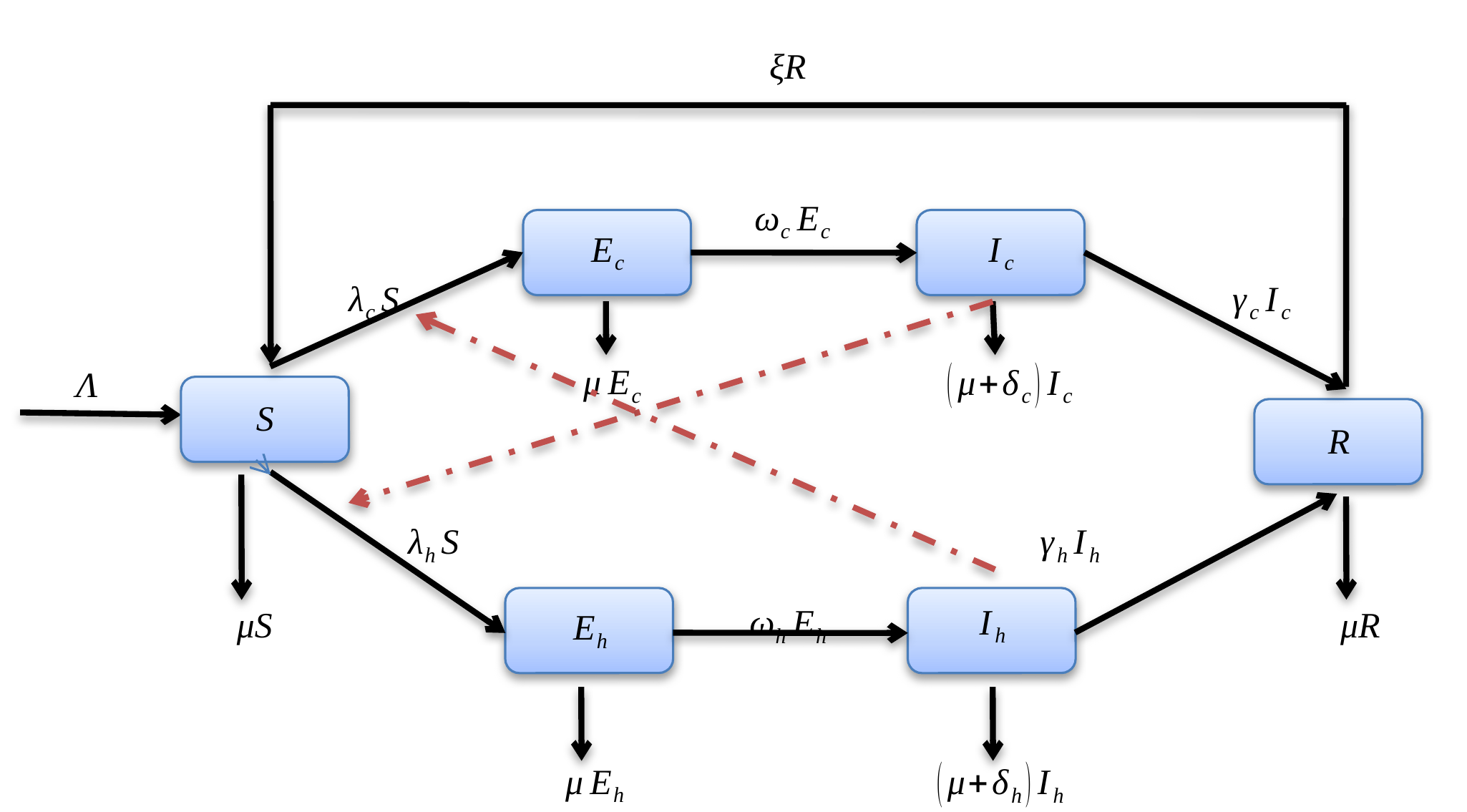
Hospital-associated infections (HAIs) remain a critical public health challenge, particularly in resource-limited settings where surveillance and infection control are inadequate. This study develops and analyzes a modified S E I R mathematical model, denoted by S EcIcEhIhR, to capture the transmission dynamics of infectious diseases across hospital and community settings. The model incorporates both community and hospital transmission of infections, which have not been addressed jointly in previous studies. Using the next-generation matrix approach, the basic reproduction number (R0) was determined. Local and global stability analyses revealed that the disease-free equilibrium is stable when R0 < 1, but unstable otherwise. Sensitivity analysis identified the recruitment rate, community contact rate, and hospital infection rate as the most influential parameters, with community transmission exerting a stronger impact on the overall dynamics than hospital transmission. Numerical simulations further confirmed the dominant role of community transmission over hospital infections. Bifurcation analysis confirmed the possibility of backward bifurcation, indicating the possible coexistence of endemic and disease-free equilibrium states, even when R0 < 1. These findings highlight the complex interplay between hospital and community transmission and indicate that effective control strategies must prioritize reducing community contact rates while strengthening hospital infection-prevention measures. The model provides insights for policymakers and healthcare managers designing evidence-based interventions to mitigate HAIs and community outbreaks, particularly in countries facing systemic healthcare challenges.
Published
How to Cite
Issue
Section
Copyright (c) 2026 Peace P. Desben, Emmanuel N. Dashe, Joel N. Ndam

This work is licensed under a Creative Commons Attribution 4.0 International License.
How to Cite
Similar Articles
- E. O. Adeniyi, L. A. Sunmonu, O. P. Oladejo, C. O. Ogunkoya, O. M. Adedokun, K. N. Alao, Qualitative and quantitative interpretations of high-resolution aeromagnetic data of Saki-East area, for basement and structural framework , African Scientific Reports: Volume 3, Issue 3, December 2024
- Matthew Olaleke Aremu, Stephen Olaide Aremu, Ibrahim Aliyu, David Bala Passali, Munir Hussaini, Benjamin Zobada Musa, Rasaq Bolakale Salau, Amino acids profile and health attributes of Bambara groundnut (Vigna subteranea L.) and sesame (Sesamum indicum L.): a comparative study , African Scientific Reports: Volume 4, Issue 1, April 2025
- E. Omugbe, O. E. Osafile, N. O. Nenuwe, E. A. Enaibe, Screening of Metal-Ion Intercalated Yttrium Carbide and Nitride MXenes for Energy Storage Applications via Density Functional Theory , African Scientific Reports: Volume 2, Issue 1, April 2023
- Emmanuel Joseph, Gonto Kamal, Oluwasesan M. Bello, Natural radionuclide distribution and analysis of associated radiological concerns in rock samples from a rocky town (Dutsin-Ma) in the North-Western region of Nigeria , African Scientific Reports: Volume 2, Issue 3, December 2023
- M. H. Muhammad, O. O. Orole, J. F. Nfongeh, E. S. Audu, F. Gbadeyan, Proteomic characteristics of resistant Proteus species in women with urinary tract infections in Nasarawa State, Nigeria , African Scientific Reports: Volume 5, Issue 2, August 2026
You may also start an advanced similarity search for this article.