
Perturbation and bifurcation analysis of a primary-secondary dengue infection transmission model with explicit vector dynamics and optimal control

Authors

  • Aloysius N. Ezaka
    Department of Mathematics/Statistics, Alex Ekwueme Federal University Ndufu Alike, Ebonyi State, Nigeria
  • Henry O. Adagba
    Department of Industrial Mathematics and Applied Statistics, Ebonyi State University, Abakaliki, Ebonyi State, Nigeria
  • Sunday N. Aloke
    Department of Industrial Mathematics and Health Statistics, David Umahi Federal University of Health Sciences, Uburu, Ebonyi State, Nigeria
  • Louis O. Omenyi
    Department of Mathematics/Statistics, Alex Ekwueme Federal University Ndufu Alike, Ebonyi State, Nigeria
  • Theresa E. Efor
    Department of Industrial Mathematics and Applied Statistics, Ebonyi State University, Abakaliki, Ebonyi State, Nigeria
  • Okorie Nwite
    Department of Industrial Mathematics and Applied Statistics, Ebonyi State University, Abakaliki, Ebonyi State, Nigeria
  • Chika Agha
    Department of Industrial Mathematics and Applied Statistics, Ebonyi State University, Abakaliki, Ebonyi State, Nigeria

Keywords:

Dengue, bifurcation, Perturbation, Reproduction number, Sensitivity

Abstract

A robust mathematical model of multi-strain dengue infection with explicit vector dynamics is formulated to incorporate optimal control and vaccination. The bifurcation coefficients were calculated, and their numerical perturbation led to transcritical, subcritical, and supercritical bifurcations. The results showed that the effective reproduction number of the model with control is sufficiently small compared with the basic reproduction number without control. The rate of secondary infection with control, ϕc, was also lower than the rate of secondary infection without control, ϕ0; that is, ϕc < ϕ0. The sensitivity results showed that the mosquito-to-human and human-to-mosquito interaction rates should be targeted by control interventions to reduce infection in the population.
Dimensions

[1] S. A. Kumar, V. Steindorf, B. Guerrero, N. Stollenwerk, B. Kooi & M. Aguiar, ``Bifurcation analysis of a two-infection transmission model with explicit vector dynamics'', Preprint, Basque Center for Applied Mathematics, Bilbao, Spain, 2026. https://doi.org/10.1007/s00285-026-02341-1.

[2] V. Steindorf, S. A. Kumar, N. Stollenwerk, B. W. Kooi & M. Aguiar, ``Modeling secondary infections with temporary immunity and disease-enhancement factor: mechanisms for complex dynamics in epidemiological models'', Preprint, 2022. Available online: https://doi.org/10.1016/j.chaos.2022.112709.

[3] P. Rashkov & B. W. Kooi, ``Complexity of host-vector dynamics in a two-strain dengue model'', Journal of Mathematical Biology 15 (2021) 35. https://doi.org/10.1080/17513758.2020.1864038.

[4] M. Aguiar, B. W. Kooi & N. Stollenwerk, ``The role of seasonality and import in a minimalistic multi-strain dengue model capturing differences between primary and secondary infections: complex dynamics and its implications for data analysis'', Journal of Theoretical Biology 289 (2011) 181. https://doi.org/10.1016/j.jtbi.2011.08.043.

[5] Bernhard Nocht Institute for Tropical Medicine, ``Annual report on tropical diseases 2023'', Hamburg, Germany, 2023. Available online: https://www.bnitm.de/fileadmin/media/Das_Institut/Ueber_uns/Bibliothek/Jahresberichte_und_Flyer/Jahresbericht_BNITM_2023-24_EN.pdf.

[6] B. Kooi, M. Aguiar & N. Stollenwerk, ``Bifurcation analysis of a family of multi-strain epidemiology models'', Journal of Computational and Applied Mathematics 252 (2013) 148. https://doi.org/10.1016/j.cam.2012.08.008.

[7] European Centre for Disease Prevention and Control, ``Annual epidemiological report on communicable diseases in Europe 2023'', Stockholm, Sweden, 2023. Available online: https://www.ecdc.europa.eu/en/publications-data/monitoring/all-annual-epidemiological-reports.

[8] Nigeria Centre for Disease Control and Prevention, ``NCDC alert following the confirmation of dengue fever outbreak in Sokoto State'', Nigeria, 2023. Available online: https://reliefweb.int/report/nigeria/ncdc-alert-following-confirmation-dengue-fever-outbreak-sokoto-state.

[9] Centers for Disease Control and Prevention, ``Dengue: epidemiology'', Atlanta, GA, USA, 2024. Available online: https://wwwnc.cdc.gov/eid/content/30/6/pdfs/v30-n6.pdf (accessed 2 June 2026).

[10] S. Robert, P. S. Diagbouga, A. D. Djibougou, D. Guy, R. Bagnall & F. Ravel, ``Dengue diagnosis and impact on clinical management: a literature review", PLoS Neglected Tropical Diseases 19 (2025) e0013196. https://doi.org/10.1371/journal.pntd.0013196.

[11] M. Aguiar, B. W. Kooi, J. Martins & N. Stollenwerk, ``Scaling of stochasticity in dengue hemorrhagic fever epidemics'', Mathematical Modelling of Natural Phenomena 7 (2012) 1. https://www.mmnp-journal.org/articles/mmnp/pdf/2012/03/mmnp201273p1.pdf.

[12] World Health Organization, ``Fact sheet dengue and severe dengue'', Geneva, Switzerland, 2019. Accessed 4 Nov 2023. Available online: https://www.who.int/news-room/fact-sheets/detail/dengue-and-severe-dengue.

[13] M. Aguiar, V. Anam, K. B. Blyuss, S. E. Delfin, B. V. Guerrero, D. Knopoff, B. W. Kooi, A. Kumar, V. Steindorf & N. Stollenwerk, ``Mathematical models for dengue fever epidemiology: a 10-year systematic review'', Physics of Life Reviews 40 (2022) 65. https://doi.org/10.1016/j.plrev.2022.02.001.

[14] Mayo Clinic, ``Dengue fever: symptoms and causes'', Rochester, MN, USA, 2024. Available online: https://www.mayoclinic.org/diseases-conditions/dengue-fever/symptoms-causes/syc-20353078.

[15] M. Aguiar, J. B. Van-Dierdonck & N. Stollenwerk, ``Reproduction ratio and growth rates: measures for an unfolding pandemic'', PLOS ONE 15 (2020) e0236620. https://doi.org/10.1371/journal.pone.0236620.

[16] M. H. Holmes, Introduction to Perturbation Methods, Springer, New York, USA, 1995, pp. 1--337. Available online: https://www.google.com/books/edition/Introduction_to_Perturbation_Methods/-7yTPwAACAAJ.

[17] L. Omenyi, A. Ezaka, H. O. Adagba, G. Ozoigbo & K. Elebute, ``A sensitivity analysis of a gonorrhoea dynamics and control model'', Journal of Mathematical and Computational Science 16 (2022) 87. https://arxiv.org/abs/2209.15419.

[18] G. Faye, ``An introduction to bifurcation theory'', Technical Report, Neuro Mathematical Computer Laboratory, Sophia Antipolis, Paris, France, 2011. Available online: https://www.math.univ-toulouse.fr/~gfaye/ENS11/chap_bif.pdf.

[19] S. N. Aloke, H. O. Adagba, U. E. Michael, O. Nwite, T. E. Efor, A. N. Ezaka & C. Agha, ``Asymptotic perturbation and sensitivity analysis of malaria transmission in Nigeria: a mathematical model''. Recent Advances in Natural Sciences 4 (2026) 203. https://doi.org/10.61298/rans.2026.4.1.203.

[20] P. van den Driessche & J. Watmough, ``Reproduction numbers and sub-threshold endemic equilibria for compartmental models of disease transmission'', Mathematical Biosciences 180 (2002) 29. https://doi.org/10.1016/S0025-5564(02)00108-6.

[21] C. Castillo-Chavez & B. Song, ``Dynamical models of tuberculosis and their applications'', Mathematical Biosciences and Engineering 1 (2004) 361. https://doi.org/10.3934/mbe.2004.1.361.

[22] L. S. Pontryagin, V. G. Boltyanskii, R. V. Gamkrelidze & E. F. Mishchenko, The Mathematical Theory of Optimal Processes, K. N. Trirogoff (Trans.), Interscience Publishers, New York, USA, 1962, 1-345. https://api.pageplace.de/preview/DT0400.9781351433075_A37629368/preview-9781351433075_A37629368.pdf.

[23] N. Emmanuel, N. A. Sunday, O. Louis & U. Michael, ``Optimal control of COVID-19: examining the incidence of contamination and its recurrence in Nigeria'', American Journal of Applied Mathematics 11 (2023) 23. https://doi.org/10.11648/j.ajam.20231102.12.

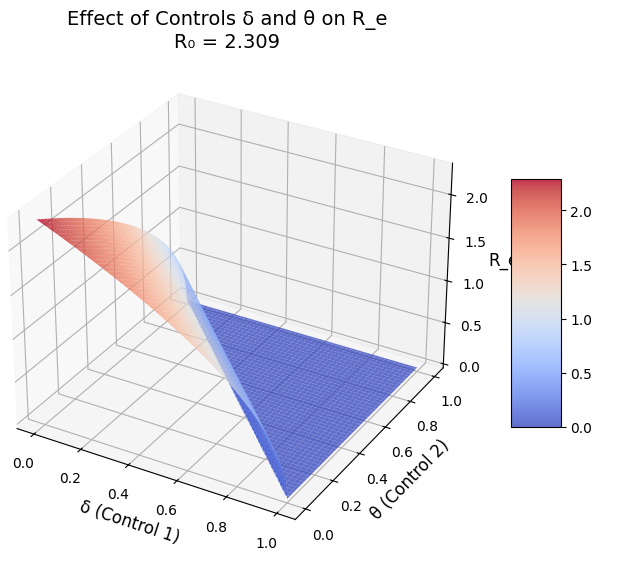
FIG 12

Published

2026-06-08

How to Cite

Perturbation and bifurcation analysis of a primary-secondary dengue infection transmission model with explicit vector dynamics and optimal control. (2026). African Scientific Reports, 5(2), 438. https://doi.org/10.46481/asr.2026.5.2.438

Issue

Section

MATHEMATICAL SCIENCES SECTION

How to Cite

Perturbation and bifurcation analysis of a primary-secondary dengue infection transmission model with explicit vector dynamics and optimal control. (2026). African Scientific Reports, 5(2), 438. https://doi.org/10.46481/asr.2026.5.2.438

Similar Articles

11-19 of 19

You may also start an advanced similarity search for this article.