
The impact of cognitive and emotional factors on user experience in HCI
Keywords:
Human–Computer Interaction (HCI), User Experience (UX), Cognitive Factors, Emotional Design, Affective ComputingAbstract
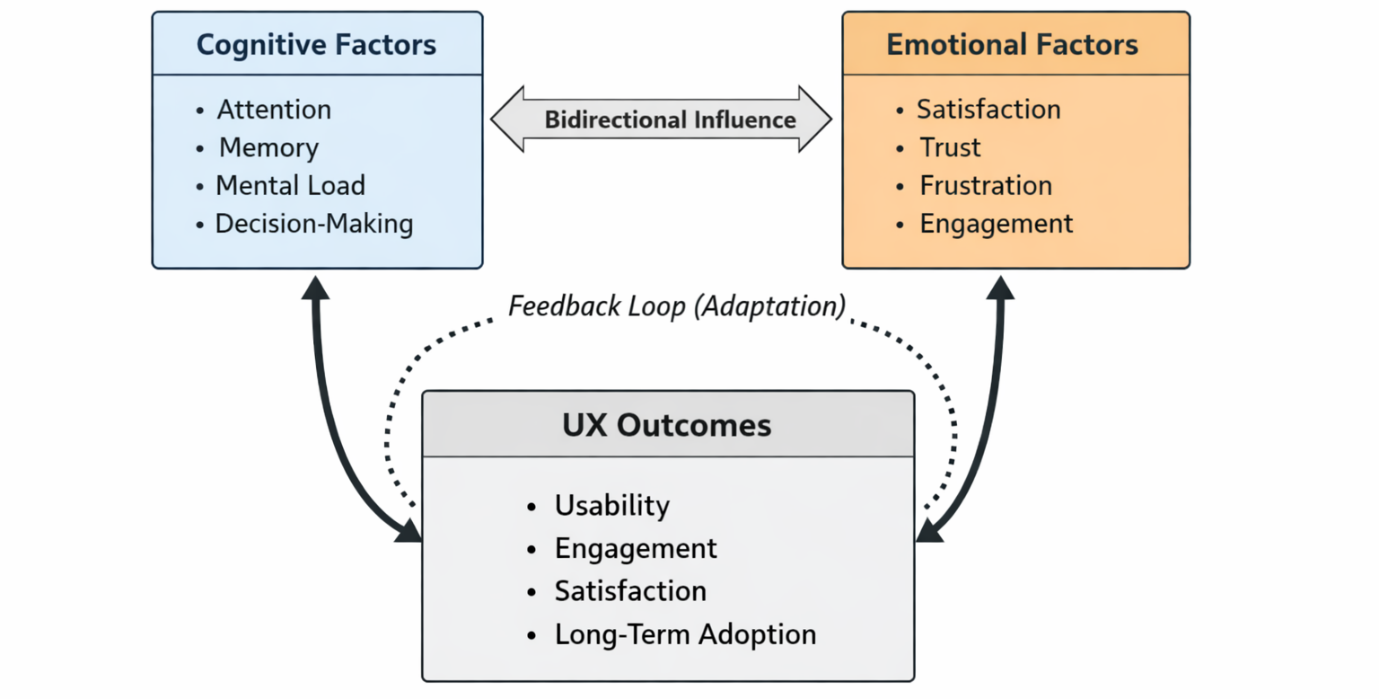
This paper discusses how cognitive and emotional factors affect user experience (UX) in human-computer interaction (HCI). It examines how users' cognitive processes, including perception, attention, memory and decision-making, interact with emotional reactions, including satisfaction, trust and engagement, to shape the quality of interaction. Drawing on principles from cognitive psychology and affective computing, the study shows that effective HCI design extends beyond functionality and efficiency to include emotional appeal and user satisfaction. The paper emphasises that reducing cognitive load, maintaining interface consistency and using intuitive visual cues improve understanding and task performance. At the same time, integrating affective design principles, including aesthetic appeal, empathy and personalisation, contributes to greater emotional satisfaction and user motivation. It also assesses approaches for measuring UX, including usability testing, heuristic evaluation, affective feedback and physiological emotion monitoring, to capture the cognitive and emotional dimensions of interaction. The findings indicate that combining cognitive ergonomics and emotional intelligence in interface design can produce more adaptive, engaging and human-centred systems. By balancing mental efficiency with positive emotional experience, designers can create technologies that promote trust, empathy and long-term user engagement. Overall, this study supports the value of balancing rational and affective design to develop interactive systems that are useful, efficient, meaningful and emotionally satisfying.
Published
How to Cite
Issue
Section
Copyright (c) 2026 Ike Joseph Mgbeafulike, Ogochukwu C. Okeke, Osita Miracle Nwakeze, Anthony T. Umerah, Uju Cynthia Nwabudike, Chikaodili Chidi-Onuigbo

This work is licensed under a Creative Commons Attribution 4.0 International License.
How to Cite
Similar Articles
- M. C. Owosen, A. W. Jik, D. D. Odonye, E. B. Ogundeji, Challenges and advances in anti-rabies vaccine development in sub-saharan Africa , African Scientific Reports: Volume 4, Issue 3, December 2025
- Samson A. Aasa, Regan K. Dunne, Dawood A. Desai, Aspect ratio of thermo-hydraulic performance of periodically prescribed semi-circular groove in rectangular channel , African Scientific Reports: Volume 4, Issue 3, December 2025
- S. M. Shiada, S. D. Igba, O. Shiekar, E. A. Damian, Simulation of the influence of cloud density on the removal of particulate matter and gaseous pollutants at the Dangote cement factory by rain , African Scientific Reports: Volume 4, Issue 2, August 2025
- Qrisstuberg M. Amua, Emmanuel K. Ukpoko, Pesticides survey and identification of common insecticides used for foodstuff storage in Makurdi, Benue State, Nigeria , African Scientific Reports: Volume 4, Issue 1, April 2025
- Tosan Peter Omayone, Ibrahim Aliyu, Grace Iyabo Adebayo-Gege, Impact of high protein diet on the formation and healing of L-arginine induced acute pancreatitis in male wistar rats , African Scientific Reports: Volume 4, Issue 1, April 2025
- A. Babangida, J. B. Yerima, A. D. Ahmed, S. C. Ezike, Strategy to Select and Grade Efficient Dyes for Enhanced Photo-Absorption , African Scientific Reports: Volume 1, Issue 1, April 2022
- Rizwan Yousuf, Khalid Ul Islam Rather, Olumide S. Adesina, Roohul Andrabi, Emmanuel F. Ologunleko, Adedayo F. Adedotun, An improved exponential ratio estimator for post-stratified sampling designs , African Scientific Reports: Volume 5, Issue 2, August 2026
You may also start an advanced similarity search for this article.