
An enhanced control solutions for efficient urban waste management using deep learning algorithms
Keywords:
Waste management, Deep learning algorithms, IoT, Support vector machineAbstract
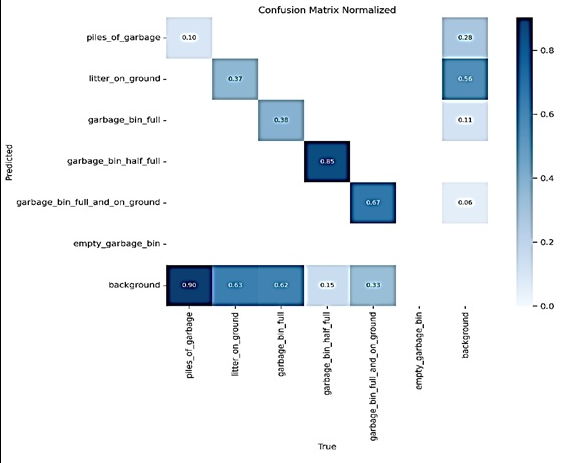
This study focuses on developing an efficient urban waste management system using deep learning algorithms and Internet of Things (IoT) technology. The goal is to improve waste management in Ikot Ekpene municipality by enabling quick disposal responses to prevent environmental pollution. The researchers employed an Object-Oriented Analysis and Design (OOAD) methodology to develop a software system that integrates mobile GIS techniques and IoT sensors to monitor and manage waste. The system was trained using a dataset of 510 images of six classes of waste-related scenarios, with an 84% training set and 16% validation set. The results showed that the garbage bin half-full class had the highest F1 score (above 80%) at a confidence score of 0.4, indicating accurate detection. The average F1 score for all classes was 0.45 at a confidence score of 0.238. The system’s API was designed using Python, supporting both web-based and Android-based applications. The integration of IoT sensors and mobile GIS techniques enables real-time monitoring and efficient waste management. This study demonstrates the potential of deep learning algorithms and IoT technology in improving waste management services, contributing to a cleaner and healthier environment. The system’s effectiveness in detecting waste levels and triggering timely disposal responses can help prevent environmental pollution and enhance the well-being of citizens.
Published
How to Cite
Issue
Section
Copyright (c) 2024 Gabriel James, Anietie Ekong, Etimbuk Abraham, Enobong Oduobuk, Nseobong Michael, Victor Ufford, Oscar Ebong

This work is licensed under a Creative Commons Attribution 4.0 International License.
How to Cite
Similar Articles
- C. Andrew, S. W. Ngbo, L. O. Edmund, P. S. Moses, P. Y. Olekwu, A. I. Onen, Spectrophotometric and voltammetric assessment of totalflavonoid and phenolic content of Cucurbita species and theirantioxidant activity , African Scientific Reports: Volume 5, Issue 2, August 2026
- Surajo Muhammed Gwio, Ibrahim Ayuba, Umar Faruk Aminua, Development of 3D flow diagnostic numerical simulator and rock property modelling for a homogeneous faulted reservoir , African Scientific Reports: Volume 3, Issue 1, April 2024
- Saheed Adekunle Ganiyu, Oluwaseun Tolutope Olurin, Sulaimon Yinka Makanjuola, Anthony Okeh, Abiodun Oluwatoyin Salawu, Rasaq Akanji Lasisi, Assessing the physical and geotechnical properties of subsoils within an active municipal solid waste dumpsite for secured future urban growth , African Scientific Reports: Volume 3, Issue 2, August 2024
- Tosan Peter Omayone, Ibrahim Aliyu, Grace Iyabo Adebayo-Gege, Impact of high protein diet on the formation and healing of L-arginine induced acute pancreatitis in male wistar rats , African Scientific Reports: Volume 4, Issue 1, April 2025
- Tertsea Igbawua, Aondongu Alexander Tyovenda, Terver Sombo, Idugba Mathias Echi, Fanan Ujoh, Investigating factors influencing PM2.5 threshold exceedance in Nigeria using multivariate logistic regression analysis , African Scientific Reports: Volume 3, Issue 3, December 2024
- Anthony E. Aiwonegbe, Odunayo D. Adeyemi, Faith I. Akhidenor, Physico-chemical, heavy metal, and microbiological analysis of effluent from a confectionery company in Lagos State, Nigeria , African Scientific Reports: Volume 4, Issue 3, December 2025
- Ahmad M. Shuaibu, Kizito O. Musa, Ijioma M. Okiyi, Groundwater recharge modelling using SWAT analysis for groundwater reserve quantification of Ka watershed catchment area part of Sokoto-Rima Basin, North West Nigeria , African Scientific Reports: Volume 4, Issue 1, April 2025
- A. U. Atumeyi, A. U. Itodo, R. Sha'Ato, R. A. Wuana, Dissolution kinetics of coal and limestone samples from Kogi state, Nigeria , African Scientific Reports: Volume 3, Issue 3, December 2024
- Anthony Ugbedeojo Atumeyi, A. U. Itodo, R. Sha'Ato, R. A. Wuana, Physicochemical analysis and dissolution kinetics of Itakpe iron ore in acid, base and aqueous media , African Scientific Reports: Volume 4, Issue 1, April 2025
- L. I. Igbinosun, N. R. Udoenoh, Optimal distribution of vehicular traffic flow with Dijkstra’s algorithm and Markov chains , African Scientific Reports: Volume 4, Issue 2, August 2025
You may also start an advanced similarity search for this article.
Most read articles by the same author(s)
- Gabriel James, Anietie Ekong, Aloysius Akpanobong, Enefiok Etuk, Saviour Inyang, Samuel Oyong, Ifeoma Ohaeri, Chikodili Orazulume, Peace Okafor, Enhanced machine learning model for classification of the impact of technostress in the COVID and post-COVID era , African Scientific Reports: Volume 4, Issue 1, April 2025