Physicochemical properties, lipid composition, and fat-soluble vitamins of oils and antioxidant activity of methanol extracts from tubers, peels, and leaves of sweet potato (Ipomoea batatas L.) in Nigeria
Keywords:
Ipomoea batatas, Bioactive lipids, Fatty acids, Phospholipids, Antioxidant activityAbstract
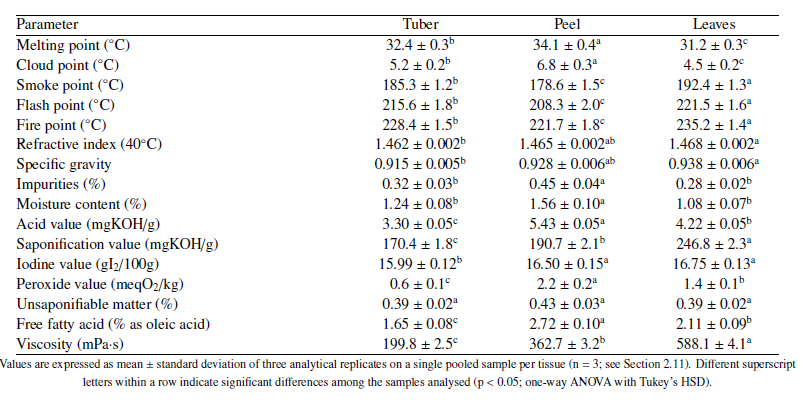
Sweet potato (Ipomoea batatas L.) peels and leaves are often discarded, contributing to post-harvest losses. This study compared physicochemical properties, fatty acids, phospholipids, phytosterols, and fat-soluble vitamins (A and E) in n-hexane-extracted oils from tubers, peels, and leaves collected in Nigeria. Water-soluble vitamins, phytochemicals, and antioxidant activity were assessed in separate methanol extracts. Physicochemical properties were evaluated using standard methods; fatty acids by gas chromatography; phospholipids by thin-layer chromatography; phytosterols by high-performance liquid chromatography; and vitamins by spectrophotometric methods. Antioxidant activity was evaluated using 2,2-diphenyl-1-picrylhydrazyl (DPPH), hydrogen peroxide scavenging, and reducing-power assays. Leaf oil contained the highest total unsaturated fatty acids (60.1%; unsaturated/saturated fatty acid ratio, 1.51), total phospholipids (152.0 mg/100 g), phytosterols (185.3 mg/100 g), and vitamin E (53.1 mg/100 g). Leaf methanol extract had the strongest apparent antioxidant activity (extrapolated DPPH IC50, 31.6 μg/mL). Peel oil had the highest carotenoid content (expressed as vitamin A, 7.08 mg/100 g), while peel methanol extract had the highest riboflavin content (16.11 mg/kg). Tuber oil had the lowest peroxide value (0.6 meq O2/kg). All oils met the Codex peroxide-value benchmark, but moisture, impurities, and peel and leaf acid values exceeded relevant limits. Results represent analytical replicates of one pooled sample per tissue, limiting population-level inference. These findings suggest potential uses for sweet potato by-products, subject to independent biological replication and oil-yield confirmation.
References
[1] FAO, IFAD, UNICEF, WFP & WHO, The State of Food Security and Nutrition in the World 2023: Urbanization, agrifood systems transformation and healthy diets across the rural-urban continuum, FAO, Rome, 2023. Available online: https://www.fao.org/publications/sofi/2023/en/.
[2] National Bureau of Statistics (Nigeria), Nigeria Multidimensional Poverty Index (MPI) 2022: Survey results, NBS, Abuja, 2022. Available online: https://www.undp.org/nigeria/publications/nigeria-multidimensional-poverty-index-2022.
[3] K. J. Ani, V. O. Anyika & E. Mutambara, ``The impact of climate change on food and human security in Nigeria'', Int. J. Clim. Change Strateg. Manag. 14 (2022) 148. https://doi.org/10.1108/IJCCSM-11-2020-0119.
[4] FAO, FAOSTAT: Crops and livestock products -- sweet potatoes, Food and Agriculture Organization of the United Nations, Rome. Available online: https://www.fao.org/faostat/en/#data/QCL.
[5] A. Bovell-Benjamin, ``Sweet potato: A review of its past, present, and future role in human nutrition'', Adv. Food Nutr. Res. 52 (2007) 1. https://doi.org/10.1016/S1043-4526(06)52001-7.
[6] M. K. Alam, ``A comprehensive review of sweet potato (Ipomoea batatas [L.] Lam): revisiting the associated health benefits'', Trends Food Sci. Technol. 115 (2021) 512. https://doi.org/10.1016/j.tifs.2021.07.001.
[7] S. Wang, S. Nie & F. Zhu, ``Chemical constituents and health effects of sweet potato'', Food Res. Int. 89 (2016) 90. https://doi.org/10.1016/j.foodres.2016.08.032.
[8] R. Mohanraj & S. Sivasankar, ``Sweet potato (Ipomoea batatas [L.] Lam) - A valuable medicinal food: A review'', J. Med. Food 17 (2014) 733. https://doi.org/10.1089/jmf.2013.2818.
[9] H. C. Nguyen, C. C. Chen, K. H. Lin, P. Y. Chao, H. H. Lin & M. Y. Huang, ``Bioactive compounds, antioxidants, and health benefits of sweet potato leaves'', Molecules 26 (2021) 1820. https://doi.org/10.3390/molecules26071820.
[10] H. Sun, T. Mu, L. Xi, M. Zhang & J. Chen, ``Sweet potato (Ipomoea batatas L.) leaves as nutritional and functional foods'', Food Chem. 156 (2014) 380. https://doi.org/10.1016/j.foodchem.2014.01.079.
[11] H. Ishida, H. Suzuno, N. Sugiyama, S. Innami, T. Tadokoro & A. Maekawa, ``Nutritive evaluation on chemical components of leaves, stalks and stems of sweet potatoes'', Food Chem. 68 (2000) 359. https://doi.org/10.1016/S0308-8146(99)00206-X.
[12] E. Menelaou, A. Kachatryan, J. N. Losso, M. Cavalier & D. La Bonte, ``Lutein content in sweetpotato leaves'', HortScience 41 (2006) 1269. https://doi.org/10.21273/HORTSCI.41.5.1269.
[13] S. Islam, ``Sweetpotato (Ipomoea batatas L.) leaf: Its potential effect on human health and nutrition'', J. Food Sci. 71 (2006) R13. https://doi.org/10.1111/j.1365-2621.2006.tb08912.x.
[14] A. Parmar, O. Hensel & B. Sturm, ``Post-harvest handling practices and associated food losses and limitations in the sweetpotato value chain of southern Ethiopia'', NJAS - Wageningen J. Life Sci. 80 (2017) 65. https://doi.org/10.1016/j.njas.2016.12.002.
[15] J. Hong, T. Mu, H. Sun, A. Richel & C. Blecker, ``Valorization of the green waste parts from sweet potato (Ipomoea batatas L.): Nutritional, phytochemical composition, and bioactivity evaluation'', Food Sci. Nutr. 8 (2020) 4086. https://doi.org/10.1002/fsn3.1675.
[16] F. M. Sacks, A. H. Lichtenstein, J. H. Y. Wu, L. J. Appel, M. A. Creager, P. M. Kris-Etherton, M. Miller, E. B. Rimm, L. L. Rudel, J. G. Robinson, N. J. Stone & L. V. Van Horn, ``Dietary fats and cardiovascular disease: A presidential advisory from the American Heart Association'', Circulation 136 (2017) e1. https://doi.org/10.1161/CIR.0000000000000510.
[17] FAO, Fats and fatty acids in human nutrition: Report of an expert consultation, FAO Food and Nutrition Paper 91, Food and Agriculture Organization of the United Nations, Rome, 2010. Available online: https://www.fao.org/nutrition/requirements/dietary-fats/en/.
[18] N. Cordeiro, N. Freitas, M. Faria & M. Gouveia, ``Ipomoea batatas (L.) Lam.: A rich source of lipophilic phytochemicals'', J. Agric. Food Chem. 61 (2013) 12380. https://doi.org/10.1021/jf404230z.
[19] K. Y. Lee & S. R. Lee, ``A study on the systematic analysis of lipids from sweet potatoes'', Korean J. Food Sci. Technol. 4 (1972) 309. Available online: https://koreascience.kr/article/JAKO197203041836250.do.
[20] Y. Yu, M. Kou, Z. Gao, Y. Liu, Y. Xuan, Y. Liu, Z. Tang, Q. Cao, Z. Li & J. Sun, ``Involvement of phosphatidylserine and triacylglycerol in the response of sweet potato leaves to salt stress'', Front. Plant Sci. 10 (2019) 1086. https://doi.org/10.3389/fpls.2019.01086.
[21] AOCS, Official Methods and Recommended Practices of the AOCS, 7th ed., AOCS Press, Urbana, IL, 2017.
[22] G. I. Onwuka, Food analysis and instrumentation: Theory and practice, 2nd ed., Naphthali Prints, Lagos, 2018. https://books.google.com.ng/books/about/Food_Analysis_and_Instrumentation.html?id=jh_iuQEACAAJ&redir_esc=y.
[23] AOAC International, Official Methods of Analysis of AOAC International, 21st ed., AOAC International, Rockville, MD, 2019. https://members.aoac.org/AOAC/AOAC/Item_Detail.aspx?iProductCode=1121&Category=OMA.
[24] International Organization for Standardization, ISO 660 (acid value and acidity), ISO 662:2016 (moisture and volatile matter), ISO 663 (insoluble impurities), ISO 3657:2023 (saponification value), ISO 3960:2017 (peroxide value), ISO 3961 (iodine value), ISO 6320 (refractive index), ISO 10540-1:2003 (phosphorus), ISO 12966-2 (preparation of methyl esters) and ISO 12966-4:2015 (GC of fatty acid methyl esters), Geneva.
[25] J. Folch, M. Lees & G. H. Sloane Stanley, ``A simple method for the isolation and purification of total lipides from animal tissues'', Journal of Biological Chemistry 226 (1957) 497. https://doi.org/10.1016/S0021-9258(18)64849-5.
[26] S. S. Nielsen, Food analysis laboratory manual, Kluwer Academic/Plenum Publishers, New York, 2003.https://books.google.com.ng/books/about/Food_Analysis_Laboratory_Manual.html?id=bBTQdb9lkIEC&redir_esc=y.
[27] D. B. Rodriguez-Amaya & M. Kimura, HarvestPlus Handbook for Carotenoid Analysis, HarvestPlus Technical Monograph 2, IFPRI and CIAT, Washington, DC and Cali, 2004. https://assets.publishing.service.gov.uk/media/57a08cbae5274a31e00013d4/tech02.pdf.
[28] Cereals & Grains Association (AACC International), Approved Methods of Analysis: Methods 86-10.01 (ascorbic acid), 86-31.01 (vitamin B6), 86-70.01 (riboflavin) and 86-80.01 (thiamine). Available online: https://cerealsgrains.org/resources/Methods/Pages/86Vitamins.aspx.
[29] V. L. Singleton & J. A. Rossi, ``Colorimetry of total phenolics with phosphomolybdic-phosphotungstic acid reagents'', Am. J. Enol. Vitic. 16 (1965) 144. https://www.ajevonline.org/content/16/3/144.
[30] C.-C. Chang, M.-H. Yang, H.-M. Wen & J.-C. Chern, ``Estimation of total flavonoid content in propolis by two complementary colometric methods'', J. Food Drug Anal. 10 (2002) 178. https://doi.org/10.38212/2224-6614.2748.
[31] J. P. Van Buren & W. B. Robinson, ``Formation of complexes between protein and tannic acid'', J. Agric. Food Chem. 17 (1969) 772. https://doi.org/10.1021/jf60164a003.
[32] S. C. Noonan & G. P. Savage, ``Oxalate content of foods and its effect on humans'', Asia Pac. J. Clin. Nutr. 8 (1999) 64. https://doi.org/10.1046/j.1440-6047.1999.00038.x.
[33] M. Latta & M. Eskin, ``A simple and rapid colorimetric method for phytate determination'', J. Agric. Food Chem. 28 (1980) 1313. https://doi.org/10.1021/jf60232a049.
[34] B. O. Obadoni & P. O. Ochuko, ``Phytochemical studies and comparative efficacy of the crude extracts of some haemostatic plants in Edo and Delta States of Nigeria'', Glob. J. Pure Appl. Sci. 8 (2002) 203. https://doi.org/10.4314/gjpas.v8i2.16033.
[35] J. B. Harborne, Phytochemical Methods: A Guide to Modern Techniques of Plant Analysis, Chapman and Hall, London, 1973. https://archive.org/details/phytochemicalmet0000harb/page/n5/mode/2up.
[36] W. Brand-Williams, M. E. Cuvelier & C. Berset, ``Use of a free radical method to evaluate antioxidant activity'', LWT - Food Sci. Technol. 28 (1995) 25. https://doi.org/10.1016/S0023-6438(95)80008-5.
[37] R. J. Ruch, S.-J. Cheng & J. E. Klaunig, ``Prevention of cytotoxicity and inhibition of intercellular communication by antioxidant catechins isolated from Chinese green tea'', Carcinogenesis 10 (1989) 1003. https://doi.org/10.1093/carcin/10.6.1003.
[38] M. Oyaizu, ``Studies on products of browning reaction: Antioxidative activities of products of browning reaction prepared from glucosamine'', Jpn. J. Nutr. 44 (1986) 307. https://www.jstage.jst.go.jp/article/eiyogakuzashi1941/44/6/44_6_307/_article.
[39] J. W. Tukey, ``Comparing individual means in the analysis of variance'', Biometrics 5 (1949) 99. https://doi.org/10.2307/3001913.
[40] FAO, Codex Alimentarius Commission, Standard for Named Vegetable Oils, CXS 210-1999, and Standard for Edible Fats and Oils not covered by Individual Standards, CXS 19-1981, FAO/WHO, Rome. Available online: https://www.fao.org/fao-who-codexalimentarius.
[41] L. Schwingshackl & G. Hoffmann, ``Monounsaturated fatty acids, olive oil and health status: A systematic review and meta-analysis of cohort studies'', Lipids Health Dis. 13 (2014) 154. https://doi.org/10.1186/1476-511X-13-154.
[42] C.-J. Lee, S.-E. Kim, S.-U. Park, Y.-H. Lim, C. Y. Ji, H. Jo, J.-D. Lee, U.-H. Yoon, H. S. Kim & S.-S. Kwak, ``Overexpression of IbFAD8 enhances the low-temperature storage ability and alpha-linolenic acid content of sweetpotato tuberous roots'', Front. Plant Sci. 12 (2021) 764100. https://doi.org/10.3389/fpls.2021.764100.
[43] A. P. Simopoulos, ``The importance of the omega-6/omega-3 fatty acid ratio in cardiovascular disease and other chronic diseases'', Exp. Biol. Med. 233 (2008) 674. https://doi.org/10.3181/0711-MR-311.
[44] S. H. Zeisel & K. A. da Costa, ``Choline: An essential nutrient for public health'', Nutr. Rev. 67 (2009) 615. https://doi.org/10.1111/j.1753-4887.2009.00246.x.
[45] M. A. Hartmann, ``Plant sterols and the membrane environment'', Trends Plant Sci. 3 (1998) 170. https://doi.org/10.1016/S1360-1385(98)01233-3.
[46] J. Dai & R. J. Mumper, ``Plant phenolics: Extraction, analysis and their antioxidant and anticancer properties'', Molecules 15 (2010) 7313. https://doi.org/10.3390/molecules15107313.
[47] C. C. Teow, V. D. Truong, R. F. McFeeters, R. L. Thompson, K. V. Pecota & G. C. Yencho, ``Antioxidant activities, phenolic and ensuremath{beta}-carotene contents of sweet potato genotypes with varying flesh colours'', Food Chem. 103 (2007) 829. https://doi.org/10.1016/j.foodchem.2006.09.033.
[48] A. Ghasemzadeh, V. Omidvar & H. Z. E. Jaafar, ``Polyphenolic content and their antioxidant activity in leaf extract of sweet potato (Ipomoea batatas)'', J. Med. Plants Res. 6 (2012) 2971. https://doi.org/10.5897/JMPR11.1353.
Published
How to Cite
Issue
Section
Copyright (c) 2026 Pheobe Sorphy Samuel, Matthew Olaleke Aremu, Jude Chinedu Onwuka, Jibrin Mohammed, Charity Musa

This work is licensed under a Creative Commons Attribution 4.0 International License.