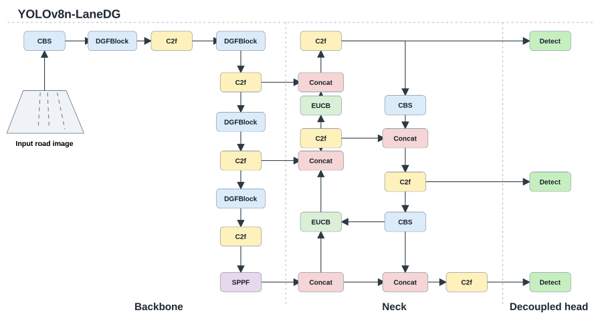
Exploratory assessment of YOLOv8n-LaneDG cross-dataset transferability using reduced-scale benchmarks
Keywords:
YOLOv8n-LaneDG, Lane detection, Cross-dataset transferability, Domain shift, Zero-shot evaluationAbstract
Lane detection is a fundamental perception task in autonomous driving and advanced driver-assistance systems, yet transferability across datasets with different visual and geometric characteristics remains uncertain. This exploratory study assesses YOLOv8n-LaneDG using reduced-scale subsets of TuSimple, CULane, and BDD100K. Each source-domain experiment used 80 training, 20 validation, and 40 evaluation images, direct 256 × 256 resizing, eight training epochs, and a batch size of four. The model has 405,088 trainable parameters and was trained independently on each source using AdamW optimization (learning rate 0.01, weight decay 0.0005, three warm-up epochs, and cosine learning-rate decay), ImageNet normalization, composite binary cross-entropy (BCE), Dice, and continuity loss (continuity weight 0.5), identical augmentation settings, and random seed 42. Frozen source models were evaluated on unseen target subsets without fine-tuning, retraining, or domain adaptation at a confidence threshold of 0.90, using pixel-level precision, recall, F1-score, intersection over union (IoU), and thresholded whole-mask IoU accuracy summaries ([email protected] and [email protected]:0.95). In this single sampled run, the CULane-trained model yielded the highest descriptive mean zero-shot F1-score (0.885) and IoU (0.800). The largest decline occurred for TuSimple→CULane with F1-score decreasing from 0.905 to 0.359 and IoU from 0.827 to 0.208. Across the reduced matrix, mean F1-score declined from 0.900 in-domain to 0.793 zero-shot. Because training was abbreviated and the experiment used a single random seed, aspect-ratio-altering resizing, and 40 evaluation images per domain, domain shift cannot be separated from under-training and sampling variability; the source-domain ordering is descriptive rather than a definitive benchmark ranking.
References
[1] L. Tabelini, R. Berriel, T. M. Paixão, C. Badue, A. F. De Souza & T. Oliveira-Santos, ``Keep your eyes on the lane: Real-time attention-guided lane detection'', 2021 IEEE/CVF Conference on Computer Vision and Pattern Recognition (CVPR), Nashville, TN, USA, 2021, pp. 294. https://doi.org/10.1109/CVPR46437.2021.00036.
[2] L. Liu, X. Chen, S. Zhu & P. Tan, ``CondLaneNet: A top-to-down lane detection framework based on conditional convolution'', 2021 IEEE/CVF International Conference on Computer Vision (ICCV), Montreal, QC, Canada, 2021, pp. 3753. https://doi.org/10.1109/ICCV48922.2021.00375.
[3] Y. He, W. Chen, C. Li, X. Luo & L. Huang, ``Fast and accurate lane detection via graph structure and disentangled representation learning'', Sensors 21 (2021) 4657. https://doi.org/10.3390/s21144657.
[4] T. Zheng, Y. Huang, Y. Liu, W. Tang, Z. Yang, D. Cai & X. He, ``CLRNet: Cross layer refinement network for lane detection'', 2022 IEEE/CVF Conference on Computer Vision and Pattern Recognition (CVPR), New Orleans, LA, USA, 2022, pp. 888. https://doi.org/10.1109/CVPR52688.2022.00097.
[5] J. Wang, Y. Ma, S. Huang, T. Hui, F. Wang, C. Qian & T. Zhang, ``A keypoint-based global association network for lane detection'', 2022 IEEE/CVF Conference on Computer Vision and Pattern Recognition (CVPR), New Orleans, LA, USA, 2022, pp. 1382. https://doi.org/10.1109/CVPR52688.2022.00145.
[6] M. Lee, J. Lee, D. Lee, W. Kim, S. Hwang & S. Lee, ``Robust lane detection via expanded self attention'', 2022 IEEE/CVF Winter Conference on Applications of Computer Vision (WACV), Waikoloa, HI, USA, 2022, pp. 1949. https://doi.org/10.1109/WACV51458.2022.00201.
[7] J. Yang, L. Zhang & H. Lu, ``Lane detection with versatile AtrousFormer and local semantic guidance'', Pattern Recognition 133 (2023) 109053. https://doi.org/10.1016/j.patcog.2022.109053.
[8] L. Xiao, X. Li, S. Yang & W. Yang, ``ADNet: Lane shape prediction via anchor decomposition'', 2023 IEEE/CVF International Conference on Computer Vision (ICCV), Paris, France, 2023, pp. 6381. https://doi.org/10.1109/ICCV51070.2023.00589.
[9] H. Honda & Y. Uchida, ``CLRerNet: Improving confidence of lane detection with LaneIoU'', 2024 IEEE/CVF Winter Conference on Applications of Computer Vision (WACV), Waikoloa, HI, USA, 2024, pp. 1165. https://doi.org/10.1109/WACV57701.2024.00121.
[10] K. Zhou, ``Lane2Seq: Towards unified lane detection via sequence generation'', 2024 IEEE/CVF Conference on Computer Vision and Pattern Recognition (CVPR), Seattle, WA, USA, 2024, pp. 16944. https://doi.org/10.1109/CVPR52733.2024.01603.
[11] J. Zhou, C. Zhang & J. Beyerer, ``Towards weakly-supervised domain adaptation for lane detection'', 2024 IEEE/CVF Conference on Computer Vision and Pattern Recognition Workshops (CVPRW), Seattle, WA, USA, 2024, pp. 3553. https://doi.org/10.1109/CVPRW63382.2024.00359.
[12] Y. Ge, Z. Ji, M. Zhang, X. Li, G. Wang & L. Wang, ``BSCNNLaneNet: A novel bidirectional spatial convolution neural network for lane detection'', Electronics 14 (2025) 2604. https://doi.org/10.3390/electronics14132604.
[13] K. Zheng, J. Jiang, Z. Liang, Y. Yoo & Y. Wang, ``Lane detection algorithm based on improved YOLOv8'', Computers 15 (2026) 561. https://doi.org/10.3390/computers15090561.
[14] Y. Yang, H. Peng, C. Li, W. Zhang & K. Yang, ``LaneFormer: Real-time lane exaction and detection via transformer'', Applied Sciences 12 (2022) 9722. https://doi.org/10.3390/app12199722.
[15] Z. Feng, S. Guo, X. Tan, K. Xu, M. Wang & L. Ma, ``Rethinking efficient lane detection via curve modeling'', 2022 IEEE/CVF Conference on Computer Vision and Pattern Recognition (CVPR), New Orleans, LA, USA, 2022, pp. 17062. https://doi.org/10.1109/CVPR52688.2022.01655.
[16] C. Li, B. Zhang, J. Shi & G. Cheng, ``Multi-level domain adaptation for lane detection'', 2022 IEEE/CVF Conference on Computer Vision and Pattern Recognition Workshops (CVPRW), New Orleans, LA, USA, 2022, pp. 4380. https://doi.org/10.1109/CVPRW56347.2022.00484.
[17] K. Bhardwaj, Z. Wan, A. Raychowdhury & R. A. Goldhahn, ``Real-time fully unsupervised domain adaptation for lane detection in autonomous driving'', 2023 Design, Automation & Test in Europe Conference & Exhibition (DATE), Antwerp, Belgium, 2023, pp. 1. https://doi.org/10.23919/DATE56975.2023.10136937.
[18] P. Ganeriwala, S. Bhattacharyya & R. Muthalagu, ``Cross dataset analysis and network architecture repair for autonomous car lane detection'', 2023 IEEE Intelligent Vehicles Symposium (IV), Anchorage, AK, USA, 2023, pp. 1. https://doi.org/10.1109/IV55152.2023.10186721.
[19] Y. Kao, S. Che, S. Zhou, S. Guo, X. Zhang & W. Wang, ``LHFFNet: A hybrid feature fusion method for lane detection'', Scientific Reports 14 (2024) 16353. https://doi.org/10.1038/s41598-024-66913-1.
[20] J. Zhang, B. Wang, H. Naeem & S. Dai, ``Robust spatiotemporal lane detection model'', Transportation Research Record 2679 (2025) 2213. https://doi.org/10.1177/03611981241260696.
[21] E. H.-C. Lu & W.-C. Chiu, ``Lane detection based on CycleGAN and feature fusion in challenging scenes'', Vehicles 7 (2025) 2. https://doi.org/10.3390/vehicles7010002.
[22] G. Lian, ``Robust lane detection based on informative feature pyramid network in complex scenarios'', Electronics 14 (2025) 3179. https://doi.org/10.3390/electronics14163179.
[23] M. Rahul Surya & S. K. Dash, ``Robust lane detection in autonomous driving using gated convolutional networks with spatial attention'', Results in Engineering 30 (2026) 110129. https://doi.org/10.1016/j.rineng.2026.110129.
[24] O. Njama-Abang, D. U. Ashishie, E. A. Edim & M. A. Agana, ``Development of a visual analogy model using transfer learning techniques'', African Scientific Reports 4 (2025) 304. https://doi.org/10.46481/asr.2025.4.3.304.
[25] A. A. Keji, O. Fakeye, N. N. Onochie & O. Sangotoki, ``Predicting long-term deposit customers using convolutional neural network and data conversion technique'', African Scientific Reports 3 (2024) 192. https://doi.org/10.46481/asr.2024.3.3.192.
[26] G. James, A. Ekong, E. Abraham, E. Oduobuk, N. Michael, V. Ufford & O. Ebong, ``An enhanced control solutions for efficient urban waste management using deep learning algorithms'', African Scientific Reports 3 (2024) 183. https://doi.org/10.46481/asr.2024.3.3.183.
[27] A. Adegoke-Elijah, T. O. Ojewumi & K. O. Jimoh, ``ECG anomaly detection: A deep learning perspective with LSTM encoders'', African Scientific Reports 4 (2025) 359. https://doi.org/10.46481/asr.2025.4.3.359.
[28] TuSimple, ``TuSimple Lane Detection Challenge'', TuSimple Benchmark (2017). Available online: https://github.com/TuSimple/tusimple-benchmark.
[29] X. Pan, J. Shi, P. Luo, X. Wang & X. Tang, ``Spatial as deep: Spatial CNN for traffic scene understanding'', Proceedings of the AAAI Conference on Artificial Intelligence 32 (2018) 7276. https://doi.org/10.1609/aaai.v32i1.12301.
[30] F. Yu, H. Chen, X. Wang, W. Xian, Y. Chen, F. Liu, V. Madhavan & T. Darrell, ``BDD100K: A diverse driving dataset for heterogeneous multitask learning'', 2020 IEEE/CVF Conference on Computer Vision and Pattern Recognition (CVPR), 2020, pp. 2633. https://doi.org/10.1109/CVPR42600.2020.00271.
Published
How to Cite
Issue
Section
Copyright (c) 2026 Ikporo Stephen Chibueze, Ogbu N. Henry, Ignatius Ogbaga, Kenechukwu M. Agbo

This work is licensed under a Creative Commons Attribution 4.0 International License.