Human activity recognition with a fine-tuned CLIP vision transformer and EfficientNet-B0 baseline
Keywords:
Human activity recognition, CLIP, Vision transformer, EfficientNet, Data leakageAbstract
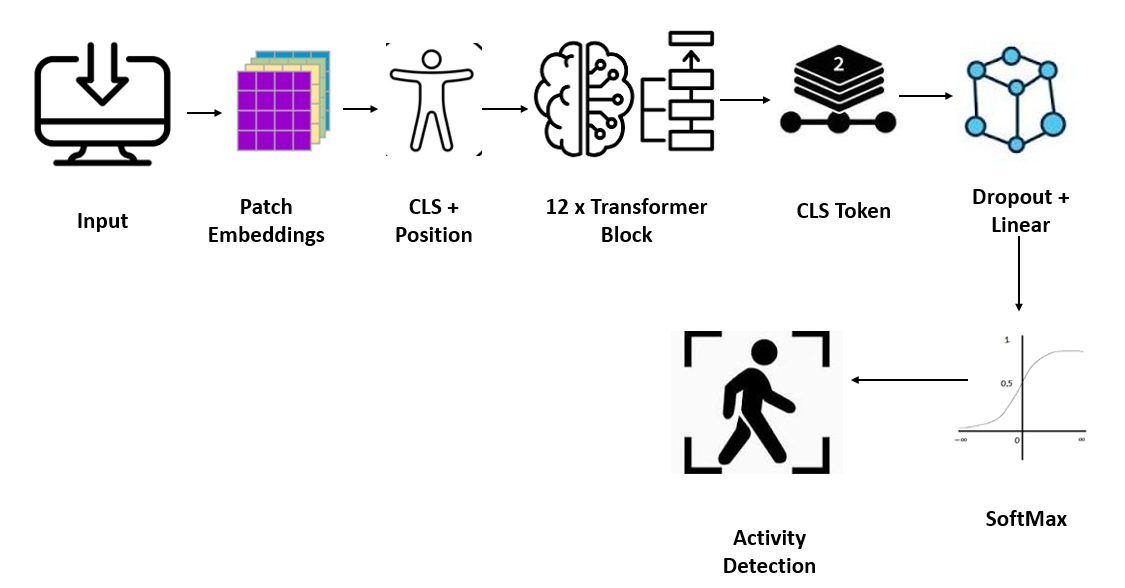
Image-based human activity recognition (HAR) is a building block for camera-based monitoring of daily routines, but reported accuracies are often inflated by train--test leakage. This study evaluates 15-class HAR from single RGB images under a leakage-controlled protocol: 12,600 labelled images were grouped by perceptual-hash near-duplicate detection and split into training, validation and test sets (9,005/1,796/1,799) before any augmentation, and augmentation was applied to training batches only. A contrastive language--image pre-training (CLIP) vision transformer (ViT)-B/16 backbone fine-tuned with layer-wise learning-rate decay, exponential-moving-average (EMA) weights and label smoothing reached 91.44% test accuracy (macro-F1 91.45%, macro one-vs-rest area under the curve (AUC) 99.55%) and 91.53 ± 0.74% in five-fold group-stratified cross-validation. A lightweight EfficientNet-B0 baseline evaluated on the same split reached 80.93% accuracy with 4.03 M parameters and 0.77 billion floating-point operations (GFLOPs), compared with 85.81 M parameters and 35.13 GFLOPs for the ViT. On an NVIDIA Tesla T4 the ViT required 7.39 ms per image (batch size 1, FP16) and approximately 0.22 J per image at a measured whole-board GPU power of about 65.9 W. The results characterise generic activity recognition which could become one component of a future, clinically validated daily-routine monitoring system.
References
[1] Alzheimer's Association Report, ``2026 Alzheimer's disease facts and figures'', Alzheimer's & Dementia 22 (2026) e71345. https://doi.org/10.1002/alz.71345.
[2] M. Nagadia, ``Human Action Recognition (HAR) dataset'', Kaggle. (Accessed 19 October 2026). Available online: https://archive.ics.uci.edu/dataset/226/opportunity+activity+recognition.
[3] A. Radford, J. W. Kim, C. Hallacy, A. Ramesh, G. Goh, S. Agarwal, G. Sastry, A. Askell, P. Mishkin, J. Clark, G. Krueger & I. Sutskever, ``Learning transferable visual models from natural language supervision'', International Conference on Machine Learning, 2021, pp. 8748--8763. https://doi.org/10.48550/arXiv.2103.00020.
[4] M. Tan & Q. Le, ``EfficientNet: Rethinking model scaling for convolutional neural networks'', International Conference on Machine Learning, 2019, pp. 6105--6114. https://doi.org/10.48550/arXiv.1905.11946.
[5] Q. Wu, Y. Wu, Y. Zhang & L. Zhang, ``A local--global estimator based on large kernel CNN and transformer for human pose estimation and running pose measurement'', IEEE Transactions on Instrumentation and Measurement 71 (2022) 5019612. https://doi.org/10.1109/TIM.2022.3200438.
[6] M. Habib, Z. Wang, S. Qiu, H. Zhao & A. S. Murthy, ``Machine learning based healthcare system for investigating the association between depression and quality of life'', IEEE Journal of Biomedical and Health Informatics 26 (2022) 2008. https://doi.org/10.1109/JBHI.2022.3140433.
[7] A. Gamal, M. Elattar & S. Selim, ``Automatic early diagnosis of Alzheimer's disease using 3D deep ensemble approach'', IEEE Access 10 (2022) 115974. https://doi.org/10.1109/ACCESS.2022.3218621.
[8] A. Lakhan, T.-M. Grønli, G. Muhammad & P. Tiwari, ``EDCNNS: Federated learning enabled evolutionary deep convolutional neural network for Alzheimer disease detection'', Applied Soft Computing 147 (2023) 110804. https://doi.org/10.1016/j.asoc.2023.110804.
[9] A. Alorf & M. U. G. Khan, ``Multi-label classification of Alzheimer's disease stages from resting-state fMRI-based correlation connectivity data and deep learning'', Computers in Biology and Medicine 151 (2022) 106240. https://doi.org/10.1016/j.compbiomed.2022.106240.
[10] B. Lee, S. Hong & H. Kim, ``Determination of workers' compliance to safety regulations using a spatio-temporal graph convolution network'', Advanced Engineering Informatics 56 (2023) 101942. https://doi.org/10.1016/j.aei.2023.101942.
[11] J. Zhou, Y. Wei, X. Li, W. Zhou, R. Tao, Y. Hua & H. Liu, ``A deep learning model for early diagnosis of Alzheimer's disease combined with 3D CNN and video Swin transformer'', Scientific Reports 15 (2025) 23311. https://doi.org/10.1038/s41598-025-05568-y.
[12] R. Mohan, P. Borugadda, N. R. Lavuri & S. Venugopal, ``An IoT-assisted Alzheimer's disease patient monitoring system using adaptive deep learning models with recommendation about patient abnormality'', Journal on Advances in Signal Processing 2026 (2026) 26. https://doi.org/10.1186/s13634-026-01301-7.
[13] L. Zhang, F. Lu, K. Zhou, X.-D. Zhou & Y. Shi, ``Hierarchical spatial-temporal adaptive graph fusion for monocular 3D human pose estimation'', IEEE Signal Processing Letters 31 (2023) 61. https://doi.org/10.1109/LSP.2023.3339060.
[14] H. Basly, W. Ouarda, F. E. Sayadi, B. Ouni & A. M. Alimi, ``Lahar-CNN: Human activity recognition from one image using convolutional neural network learning approach'', International Journal of Biometrics 13 (2021) 385. https://www.inderscienceonline.com/doi/abs/10.1504/IJBM.2021.117855.
[15] Y. Kong & Y. Fu, ``Human action recognition and prediction: A survey'', International Journal of Computer Vision 130 (2022) 1366. https://doi.org/10.1007/s11263-022-01594-9.
[16] Z. Sun, Q. Ke, H. Rahmani, M. Bennamoun, G. Wang & J. Liu, ``Human action recognition from various data modalities: A review'', IEEE Transactions on Pattern Analysis and Machine Intelligence 45 (2023) 3200. https://doi.org/10.1109/TPAMI.2022.3183112.
[17] C. Zheng, W. Wu, C. Chen, T. Yang, S. Zhu, J. Shen, N. Kehtarnavaz & M. Shah, ``Deep learning-based human pose estimation: A survey'', ACM Computing Surveys 56 (2023) 1. https://doi.org/10.1145/3603618.
[18] K. Han, Y. Wang, H. Chen, X. Chen, J. Guo, Z. Liu, Y. Tang, A. Xiao, C. Xu, Y. Xu, Z. Yang, Y. Zhang & D. Tao, ``A survey on vision transformer'', IEEE Transactions on Pattern Analysis and Machine Intelligence 45 (2023) 87. https://doi.org/10.1109/TPAMI.2022.3152247.
[19] S. Khan, M. Naseer, M. Hayat, S. W. Zamir, F. S. Khan & M. Shah, ``Transformers in vision: A survey'', ACM Computing Surveys 54 (2022) 200. https://doi.org/10.1145/3505244.
[20] D. Patterson, J. Gonzalez, U. Hölzle, Q. Le, C. Liang, L.-M. Munguia, D. Rothchild, D. R. So, M. Texier & J. Dean, ``The carbon footprint of machine learning training will plateau, then shrink'', Computer 55 (2022) 18. https://ieeexplore.ieee.org/document/9810097.
[21] A. Ebrahimi, S. Luo & Alzheimer's Disease Neuroimaging Initiative, ``Convolutional neural networks for Alzheimer's disease detection on MRI images'', Journal of Medical Imaging 8 (2021) 024503. https://doi.org/10.1117/1.JMI.8.2.024503.
[22] S. Kapoor & A. Narayanan, ``Leakage and the reproducibility crisis in machine-learning-based science'', Patterns 4 (2023) 100804. https://doi.org/10.1016/j.patter.2023.100804.
[23] E. Yagis, S. W. Atnafu, A. García Seco de Herrera, C. Marzi, R. Scheda, M. Giannelli, C. Tessa, L. Citi & S. Diciotti, ``Effect of data leakage in brain MRI classification using 2D convolutional neural networks'', Scientific Reports 11 (2021) 22544. https://doi.org/10.1038/s41598-021-01681-w.
[24] A. Adegoke-Elijah, T. O. Ojewumi & K. O. Jimoh, ``ECG anomaly detection: A deep learning perspective with LSTM encoders'', African Scientific Reports 4 (2025) 359. https://doi.org/10.46481/asr.2025.4.3.359.
[25] A. A. Keji, O. Fakeye, N. N. Onochie & O. Sangotoki, ``Predicting long-term deposit customers using convolutional neural network and data conversion technique'', African Scientific Reports 3 (2024) 192. https://doi.org/10.46481/asr.2024.3.3.192.
[26] A. E. A. Mohammed, H. Mwambi & B. Omolo, ``Integrative approaches of multivariate convolutional neural networks with a dynamic conditional correlation model for forecasting stock market volatility'', Recent Advances in Natural Sciences 3 (2025) 197. https://doi.org/10.61298/rans.2025.3.2.197.
Published
How to Cite
Issue
Section
Copyright (c) 2026 Aanjan Kumar, Midhunchakkaravarthy Janarthanan, Ganesh Khekare

This work is licensed under a Creative Commons Attribution 4.0 International License.