
Occupational radiation dose assessment across clinical specialties in a Nigerian tertiary hospital using optically stimulated luminescence dosimetry
Keywords:
Healthcare workers, Radiation protection, Occupational radiation exposure, Personal dose equivalent, Optically stimulated luminescent dosimetryAbstract
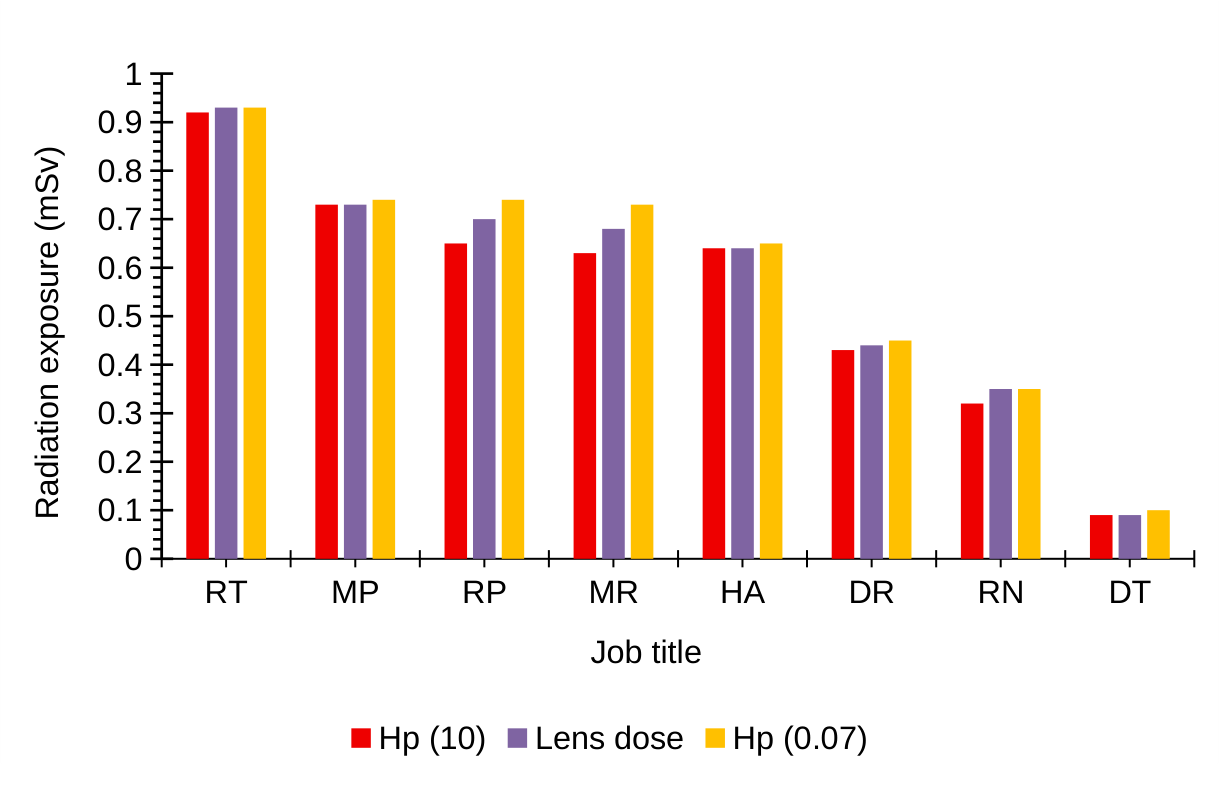
Occupational radiation exposure varies across healthcare specialties, requiring monitoring. This study assessed occupational radiation exposure among healthcare workers (HCWs) at the National Hospital Abuja (NHA), Nigeria, using optically stimulated luminescence (OSL) dosimetry. A total of 386 annual OSL dose records (worker-years) (2020--2024) were analyzed across diagnostic radiology, nuclear medicine, radiotherapy, and medical physics departments to determine personal dose equivalents (Hp (10), Hp (3), and Hp (0.07)). A single chest-level badge was worn over the lead apron; consequently, Hp (3) and Hp (0.07) represented chest-level estimates rather than dedicated eye-lens or extremity measurements. Year-stratified comparisons characterized dose distributions. Technologists recorded the highest mean annual doses of 0.92, 0.93, and 0.93 mSv for Hp (10), Hp (3), and Hp (0.07), respectively, with means strongly influenced by a single 46.12 mSv record (median Hp (10): 0.21 mSv). Darkroom technicians had the lowest exposures. Pooled median Hp (10) was highest in nuclear medicine (0.54 (IQR 0.40) mSv), followed by radiotherapy (0.47 (IQR 0.68) mSv), medical physics (0.40 (IQR 0.76) mSv), and diagnostic radiology (0.07 (IQR 0.20) mSv); significant interdepartmental differences occurred only in 2024. The 46.12 mSv record exceeded the 20 mSv annual average effective-dose limit but remained below the 50 mSv single-year ceiling under the five-year framework and requires verification. All other reported Hp (10) and Hp (3) values were below 20 mSv, and Hp (0.07) values were below the 500 mSv annual skin-dose limit. Findings indicate generally low occupational exposure and support OSL dosimetry for routine monitoring in resource-limited healthcare settings.
References
[1] N. Karmaker, K. M. Maraz, F. Islam, M. M. Haque, M. Razzak, M. Z. I. Mollah, M. R. I. Faruque & R. A. Khan, ``Fundamental characteristics and application of radiation'', GSC Advanced Research and Reviews 7 (2021) 64. https://doi.org/10.30574/gscarr.2021.7.1.0043.
[2] M. Sallam, C. Beaini, M. M. Mijwil & M. Sallam, ``AI at the crossroads of cost and care: A SWOT analysis of Microsoft AI Diagnostic Orchestrator (MAI-DxO) in clinical diagnosis'', Journal of Clinical Medicine and Research 2 (2025). https://doi.org/10.37155/3060-8708-02.
[3] M. M. Rehani, O. Vano & O. Ciraj-Bjelac, ``Sources, effects and risks of ionizing radiation: UNSCEAR 2020/2021 report to the General Assembly, volume IV, scientific annex D'', United Nations, 2022.
[4] X. Liu, Q. Su, J. Zhang, Y. Chen, F. Li, C. Xie, L. He, S. Liu & Y. Lv, ``Low-dose radiation exposure and health outcomes among healthcare workers: a multi-center prospective cohort study'', Journal of Health, Population and Nutrition 44 (2025) 414. https://doi.org/10.1186/s41043-025-01133-5.
[5] D. Leszczynski, ``The grand challenge: Use of a new approach in developing policies in the area of radiation and health'', Frontiers in Public Health 2 (2014) 50. https://doi.org/10.3389/fpubh.2014.00050.
[6] S. Onwuzu, O. Abonyi, D. Sunday, A. Ozioko, C. Umeugochukwu, V. Ugwu & I. Onwuzu, ``The practice and implementation of radiation monitoring of radiographers in tertiary hospitals in southeastern Nigeria: A reassessment'', Journal of Radiography and Radiation Sciences 35 (2022) 1. https://doi.org/10.48153/jrrs.v35i2.225188.
[7] N. N. Jibiri, T. O. Akintunde, M. Y. Dambele & C. J. Olowookere, ``Occupational Radiation Exposure to the Extremities of Medical Staff during Hysterosalpingography and Radionuclide Bone Scan Procedures in Several Nigerian Hospitals'', Mol Imaging Radionucl Ther. 25(3) 114 (2016). https://doi.org/10.4274/mirt.96158.
[8] I. Pada, I. Umaru & I. M. Mustapha, ``Assessment of radiation protection of occupational workers in the radiotherapy facility at National Hospital Abuja, Nigeria'', Dutse Journal of Pure and Applied Sciences (DUJOPAS) 11 (2025) 213. https://doi.org/10.4314/4/dujopas.v11i4a.20.
[9] P. Covens, D. Berus, N. Buls, P. Clerinx & F. Vanhavere, ``Personal dose monitoring in hospitals: Global assessment, critical applications and future needs'', Radiation Protection Dosimetry 124 (2007) 250. https://doi.org/10.1093/rpd/ncm418.
[10] J.D. Harrison, M. Balonov, F. Bochud, C. Martin, H-G. Menzel, P. Ortiz-Lopez, R. Smith-Bindman, J.R. Simmonds, & R. Wakeford (International Commission on Radiological Protection), ``Use of dose quantities in radiological protection'', ICRP Publication 147, Annals of the ICRP 50 (2021) 9. https://doi.org/10.1177/0146645320911864.
[11] M. Alakhras, D. S. Al-Mousa, B. Al Mohammad & I. Kleib, ``Radiation dose to health care workers measured by thermoluminescent dosimetry'', Clinical Radiology 81 (2025) 106712. https://doi.org/10.1016/j.crad.2024.09.018.
[12] R. Kopec, M. Budzanowski, A. Budzy'{n}ska, R. Czepczynski, M. Dziuk, J. Sowinski & A. Wyszomirska, ``On the relationship between whole body, extremity and eye lens doses for medical staff in the preparation and application of radiopharmaceuticals in nuclear medicine'', Radiation Measurements 46 (2011) 1295. https://doi.org/10.1016/J.RADMEAS.2011.07.036.
[13] A. Milatovi'{c}, S. Ivanovi'{c}, V. Spasi'{c}-Joki'{c} & S. Jovanovi'{c}, ``A dose estimation for persons occupationally exposed to ionizing radiation in Montenegro'', Archive of Oncology 16 (2008) 5. https://www.researchgate.net/publication/47366702_A_dose_estimation_for_persons_occupationally_exposed_to_ionizing_radiation_in_Montenegro.
[14] P. Anzaku & T. Bichi, ``A multi-center assessment of occupational radiation exposure levels due to radio-diagnostic activities in four specialist hospitals in northwestern Nigeria'', International Journal of Medical Research and Innovation 1 (2025) 20. https://doi.org/10.11648/j.ijmri.20250101.13.
[15] C. Baudin, B. Vacquier, G. Thin, L. Chenene, J. Guersen, I. Partarrieu, M. Louet, H. Ducou Le Pointe, S. Mora, C. Verdun-Esquer, J. Feuardent, F. Rousseau, H. Roy, L. Bensefa-Colas, L. Boyer & M. O. Bernier, ``Occupational exposure to ionizing radiation in medical staff: trends during the 2009--2019 period in a multicentric study'', European Radiology 33 (2023) 5675. https://doi.org/10.1007/s00330-023-09541-z.
[16] T. c{S}ahmaran & H. c{C}orapli{}, ``Exploring occupational radiation exposure: Insights from a decade-long study (2012--2021)'', Journal of Radiation Research and Applied Sciences 17 (2024) 100830. https://doi.org/10.1016/j.jrras.2024.100830.
[17] E. Carinou, I. Clairand, J. Dabin, P. Ferrari, M. Ginjaume, O. Hupe, M. Gracia Ochoa, U. O’Connor & F. Vanhavere, ``Individual exposure and monitoring in interventional radiology and cardiology'', EURADOS Reports, No. 2023-02, EURADOS -- European Radiation Dosimetry Group e. V. (2023). https://doi.org/10.12768/0yfk-yx46.
[18] M. B. Freitas, R. H. C. Alves & E. M. Yoshimura, ``Calibration of OSL dosimeters according to the IAEA code of practice for diagnostic radiology dosimetry TRS-457'', IAEA INIS, 2010. Available online: https://inis.iaea.org/records/2ennp-9c984.
[19] International Atomic Energy Agency, ``Occupational radiation protection'', General Safety Guide No. GSG-7, Vienna, 2018. Available online: https://www-pub.iaea.org/mtcd/publications/pdf/pub1785_web.pdf.
[20] International Commission on Radiological Protection, ``The 2007 recommendations of the International Commission on Radiological Protection'', ICRP Publication 103, Annals of the ICRP 37 (2007) 9. https://doi.org/10.1016/j.icrp.2007.10.003.
[21] International Organization for Standardization, ``ISO 15382:2015 radiological protection: Procedures for monitoring the dose to the lens of the eye, the skin and the extremities'', 2nd ed., Geneva, 2015. Available online: https://www.iso.org/standard/61582.html.
[22] O. J. Dunn, ``Multiple comparisons using rank sums'', Technometrics 6 (1964) 241. https://doi.org/10.1080/00401706.1964.10490181.
[23] S. Holm, ``A simple sequentially rejective multiple test procedure'', Scandinavian Journal of Statistics 6 (1979) 65. https://www.jstor.org/stable/4615733.
[24] F. Hasford, J. Owusu-Banahene, J. K. Amoako, F. Otoo, E. O. Darko, G. Emi-Reynolds, J. Yeboah, C. C. Arwui & S. Adu, ``Assessment of annual whole-body occupational radiation exposure in medical practice in Ghana (2000--09)'', Radiation Protection Dosimetry 149 (2012) 431. https://doi.org/10.1093/rpd/ncr318.
[25] T. G. Alemayehu, G. G. Bogale & G. W. Bazie, ``Occupational radiation exposure dose and associated factors among radiology personnel in Eastern Amhara, Ethiopia'', PLoS ONE 18 (2023) e0286400. https://doi.org/10.1371/journal.pone.0286400.
[26] G. K. Korir, J. S. Wambani & I. K. Korir, ``Estimation of annual occupational effective doses from external ionising radiation at medical institutions in Kenya'', South African Journal of Radiology 15 (2011) 116. https://doi.org/10.4102/SAJR.V15I4.353.
[27] J. Deng, S. Fan, T. Wang, S. Hao, X. Liu, W. Guo & Q. Sun, ``Trends and distribution analysis of occupational exposure from medical practices in China (2010-2016)'', Health Physics 117 (2019) 656. https://doi.org/10.1097/HP.0000000000001118.
[28] P. A. Colgan, L. Currivan & D. Fenton, ``An assessment of annual whole-body occupational radiation exposure in Ireland (1996-2005)'', Radiation Protection Dosimetry 128 (2008) 12. https://doi.org/10.1093/rpd/ncm235.
[29] N. Shubayr, Y. Alashban, M. Almalki, S. Aldawood & A. Aldosari, ``Occupational radiation exposure among diagnostic radiology workers in the Saudi ministry of health hospitals and medical centers: A five-year national retrospective study'', Journal of King Saud University - Science 33 (2021) 101249. https://doi.org/10.1016/j.jksus.2020.101249.
[30] A. Jabeen, M. Munir, A. Khalil, M. Masood & P. Akhter, ``Occupational exposure from external radiation used in medical practices in Pakistan by film badge dosimetry'', Radiation Protection Dosimetry 140 (2010) 396. https://doi.org/10.1093/rpd/ncq134.
[31] M. H. Nassef & A. A. Kinsara, ``Occupational radiation dose for medical workers at a university hospital'', Journal of Taibah University for Science 11 (2017) 1259. https://doi.org/10.1016/j.jtusci.2017.01.003.
[32] K. Masood, J. Zafar, T. Zafar & H. Zafar, ``Assessment of the occupational radiation exposure doses to workers at INMOL Pakistan (2007-11)'', Radiation Protection Dosimetry 155 (2013) 110. https://doi.org/10.1093/RPD/NCS306.
[33] V. Samerdokiene, V. Atkocius & R. Ofomala, ``Radiation exposure received by the medical radiation workers in Lithuania at The Institute of Oncology, Vilnius University, 2004-2011'', Radiation Protection Dosimetry 157 (2013) 152. https://doi.org/10.1093/rpd/nct111.
[34] D. Phinsiri, P. Asavaruangkitkul, S. Kurdsithong & D. Suttho, ``The estimation of the occupational radiation dose for medical staff in Thailand by using retrospective annual dosimetry data'', International Journal of Radiation Research 22 (2024) 763. https://doi.org/10.61186/ijrr.22.3.763.
[35] C. H. Clement, F. A. Stewart, A. V. Akleyev, et al. International Commission on Radiological Protection, ``ICRP statement on tissue reactions and early and late effects of radiation in normal tissues and organs: Threshold doses for tissue reactions in a radiation protection context'', ICRP Publication 118, Annals of the ICRP 41 (2012) 1. https://doi.org/10.1016/j.icrp.2012.02.001.
Published
How to Cite
Issue
Section
Copyright (c) 2026 Charles Oshevire Ayara, Damilola Oluwafemi Samson, Victoria Taye Oluwasusi, Isaac Pada, Joyce Ekeme Ikubor, Omolara Victoria Oyelade

This work is licensed under a Creative Commons Attribution 4.0 International License.