A comparative review of machine learning models and deep learning architectures for pregnancy progression prediction
Keywords:
Pregnancy progression, Machine learning, Deep learning, Preeclampsia, Preterm birthAbstract
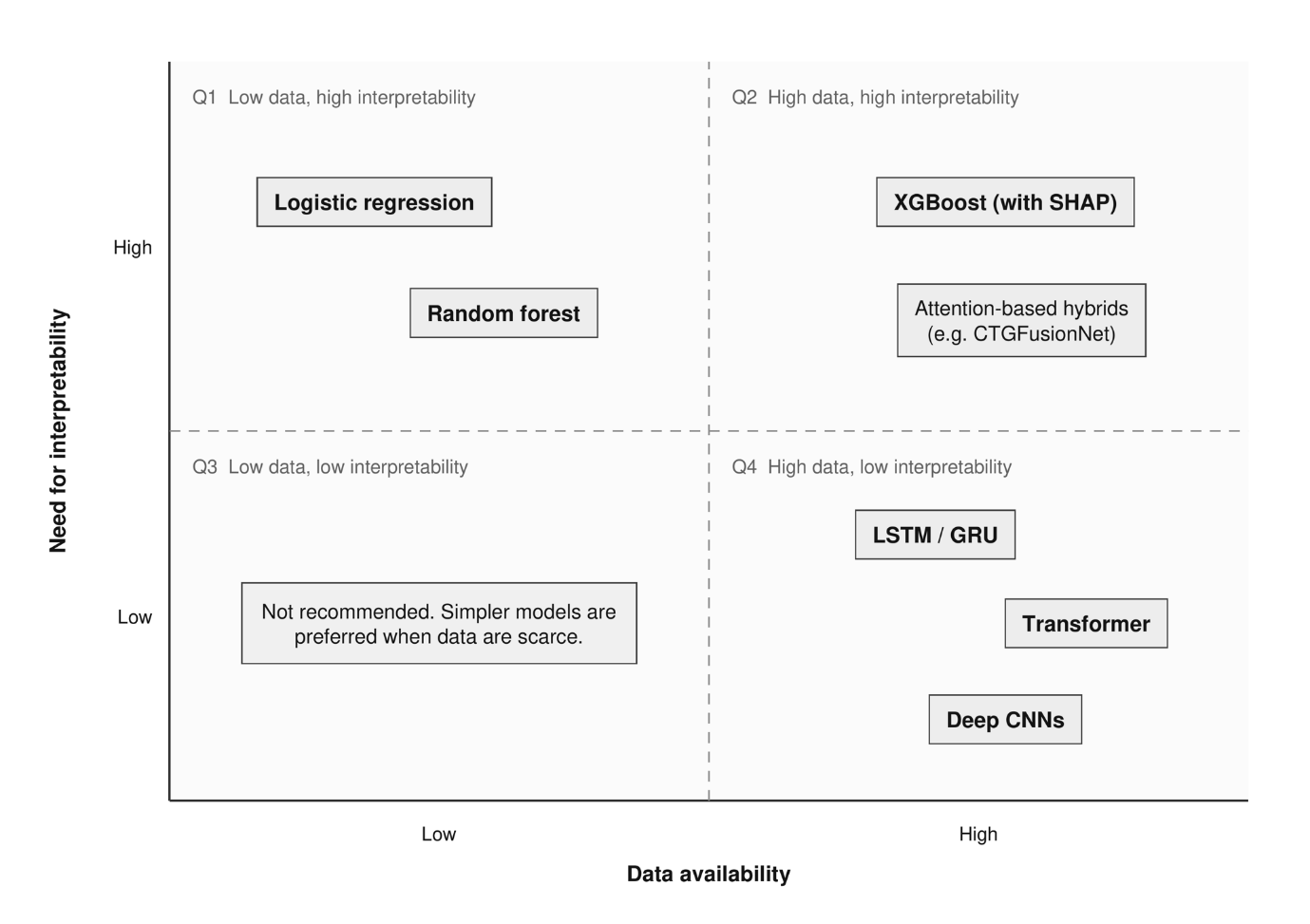
Monitoring the course of pregnancy is of paramount importance, enabling the identification of negative outcomes and clinically significant changes. Although parity status may contribute to information needs, status as first-time mothers is not considered as a causal determinant. This paper presents a structured scoping review comparing conventional and deep learning approaches to pregnancy-related prediction tasks. The reviewed machine learning models include logistic regression; random forest; Extreme Gradient Boosting (XGBoost); Recurrent Neural Networks (RNNs) and their gated variants, long short-term memory (LSTM) and Gated Recurrent Units (GRUs); Convolutional Neural Networks (CNNs); transformers; and hybrid architectures. The analysis employs six dimensions: performance; ability to encode temporal data; model interpretability; data requirements for training; computational costs; and clinical relevance. As primary studies report outcome-specific performance results, the findings are presented across outcome domains rather than aggregated rankings of model architectures. In a study on predicting preterm-birth outcomes, a transformer achieved a test-set Area Under the Receiver Operating Characteristic Curve (AUROC) of 0.792, compared to 0.78 for logistic regression, 0.751 for random forest, and 0.717 for a Support Vector Machine (SVM). In predicting preeclampsia, a CNN achieved an AUC of 0.85 on holdout validation and 0.81 on an external test set, with an AUC of 0.98 for early-onset preeclampsia. CTGFusionNet, which employs a hybrid architecture of convolutional, recurrent, and attention layers applied to Cardiotocography (CTG) and clinical records, reported 97.85% accuracy for the task of fetal-distress classification. The findings highlight the complementary strengths and weaknesses of conventional and deep learning models for the analyzed tasks. The choice of an architecture should be informed by the target outcome, data type, volume, and quality, calibration and validation strategies, requirements for interpretability and fairness, and computational costs rather than a singular emphasis on performance.
References
[1] M. F. Escobar, N. Benitez-Díaz, I. Blanco-Londoño, C. Cerón-Garcés, E. E. Peña-Zárate, L. A. Guevara-Calderón, L. Libreros-Peña & J. S. Galindo, ``Synthesis of evidence for managing hypertensive disorders of pregnancy in low middle-income countries: a scoping review'', BMC Pregnancy and Childbirth 24 (2024) 622. https://doi.org/10.1186/s12884-024-06796-2.
[2] G. G. Kyambille, A. N. Mvuma & D. Machuve, ``An overview of maternity healthcare monitoring in developing nations'', Tanzania Journal of Engineering and Technology 42 (2023) 46. https://doi.org/10.52339/tjet.v42i4.866.
[3] A. Tagetti & C. Fava, ``Diagnosis of hypertensive disorders in pregnancy: an update'', Journal of Laboratory and Precision Medicine 5 (2020) 8. https://doi.org/10.21037/jlpm.2019.11.04.
[4] H. Hu, N. Noori, V. Lee, C. Chow, N. W. Cheung, K. Ekanayake & M. Zen, ``eHealth and hypertensive disorders of pregnancy: systematic review'', Journal of Medical Internet Research 27 (2025) e77064. https://doi.org/10.2196/77064.
[5] S. Mizuno, S. Nagaie, J. Sugawara, G. Tamiya, T. Obara, M. Ishikuro, S. Kuriyama, N. Yaegashi, H. Tanaka, M. Yamamoto & S. Ogishima, ``Early prediction of hypertensive disorders of pregnancy toward preventive early intervention'', AJOG Global Reports 4 (2024) 100383. https://doi.org/10.1016/j.xagr.2024.100383.
[6] A. O. Babatunde, A. I. Ayede, A. Colangelo, T. D. Nguyen, A. T. Aborode, C. Umeh, M. P. Hernandez, O. I. Ayede & O. O. Ayede, ``Development of an educational and monitoring mobile application for pregnant women in Nigeria'', Frontiers in Public Health 12 (2025) 1368631. https://doi.org/10.3389/fpubh.2024.1368631.
[7] F. Sarhaddi, I. Azimi, S. Labbaf, H. Niela-Vilén, N. Dutt, A. Axelin, P. Liljeberg & A. M. Rahmani, ``Long-term IoT-based maternal monitoring: system design and evaluation'', Sensors 21 (2021) 2281. https://doi.org/10.3390/s21072281.
[8] S. S. Mousavi, K. Tierney, C. Robichaux, S. L. Boulet, C. Franklin, S. Chandrasekaran, R. Sameni, G. D. Clifford, N. Katebi & S Nikookar, ``Early prediction of hypertensive disorders of pregnancy using machine learning and medical records from the first and second trimesters'', Health 2 (2026) 025015. https://doi.org/10.1088/3049-477X/ae9e34.
[9] J. S. Schor, A. Kadambi, I. Fulcher, K. K. Venkatesh, M. A. Clapp, S. Ebrahim, A. Ebrahim & T. Wen, ``Using machine learning to predict the risk of developing hypertensive disorders of pregnancy using a contemporary nulliparous cohort'', AJOG Global Reports 4 (2024) 100386. https://doi.org/10.1016/j.xagr.2024.100386.
[10] G. Janoudi, D. B. Fell, J. G. Ray, A. M. Foster, R. Giffen, T. J. Clifford, M. A. Rodger, G. N. Smith & M. C. Walker, ``Augmented intelligence for clinical discovery in hypertensive disorders of pregnancy using outlier analysis'', Cureus 15 (2023) e36909. https://doi.org/10.7759/cureus.36909.
[11] L. Butler, F. Gunturkun, L. Chinthala, I. Karabayir, M. S. Tootooni, B. Bakir-Batu, T. Celik, O. Akbilgic & R. L. Davis, ``AI-based preeclampsia detection and prediction with electrocardiogram data'', Frontiers in Cardiovascular Medicine 11 (2024) 1360238. https://doi.org/10.3389/fcvm.2024.1360238.
[12] F. Zhang, L. Tong, C. Shi, R. Zuo, L. Wang & Y. Wang, ``Deep learning in predicting preterm birth: a comparative study of machine learning algorithms'', Maternal-Fetal Medicine 6 (2024) 141. https://doi.org/10.1097/FM9.0000000000000236.
[13] P. P. Aswathi Mohan, V. Uma, R. Sasirekha & V. Hamsika, ``CTGFusionNet: fusion of deep learning models for predicting fetal distress: a multimodal approach'', Health Information Science and Systems 13 (2025) 66. https://doi.org/10.1007/s13755-025-00383-1.
[14] A. T. Layton, ``Artificial intelligence and machine learning in preeclampsia'', Arteriosclerosis, Thrombosis, and Vascular Biology 45 (2025) 165. https://doi.org/10.1161/ATVBAHA.124.321673.
[15] R. Pangestuti, P. D. Ratrikaningtyas & A. H. Sutomo, ``Monitoring of pregnant women using the `Risk Identification, Evaluation Counseling, Systematic Monitoring, Troubleshooting' (REST) mobile app: protocol for a cluster randomized controlled trial'', JMIR Research Protocols 14 (2025) e66774. https://doi.org/10.2196/66774.
[16] Y. Liu & X. Wang, ``Application of smart mobile medical services in maternal health care management'', Contrast Media & Molecular Imaging 2021 (2021) 6249736. https://doi.org/10.1155/2021/6249736.
[17] A. Khalil, A. L. Ahmad Sunawari, S. Ismail & A. S. Abdul Jamil, ``Development of a web-based maternal health monitoring system: advancing beyond manual record-keeping'', in Biomedical Engineering, K. W. Lai & P. S. Q. Yeoh (Eds.), Springer, Singapore, 2024, pp. 1--18. https://doi.org/10.1007/978-981-97-9294-8-1.
[18] S. Borhade, G. Doke, P. Bhujbal & S. Said, ``MOM CARE: leveraging intelligent systems for comprehensive monitoring and support during pregnancy'', International Journal of Recent Advances in Engineering and Technology 141s (2025) 330. https://doi.org/10.65521/intjournalrecadvengtech.v14i1s.776.
[19] M. Oku, S. Ohno, H. Metoki, E. Arai, M. Ito, A. Shiozaki, A. Nakashima, N. Iwama, R. Tsuchida, S. Yoneda, N. Yoneda, S. Tsuda, M. Satoh, T. Murakami, S. Tanigawara, K. Hoshi, K. Tanaka, M. Yamada & S. Saito, ``Prediction model of hypertensive disorders of pregnancy based on home blood pressure monitoring'', Journal of the American Heart Association 15 (2026) e047093. https://doi.org/10.1161/JAHA.125.047093.
[20] Y. Chen, X. Shi, Z. Wang & L. Zhang, ``Machine learning-based management of hypertensive disorders in pregnancy: analysis of differences in key risk factors between gestational hypertension and pre-eclampsia and construction of a pre-eclampsia prediction model'', European Journal of Medical Research 30 (2025) 1135. https://doi.org/10.1186/s40001-025-03407-4.
[21] A. Bülez, K. Hansu, E. S. Çağan, A. R. Şahin & H. Ö. Dokumacı, ``Artificial intelligence in early diagnosis of preeclampsia'', Nigerian Journal of Clinical Practice 27 (2024) 383. https://doi.org/10.4103/njcp.njcp-222-23.
[22] A. Adegoke-Elijah, T. O. Ojewumi & K. O. Jimoh, ``ECG anomaly detection: a deep learning perspective with LSTM encoders'', African Scientific Reports 4 (2025) 359. https://doi.org/10.46481/asr.2025.4.3.359.
[23] O. Njama-Abang, D. U. Ashishie, P. T. Bukie & A. I. Bassey, ``A methodological framework for evaluating ADASYN and borderline-SMOTE oversampling techniques in imbalanced epidemiological data: a proof-of-concept study for Lassa fever detection'', Recent Advances in Natural Sciences 4 (2026) 238. https://doi.org/10.61298/rans.2026.4.1.238.
Published
How to Cite
Issue
Section
Copyright (c) 2026 Ogbaga Ignatius Nwoyibe, Agbo Kenechukwu Martin

This work is licensed under a Creative Commons Attribution 4.0 International License.