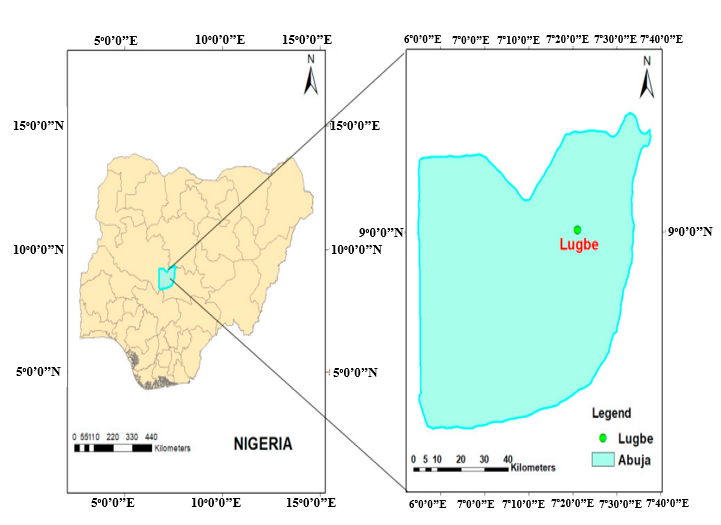
A comparative study of deep learning architectures for particulate matter prediction in Lugbe, FCT Abuja, Nigeria
Keywords:
Deep learning, Air quality, Neural networks, Prediction, Particulate matterAbstract
This study developed and evaluated three deep learning architectures: a recurrent neural network (RNN), a long short-term memory (LSTM) network and a convolutional neural network--bidirectional LSTM (CNN--BiLSTM) for predicting fine (PM2.5) and coarse (PM10) particulate matter concentrations. The models used 2-h (60-observation) sliding-window inputs and air quality and meteorological data comprising 1,211,810 entries. Hyperparameters were optimized using GridSearchCV with time-series cross-validation. Performance was assessed using mean absolute error (MAE), root mean square error (RMSE), relative absolute error (RAE), mean absolute percentage error (MAPE) and the coefficient of determination (R2). All three models demonstrated strong PM2.5 predictive capability (R2 > 0.90), explaining more than 90% of the observed variability. Model 2 showed the most balanced performance, with MAE of 2.898 μg/m3, RAE of 0.1697, RMSE of 6.453 μg/m3, MAPE of 7.7013% and R2 of 0.9166; Model 3 achieved a marginally higher R2 of 0.9188. Model 2 was considered the most reliable PM2.5 estimator because its error metrics were generally lower than those of Model 3. Prediction was weaker for PM10 across all architectures (R2 = 0.7037--0.7348), reflecting greater temporal variability and complexity. For PM10, Model 2 achieved the lowest RMSE (12.7097 μg/m3) and highest R2 (0.7348), indicating superior generalization. The results highlight the effectiveness of hybrid deep learning approaches for air quality forecasting, particularly for fine particulate matter.
References
[1] World Health Organization, ``WHO global air quality guidelines for particulate matter(PM$_{2.5}$ and PM$_{10}$), ozone, nitrogen dioxide and sulfur dioxide'', 2021. https://www.who.int/publications/i/item/9789240034433.
[2] United Nations Environment Programme, ``Cleaner fuels and vehicle emission standards proposed for West Africa'', UN Environment (2018). Available online: https://www.unep.org/news-and-stories/story/cleaner-fuels-and-vehicle-emission-standards-proposed-west-africa.
[3] A. M. Evuti, ``Sustainable environmental management in Nigeria: an appraisal'', The Journal of Social Sciences Research, Special Issue 2 (2018) 257. https://doi.org/10.32861/jssr.spi2.257.263.
[4] Climate & Clean Air Coalition, ``Nigeria - National action plan (NAP) to reduce short lived climate pollutant planning on short-lived climate pollutants(SLCP)'', 2023. https://www.ccacoalition.org/sites/default/files/policy-documents/nigeria-s-national-action-plan-nap-to-reduce-short-lived-climate-pollutants-slcps-.pdf.
[5] J. Adetayo, R. Yusuf, M. Amole, L. Jimoda & J. Sonibara, ``Air quality impact of diesel back-up generators (BUGs) in Nigeria's mobile telecommunication base transceiver stations (BTS)'', Management of Environmental Quality: An International Journal 28 (2017) 723. https://doi.org/10.1108/MEQ-09-2015-0168.
[6] O. Adama, ``Urban imaginaries: funding mega infrastructure projects in Lagos, Nigeria'', GeoJournal 83 (2018) 257. https://doi.org/10.1007/s10708-016-9761-8.
[7] J. S. Apte, J. D. Marshall, A. J. Cohen & M. Brauer, ``Addressing global mortality from ambient PM$_{2.5}$'', Environmental Science & Technology 49 (2015) 8057. https://doi.org/10.1021/acs.est.5b01236.
[8] A. Enumah, A. M. Evuti, K. A. Salam, Y. S. Mohammad & S. S. Silas, ``Temporal variations of PM$_{10}$ and PM$_{2.5}$ in Lugbe, FCT Abuja Nigeria'', Journal CleanWAS 9 (2025) 98. https://www.researchgate.net/publication/399528918_Temporal_Variations_Of_Pm_And_Pm_In_Lugbe.
[9] J. Wang, T. Niu & R. Wang, ``Research and application of an air quality early warning system based on a modified least squares support vector machine and a cloud model'', International Journal of Environmental Research and Public Health 14 (2017) 249. https://doi.org/10.3390/ijerph14030249.
[10] S. Wu, X. Li, W. Dong, S. Wang, X. Zhang & Z. Xu, ``Multi-source and heterogeneous marine hydrometeorology spatio-temporal data analysis with machine learning: a survey'', World Wide Web 26 (2023) 1115. https://doi.org/10.1007/s11280-022-01069-4.
[11] S. Subramaniam, N. Raju, A. Ganesan, N. Rajavel, M. Chenniappan, C. Prakash, A. Pramanik, A. K. Basak & S. Dixit, ``Artificial intelligence technologies for forecasting air pollution and human health: a narrative review'', Sustainability 14 (2022) 9951. https://doi.org/10.3390/su14169951.
[12] F. Biancofiore, M. Busilacchio, M. Verdecchia, B. Tomassetti, E. Aruffo, S. Bianco, S. Di Tommaso, C. Colangeli, G. Rosatelli & P. Di Carlo, ``Recursive neural network model for analysis and forecast of PM$_{10}$ and PM$_{2.5}$'', Atmospheric Pollution Research 8 (2017) 652. https://doi.org/10.1016/j.apr.2016.12.014.
[13] U. Pak, J. Ma, U. Ryu, K. Ryom, U. Juhyok, K. Pak & C. Pak, ``Deep learning-based PM$_{2.5}$ prediction considering the spatiotemporal correlations: a case study of Beijing, China'', Science of the Total Environment 699 (2020) 133561. https://doi.org/10.1016/j.scitotenv.2019.07.367.
[14] A. Bekkar, B. Hssina, S. Douzi & K. Douzi, ``Air-pollution prediction in smart city, deep learning approach'', Journal of Big Data 8 (2021) 161. https://doi.org/10.1186/s40537-021-00548-1.
[15] L. Zhang, P. Liu, L. Zhao, G. Wang, W. Zhang & J. Liu, ``Air quality predictions with a semi-supervised bidirectional LSTM neural network'', Atmospheric Pollution Research 12 (2021) 328. https://doi.org/10.1016/j.apr.2020.09.003.
[16] S. Chae, J. Shin, S. Kwon, S. Lee, S. Kang & D. Lee, ``PM10 and PM2.5 real-time prediction models using an interpolated convolutional neural network'', Scientific Reports 11 (2021) 11952. https://doi.org/10.1038/s41598-021-91253-9.
[17] J. Duan, Y. Gong, J. Luo & Z. Zhao, ``Air-quality prediction based on the ARIMA-CNN-LSTM combination model optimized by dung beetle optimizer'', Scientific Reports 13 (2023) 12127. https://doi.org/10.1038/s41598-023-36620-4.
[18] T. D. Morapedi & I. C. Obagbuwa, ``Air pollution particulate matter (PM$_{2.5}$) prediction in South African cities using machine learning techniques'', Frontiers in Artificial Intelligence 6 (2023) 1230087. https://doi.org/10.3389/frai.2023.1230087.
[19] O. E. Taylor & P. S. Ezekiel, ``A model for forecasting air quality index in Port Harcourt Nigeria using Bi-LSTM algorithm'', arXiv (2023). https://doi.org/10.48550/arXiv.2302.03930.
[20] Q. Liu, B. Cui & Z. Liu, ``Air quality class prediction using machine learning methods based on monitoring data and secondary modeling'', Atmosphere 15 (2024) 553. https://doi.org/10.3390/atmos15050553.
[21] S. Gaowa, Z. Zhang, J. Nie, L. Li, H. A-ru & Z. Yu, ``Using artificial neural networks to predict indoor particulate matter and TVOC concentration in an office building: model selection and method development'', Energy and Built Environment 6 (2025) 750. https://doi.org/10.1016/j.enbenv.2024.03.001.
[22] D. Faye, R. Lguensat, F. Kaly, A. Sudmant, A. Gaye & E. Kalisa, ``Machine learning for air quality forecasting: insights from five provinces of Rwanda'', Scientific African 30 (2025) e02959. https://doi.org/10.1016/j.sciaf.2025.e02959.
[23] O. A. Falaiye, O. F. Odubanjo & M. Sanni, ``Leveraging machine learning for accurate PM$_{2.5}$ concentration prediction in selected Nigerian locations'', Journal of Atmospheric and Solar-Terrestrial Physics 271 (2025) 106515. https://doi.org/10.1016/j.jastp.2025.106515.
[24] O. F. Odubanjo, T. O. Aluko, M. Sanni & O. E. Jimoh, ``Machine learning prediction of PM$_{2.5}$ in Lagos using embedded real-time environmental monitoring'', FUDMA Journal of Sciences 9 (2025) 218. https://doi.org/10.33003/fjs-2025-0909-3932.
[25] National Population Commission, ``Nigeria population projections and demographic indicators'', 2020, pg. 172. Available online: https://factcheckhub.com/wp-content/uploads/2022/07/national-population-commission-Projection_2022.pdf.
[26] National Bureau of Statistics, 2012, pg. 65. Available online: https://nigerianstat.gov.ng/pdfuploads/annual_abstract_2012.pdf.
[27] Nigerian Meteorological Agency, ``State of the climate in Nigeria'', 2023, pp 5-12. Available online: https://nimet.gov.ng/document.
[28] E. Abdullahi, L. Okobia & S. Hassan, ``Assessment of ambient atmospheric concentration of volatile organic compounds'', J. Chem. Bio. Phy. Sci. Sec. D. 2 (2012) 1637. https://www.researchgate.net/publication/236612106_Correspondence_Author_Assessment_of_Ambient_Atmospheric_Concentration_of_Volatile_Organic_Compounds_in_Abuja-Nigeria
[29] PurpleAir, ``Classic Plus air quality monitor'' (2026). Available online: https://www.purpleair.com/products/classic-plus-air-quality-monitor.
[30] C. Yi, J. Chen & L. Li, ``An adaptive robust gradient-based recurrent neural network for solving time-varying linear matrix equation and its application'', Journal of the Franklin Institute 362 (2025) 107991. https://doi.org/10.1016/j.jfranklin.2025.107991.
[31] Y. Huang, X. Zhang & Y. Li, ``A novel hybrid model for PM$_{2.5}$ concentration forecasting based on secondary decomposition ensemble and weight combination optimization'', IEEE Access 11 (2023) 119748. https://doi.org/10.1109/ACCESS.2023.3327707.
[32] E. Gross, R. Kruger & F. Toerien, ``A comparative analysis of option pricing models: Black--Scholes, Bachelier, and artificial neural networks'', Risk Management 27 (2025) 8. https://doi.org/10.1057/s41283-025-00160-0.
Published
How to Cite
Issue
Section
Copyright (c) 2026 Amarachukwu Enumah, Abdullahi Mohammed Evuti, Kamoru Adio Salam, Yahaya Sayyadi Mohammad, Samuel Shamaye Silas, Babatunde Abdulraheem Atoyebi

This work is licensed under a Creative Commons Attribution 4.0 International License.