
Parameter-space analysis of functional path-flow substitutions in Wardrop network equilibrium models
Keywords:
Wardrop equilibrium, Network flow, Functional substitution, Zero-flow property, Dimensionless condition numberAbstract
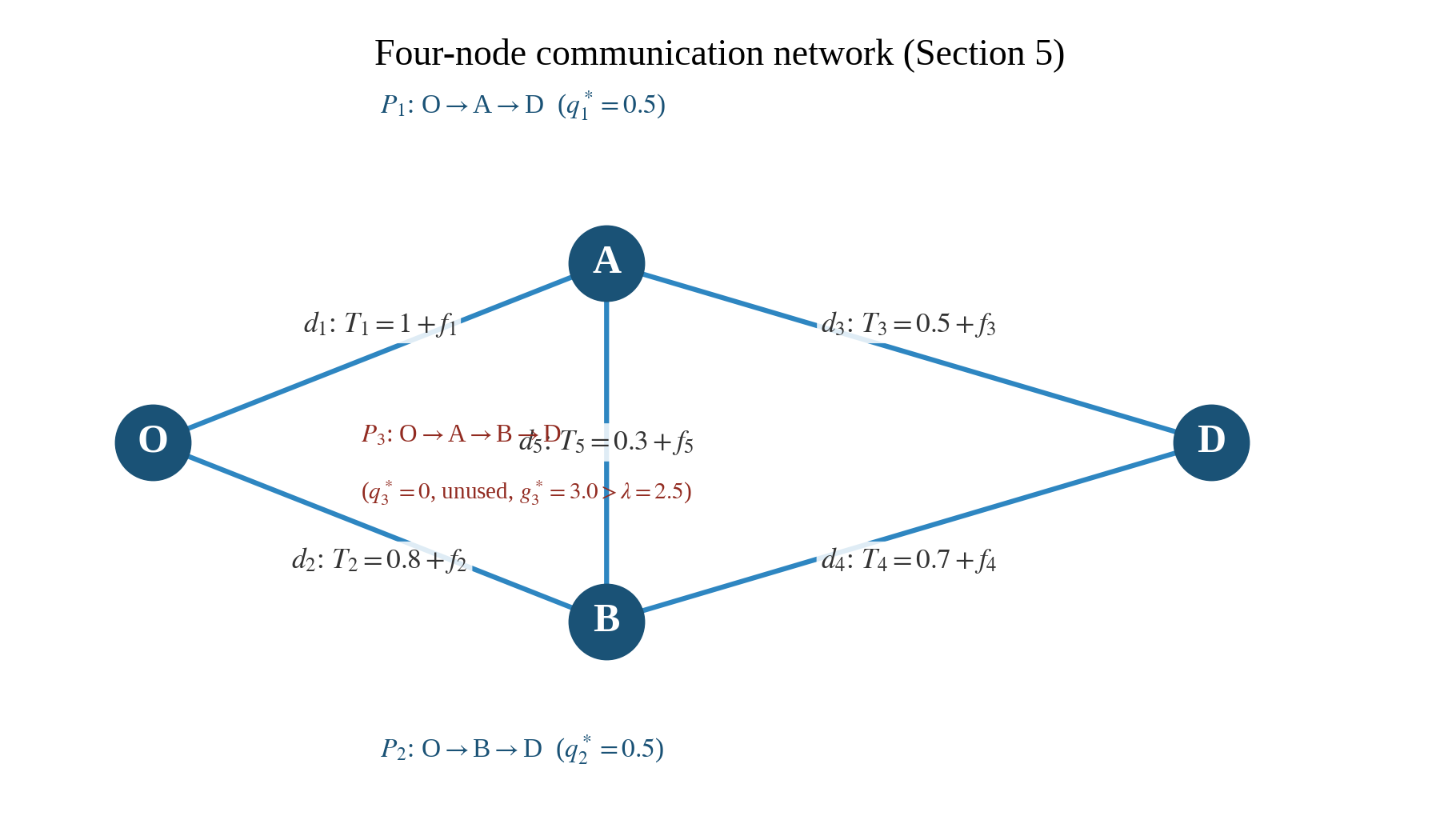
We study a path-flow Wardrop network equilibrium model in which total demand is split among paths subject to non-negativity, demand conservation, and a cost-balance condition. Each path flow is reparameterized as qp = ϕ(sp) for a scalar function ϕ and a parameter sp, and we build a single mathematical framework for comparing six choices of ϕ: cosine, sine, the exponential, the hyperbolic sine, the hyperbolic cosine, and the shifted hyperbolic cosine ϕ(s) = cosh(s) - 1. For each substitution we prove a feasibility bound, identify the admissible domain on which it is injective, give its closed-form inverse, and derive the dimensionless condition number kp = |ϕ'(sp) sp/qp|. We prove --- conditionally, not universally --- that if two admissible substitutions produce the same flow vector q*, then the link flow, costs, and all equilibrium quantities are identical; the substitutions differ in feasibility, in the zero-flow property (ability to represent an unused path at a finite parameter), in parameter uniqueness, and in kp. A fully worked example on a four-node, five-link communication network with a naturally unused path illustrates the theory with reproducible, independently verified computations.
References
[1] J. G. Wardrop, ``Some theoretical aspects of road traffic research'', Proceedings of the Institution of Civil Engineers 1 (1952) 325. https://doi.org/10.1680/ipeds.1952.11259.
[2] S. Dafermos, ``Traffic equilibrium and variational inequalities'', Transportation Science 14 (1980) 42. https://doi.org/10.1287/trsc.14.1.42.
[3] M. J. Smith, ``The existence, uniqueness and stability of traffic equilibria'', Transportation Research Part B: Methodological 13 (1979) 295. https://doi.org/10.1016/0191-2615(79)90022-5.
[4] A. Nagurney, Network Economics: A Variational Inequality Approach, Kluwer Academic Publishers, Dordrecht, Netherlands, 1993. https://doi.org/10.1007/978-94-011-2178-1.
[5] F. Facchinei & J. S. Pang, Finite-Dimensional Variational Inequalities and Complementarity Problems, Vols. I--II, Springer, New York, USA, 2003. https://doi.org/10.1007/b97543.
[6] F. P. Kelly, A. K. Maulloo & D. K. H. Tan, ``Rate control for communication networks: shadow prices, proportional fairness and stability'', Journal of the Operational Research Society 49 (1998) 237. https://doi.org/10.1057/palgrave.jors.2600523.
[7] T. Roughgarden & E. Tardos, ``How bad is selfish routing?'', Journal of the ACM 49 (2002) 236. https://doi.org/10.1145/506147.506153.
[8] L. I. Igbinosun & N. R. Udoenoh, ``Optimal distribution of vehicular traffic flow with Dijkstra's algorithm and Markov chains'', African Scientific Reports 4 (2025) 292. https://doi.org/10.46481/asr.2025.4.2.292.
[9] G. E. Bottomley, Channel Equalization for Wireless Communications: From Concepts to Detailed Mathematics, Wiley--IEEE Press, Hoboken, NJ, USA, 2011. https://doi.org/10.1002/9781118105283.
[10] P. Balaban & J. Salz, ``Optimum diversity combining and equalization in digital data transmission with applications to cellular mobile radio---Part I: theoretical considerations'', IEEE Transactions on Communications 40 (1992) 885. https://doi.org/10.1109/26.141454.
[11] D. N. Godard, ``Self-recovering equalization and carrier tracking in two-dimensional data communication systems'', IEEE Transactions on Communications 28 (1980) 1867. https://doi.org/10.1109/TCOM.1980.1094608.
Published
How to Cite
Issue
Section
Copyright (c) 2026 Samuel Okon Essang, Adie Emmanuel Benimpuye, John Eteng Imoke, Moses Ede Aigberemhon, Anditung Peter Agbudu, Amos Paul Imeh

This work is licensed under a Creative Commons Attribution 4.0 International License.