
Assessment of mycotoxin presence and distribution in maize grains across North central states of Nigeria
Keywords:
Grains, Fungi, Mycotoxins, LC-MS, Hygiene, PrevalenceAbstract
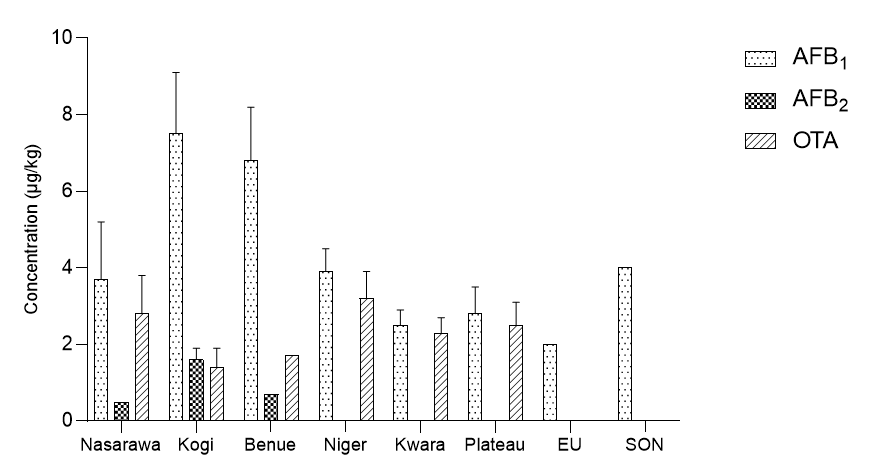
This research identified the prevalent fungal species and determined the concentration and distribution of mycotoxins in maize grains consumed in the North-central states of Nigeria. Six hundred composite samples were collected and screened for fungal contamination. The fumonisins, aflatoxins, ochratoxin, trichothecenes, and zearalenone concentrations were quantified in the samples using liquid chromatography-mass spectrometry (LC-MS). Kogi State had the highest concentration of fumonisin B1 (FB1) (755.7±56.7 µg/kg), Deoxynivalenol (DON) (1211 µg/kg), zearalenone (ZEA) (313 µg/kg) and aflatoxin B1 (AFB1) (7.5±1.6 µg/kg) and B2 (1.6±0.3 µg/kg) respectively. Ochratoxin A (OTA) value in Benue State (3.2±0.7 µg/kg) exceeded the European Union (EU) recommended amount of 3 µg/kg, while AFB1 concentrations in Kogi State (7.5±1.6 µg/kg) and Benue State (6.8±1.4 µg/kg) exceeded the EU and Standard Organization of Nigeria (SON) recommended amount of 2 µg/kg and 4 µg/kg respectively. Trichothecenes concentrations were all low compared to the EU-recommended amount in maize grains meant for the table.
References
[1] F. Imade, E. M. Ankwasa, H. Geng, S. Ullah, T. Ahmad, G. Wang, C. Zhang, O. Dada, F. Xing, Y. Zheng & Y. Liu, “Updates on food and feed mycotoxin contamination and safety in Africa with special reference to Nigeria”, Mycology 12 (2021) 245. https://doi.org/10.1080/21501203.2021.1941371.
[2] O. P. Omotayo, A. O. Omotayo, M. Mwanza & O. O. Babalola, “Prevalence of mycotoxins and their consequences on human health”, Toxicological Research 35 (2018) 1. https://doi.org/10.5487/TR.2019.35.1.001.
[3] A. A. Ismaiel & J. Papenbrock, “Mycotoxins: producing fungi and mechanisms of phytotoxicity”, Agriculture 5 (2015) 492. https://doi.org/10.3390/agriculture5030492.
[4] H. Shi, W. Schwab & P. Yu, “Natural occurrence and co-contamination of twelve mycotoxins in industry-submitted cool-season cereal grains grown under a low heat-unit climate condition”, Toxins 11 (2019) 160. https://doi.org/10.3390/toxins11030160.
[5] C. Ladeira, C. Frazzoli & O. E. Orisakwe, “Engaging one health for non-communicable diseases in Africa: Perspective for mycotoxins”, Frontiers in Public Health 5 (2017) 266. https://doi.org/10.3389/fpubh.2017.00266.
[6] H. Shi & P. Yu, “Advanced synchrotron-based and globar-sourced molecular (micro)-spectroscopy contributions to food and feed research on molecular structure, mycotoxin determination, and molecular nutrition”, Critical Reviews in Food Science and Nutrition 58 (2018) 2164. https://www.tandfonline.com/doi/abs/10.1080/10408398.2017.1303769.
[7] A. Cinar & E. Onbas¸ı, “Mycotoxins: the hidden danger in foods”, in Mycotoxins and Food Safety, A. Cinar (Ed.), IntechOpen Limited, London, United Kingdom, 2019, pp. 1–18. https://doi.org/10.5772/intechopen.89001.
[8] M. Eskola, G. Kos, C. T. Elliott, J. Hajˇslov´a, S. Mayar & R. Krska, “Worldwide contamination of food crops with mycotoxins: validity of the widely cited FAO estimate of 25%”, Critical Reviews in Food Science and Nutrition 3 (2019) 1. https://www.tandfonline.com/doi/full/10.1080/10408398.2019.1658570.
[9] A. Kornerup & J. Wanscher, Metheun Handbook of Colour, 3rd ed., Metheun London Ltd., London, 1978, pp. 144–148.
[10] A. Y. Sirhan, G. H. Tan, A. Al-Shunnaq, L. Abdulra’uf & R. C. Won, “QuEChERS-HPLC method for aflatoxin detection of domestic and imported food in Jordan”, Journal of Liquid Chromatography & Related Technologies 37 (2014) 321. https://www.tandfonline.com/doi/abs/10.1080/10826076.2012.745138.
[11] O. O. Orole, T. O. Adejumo, T. Link & R. T. Voegele, “Molecular identification of endophytes from maize roots and their biocontrol potential against toxigenic fungi of Nigerian maize”, Science Progress 106 (2023) 3. https://doi.org/10.1177/00368504231186514.
[12] H. Muhammad, D. Apeh, H. Muhammad, Y. Olorunmowaju, E. Ifeji & H. Makun, “Mycoflora of maize in Niger State, Nigeria”, Advanced Research in Life Sciences 3 (2019) 40. https://doi.org/10.2478/arls-2019-0009.
[13] T. O. Akande, A. S. Agboola & F. P. Okunola, “Mycological and chemical screening of maize at open markets in Osun State, Nigeria”, Nigerian Journal of Animal Production 44 (2017) 232. https://mail.njap.org.ng/index.php/njap/article/view/507.
[14] Z. Liu, G. Zhang, Y. Zhang, Q. Jin, J. Zhao & J. Li, “Factors controlling mycotoxin contamination in maize and food in the Hebei province, China”, Agronomy for Sustainable Development 36 (2016) 39. https://doi.org/10.1007/s13593-016-0374-x.
[15] R. Y. Kelley, W. P. Williams, J. E. Mylroie, D. L. Boykin, J. W. Harper, G. L. Windham, A. Ankala & X. Shan, “Identification of maize genes associated with host-plant resistance or susceptibility to Aspergillus flavus infection and aflatoxin accumulation”, PLoS ONE 7 (2021) e36892. https://doi.org/10.1371/journal.pone.0036892.
[16] U. S. Batagarawa, D. B. Dangora & M. Haruna, “Aflatoxin contamination in some selected grains, feeds and feed ingredients in Katsina and Zaria metropolis”, Annals of Experimental Biology 3 (2015) 1. https://www.researchgate.net/profile/Usman-Batagarawa-Salisu/publication/314363527.
[17] M. Egbuta, M. Wanza & M. Dutton, “Evaluation of five major mycotoxins co-contaminating two cereal grains from Nigeria”, International Journal of Biochemistry Research & Review 6 (2015) 160. https://doi.org/10.9734/ijbcrr/2015/15306.
[18] P. A. Neji, T. O. Vincent & R. C. Anozie, “Assessment of the levels of mycotoxins in varieties of cereals (Oryza sativa, Zea mays, Pennisetum glaucum and Triticum aestivum) obtained from Calabar markets, Cross River State, Nigeria”, International Journal of Scientific and Research Publications 8 (2018) 393. https://doi.org/10.29322/ijsrp.8.4.2018.p7655.
[19] R. Bandyopadhyay, A. Ortega-Beltran, A. Akande, C. Mutegi, J. Atehnkeng, L. Kaptoge, A. L. Senghor, B. N. Adhikari, P. J. Cotty, “Biological control of aflatoxins in Africa: current status and potential challenges in the face of climate change”, World Mycotoxin Journal 9 (2016) 771. https://doi.org/10.3920/WMJ2016.2130.
[20] L. S. O. Liverpool-Tasie, N. S. Turna, O. Ademola, A. Obadina & F. Wu, “The occurrence and co-occurrence of aflatoxin and fumonisin along the maize value chain in southwest Nigeria”, Food and Chemical Toxicology 129 (2019) 458. https://doi.org/10.1016/j.fct.2019.05.008.
[21] World Health Organization (WHO), “Fumonisins”, in Food Safety Digest, World Health Organization, Geneva, Switzerland, 2018. https://www.who.int/foodsafety/FSDigest Fumonisins EN.pdf.
[22] P. Joshi, C. Chauysrinule, W. Mahakarnchanakul & T. Maneeboon, “Multi-mycotoxin contamination, mold incidence and risk assessment of aflatoxin in maize kernels originating from Nepal”, Microbiology Research 13 (2022) 258. https://doi.org/10.3390/microbiolres13020021.
[23] O. N. Akoma, C. C. Ezeh, K. I. Chukwudozie, C. C. Iwuchukwu & D. O. Apeh, “Fungal and mycotoxin contamination of stored maize in Kogi, North-Central Nigeria: an implication for public health”, European Journal of Nutrition & Food Safety, 9 (2019) 220. https://doi.org/10.9734/ejnfs/2019/v9i330061.
[24] M. R. Greeff-Laubscher, I. Beukes, G. J. Marais & K. Jacobs, “Mycotoxin production by three different toxigenic fungi genera on formulated abalone feed and the effect of an aquatic environment on fumonisins”, Mycology 11 (2019) 105. https://doi.org/10.1080/21501203.2019.1604575.
[25] V. Spanic, Z. Katanic, M. Sulyok, R. Krska, K. Puskas, G. Vida, G. Drezner & B. ˇSarkanj, “Multiple fungal metabolites including mycotoxins in naturally infected and Fusarium-inoculated wheat samples”, Microorganisms 8 (2020) 578. https://doi.org/10.3390/microorganisms8040578.
[26] O. Degani, R. Yifa, A. Gordani, P. Becher & A. Chen, “Cultivars resistance assay for maize late-wilt disease”, Biology 11 (2022) 1854. https://doi.org/10.3390/biology11121854.
[27] T. I. Ekwomadu, T. A. Dada, S. A. Akinola, N. Nleya & M. Mwanza, “Analysis of selected mycotoxins in maize from North-West South Africa using high-performance liquid chromatography (HPLC) and other analytical techniques”, Separations 8 (2021) 143. https://doi.org/10.3390/separations8090143.
[28] I. Alassane-Kpembi, G. Schatzmayr, I. Taranu, D. Marin, O. Puel & I. P. Oswald, “Mycotoxins co-contamination: methodological aspects and biological relevance of combined-toxicity studies”, Critical Reviews in Food Science and Nutrition 57 (2017) 3489. https://europepmc.org/article/med/26918653.
[29] World Health Organization (WHO), Evaluation of certain contaminants in food: Eighty-third report of the Joint FAO/WHO Expert Committee on Food Additives (JECFA), WHO Technical Report Series No. 1002, World Health Organization, Geneva, Switzerland, 2017. https://apps.who.int/iris/bitstream/handle/10665/254893/9789241210027-eng.pdf.
[30] World Health Organization (WHO), “Co-exposure of fumonisins with aflatoxins”, in Food Safety Digest, World Health Organization, Geneva, Switzerland,2018. https://www.paho.org/en/node/64211.
[31] H. Meyer, Z. D. Skhosana, M. Motlanthe, W. Louw & E. Rohwer, “Long-term monitoring (2014–2018) of multi-mycotoxins in South-African commercial maize and wheat with a locally developed and validated LC-MS/MS method”, Toxins 11 (2019) 271. https://doi.org/10.3390/toxins11050271.
Published
How to Cite
Issue
Section
Copyright (c) 2025 Eno Chongs Mantu, Olukayode Olugbenga Orole, Aleruchi Chuku, Femi Gbadeyan, Tosin Okunade

This work is licensed under a Creative Commons Attribution 4.0 International License.